


NVIDIA makes a significant move into "server CPUs," Jensen Huang: Vera CPU will be launched

NVIDIA CEO Jensen Huang announced the launch of the server CPU codenamed "Vera," which will be sold as an independent product for the first time, aimed at addressing the CPU bottleneck in the AI supply chain. The chip is based on the Arm architecture, equipped with 88 cores and 1.5TB of memory, significantly improving performance compared to the previous generation. NVIDIA is making an additional $2 billion investment in CoreWeave, which will be the first to deploy the Vera CPU
NVIDIA is further consolidating its dominance in the AI infrastructure market through a significant layout in the server CPU field. CEO Jensen Huang confirmed the launch of a new CPU codenamed "Vera," which will be introduced to the market as an independent product for the first time, aiming to eliminate the computing power bottleneck in the AI supply chain and fully support the development of Agentic AI.
On January 26, Bloomberg reported that NVIDIA has committed an additional $2 billion investment to emerging cloud service provider CoreWeave, making CoreWeave the first customer to deploy the Vera CPU as an independent infrastructure option. In an interview with Bloomberg's Ed Ludlow, Huang stated that Vera is a "revolutionary" CPU. Analysts believe that this collaboration not only continues the long-term relationship between the two parties but also marks a significant strategic shift for NVIDIA at the computing stack level.
Reports indicate that NVIDIA's move aims to address the issue of server CPUs becoming a major bottleneck in the AI supply chain. By providing the independent Vera CPU, NVIDIA offers customers a more cost-effective high-end computing alternative, allowing workloads to run not only on NVIDIA GPUs but also on NVIDIA CPUs, which will directly impact the existing server processor market landscape.
As details of the Vera CPU technology are revealed and production plans advance, NVIDIA is showcasing its ambitions in the "post-Blackwell era." This strategy targets not only high-end rack-level solutions but also begins to penetrate the broader general computing market, attempting to build a full-stack computing ecosystem.
Deepening Cooperation with CoreWeave, Launching Independent CPU Product
According to reports, CoreWeave plays a key role in this strategic layout. As an important partner of NVIDIA, CoreWeave is ambitiously planning to build a 5-gigawatt (GW) AI factory by 2030.
According to official disclosures, NVIDIA will purchase Class A common stock of CoreWeave at a price of $87.20 per share, and this additional investment of up to $2 billion will directly support CoreWeave's infrastructure expansion.
Jensen Huang revealed that CoreWeave will have to "race" to become the first customer to deploy the Vera CPU. Unlike the usual sales strategy of offering CPUs as part of an overall superchip or rack system, NVIDIA is clearly providing the Vera CPU as an "independent part" of the infrastructure this time.
This means that customers will have greater flexibility when building their computing stacks without being forced to purchase an entire rack-level solution. Huang hinted that while the bidding situation for other CPU designs has not yet been officially announced, more customers will join in the future.
Vera Architecture Analysis: Performance Leap Codenamed "Olympus"
From a technical specification perspective, the Vera CPU represents a significant leap in NVIDIA's processor design. This processor is based on the next-generation custom Arm architecture, codenamed "Olympus," designed to handle the most demanding AI and computing workloads. **
Data shows that the Vera CPU is equipped with 88 cores and 176 threads, introducing NVIDIA's so-called "Spatial Multi-Threading" technology.**
In terms of memory performance, Vera is equipped with 1.5 TB of system memory, three times that of the previous generation Grace CPU; it also uses SOCAMM LPDDR5X technology to achieve a memory bandwidth of 1.2 TB/s. Additionally, through NVLink-C2C interconnect technology, its coherent memory interconnect speed reaches up to 1.8 TB/s, double that of Grace.
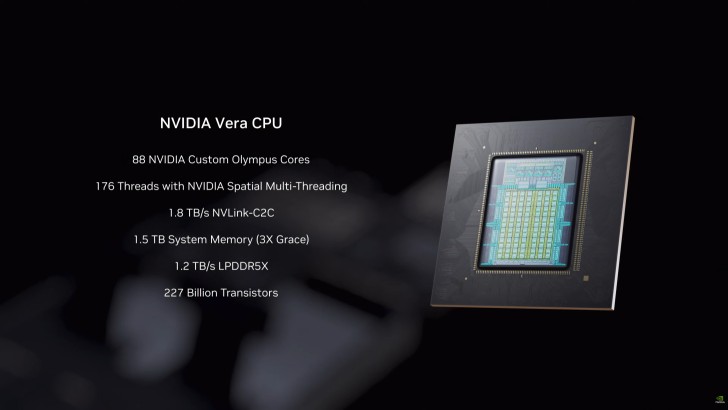
Compared to the Grace CPU, Vera has also undergone significant upgrades in cache design. Each core has 2MB of L2 cache (twice that of Grace) and 162MB of shared L3 cache (a 42% increase).
This allows Vera to share data with paired GPUs more quickly, significantly enhancing overall system efficiency. NVIDIA stated that Vera will be one of its most powerful CPU products to date and has a leading advantage in rack-level confidential computing.
It is worth noting that the Vera CPU does not exist in isolation; it is a core component of NVIDIA's next-generation Vera-Rubin platform.
Dion Harris, Senior Director of High-Performance Computing and AI Factory Solutions at NVIDIA, revealed that the core chip of the Vera-Rubin NVL72 platform has returned from TSMC and is currently being debugged and sent to key partners, with mass production expected to begin in the second half of 2026.
This platform combines the Vera CPU with the next-generation GPU codenamed "Rubin." The Rubin GPU is expected to use HBM4 memory, with a bandwidth of up to 22 TB/s, 2.75 times that of the Blackwell GPU.
Breaking Supply Chain Bottlenecks to Meet Market Demand
Reports indicate that NVIDIA's strong push for an independent CPU strategy is driven by a profound insight into AI supply chain bottlenecks. As the adoption of Agentic AI applications accelerates, server CPUs are gradually becoming a key factor limiting overall system performance.
NVIDIA realizes that relying solely on the growth of GPU computing power is insufficient to meet market demand; a performance-matched CPU platform must be provided.
Analysis indicates that by offering the independent Vera CPU, NVIDIA can not only provide customers with a "workaround" to bypass the traditional x86 architecture bottlenecks but also attract those looking for high-end CPU capabilities but with limited budgets through lower-cost options.
In addition to CoreWeave, the early customer list for NVIDIA's Vera-Rubin system also includes cloud giants such as Amazon AWS, Google Cloud, Microsoft Azure, Oracle Cloud Infrastructure, as well as emerging players like Lambda, Nebius, and Nscale Analysis indicates that although some cloud service providers are developing their own accelerators, NVIDIA is "doubling down" in the server CPU ecosystem, attempting to maintain its unshakeable core position in the next-generation AI infrastructure competition
