UBS Outlook 2026 U.S. Economy: Once the AI bubble bursts, the probability of recession will reach 50%, and the market has underestimated the possibility of interest rate cuts before June

UBS warns in its 2026 U.S. Economic Outlook that the current expansion heavily relies on AI investment and fiscal stimulus, making it structurally fragile. The report emphasizes that due to the contradiction between the actual weakening of the labor market and the stagflation pressures driven by tariffs, the Federal Reserve may cut interest rates before June 2026 to prevent an economic slowdown, and the urgency of this shift has not yet been fully priced in by the market
UBS believes that beneath the surface of the "resilience" of the U.S. economy lies a fragile balance that is actually supported by a single driving force—artificial intelligence.
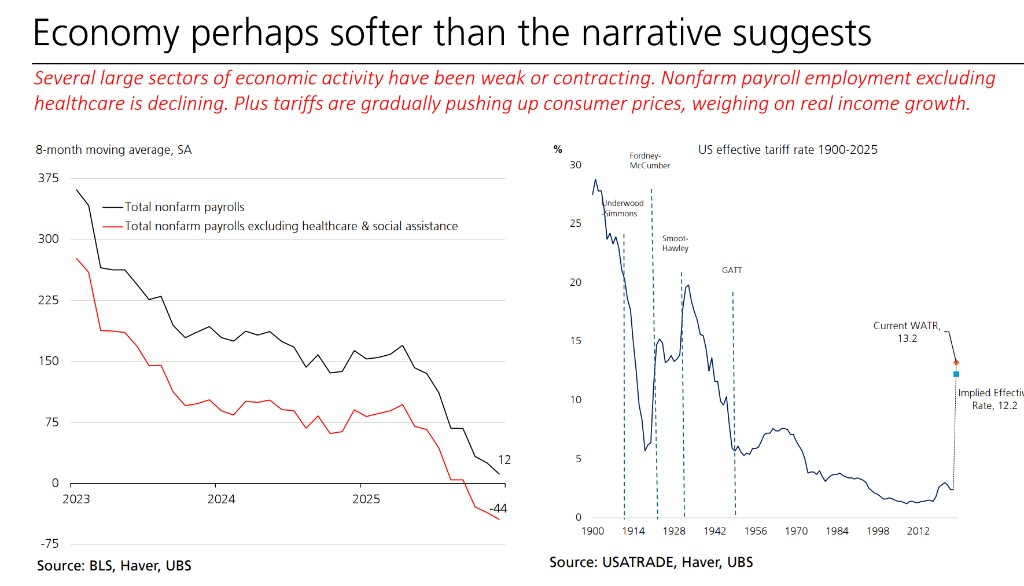
According to the Wind Trading Desk, UBS pointed out in a report on January 23 that although overall economic data appears strong, the sources of growth are extremely narrow. Aside from AI and the technology sector, most of the real economy is in a state of weakness or even contraction. The expansion of the labor market has significantly slowed, and excluding the "prosperity" of the healthcare sector, employment is actually shrinking.
For investors, this means that there is a distortion in the market's pricing logic. The Federal Reserve (FOMC) is in a dilemma: on one hand, there is a weak labor market, and on the other hand, there is cost-push inflation due to tariffs. Current asset prices are built on the "dual pillars" of sustained AI investment prosperity and strong consumption from the wealthy class. UBS warns that the main risk is that any shake in the AI investment boom could trigger a recession (with a probability of 50%). UBS believes the market underestimates the urgency for the Federal Reserve to cut interest rates before June in response to worsening employment.
Federal Reserve Dilemma: Political Pressure and Interest Rate Path
The Federal Reserve is caught between "maintaining independence" and "saving the labor market."
Interest Rate Path Forecast: UBS expects the Federal Reserve to cut rates twice by 25 basis points in 2026, with the federal funds rate target range dropping to 3.00% to 3.25% by the end of the year.
Underestimated March Rate Cut: The market is currently pricing in only about a 16% probability of a March rate cut (i.e., 4 basis points out of 25). UBS believes that given the February labor report may show weakness and inflation rebound may be less than expected, the likelihood of an early rate cut is higher than what the market is pricing.
Political Interference Risk: The Federal Reserve is facing immense pressure from the White House and the Department of Justice (including grand jury investigations). UBS warns that Chairman Powell may counterintuitively delay necessary rate cuts to demonstrate the Fed's political independence, to avoid being seen as yielding to political pressure. Additionally, the Supreme Court hearing regarding Lisa Cook's board position has also increased institutional uncertainty.
Single Growth Driver: Other Sectors Shrinking Besides AI and Wealthy Consumption
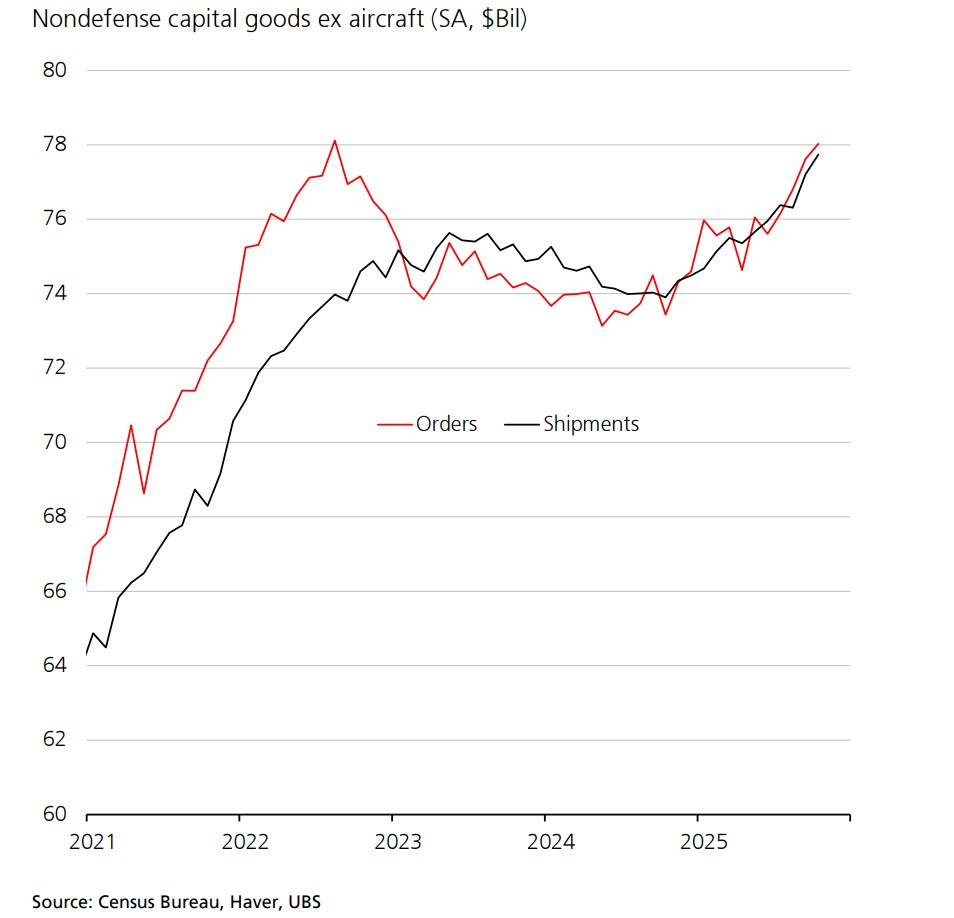
The sources of growth in the U.S. economy are extremely narrow. UBS's data shows that although GDP data is acceptable, it is propped up by investments in AI-related equipment and software. Over the past four quarters, investment in AI-related equipment has grown by 17%, while other equipment investments have declined by 1%. Non-residential structural investment has contracted for six consecutive quarters, and residential investment has declined in four out of the past five quarters.
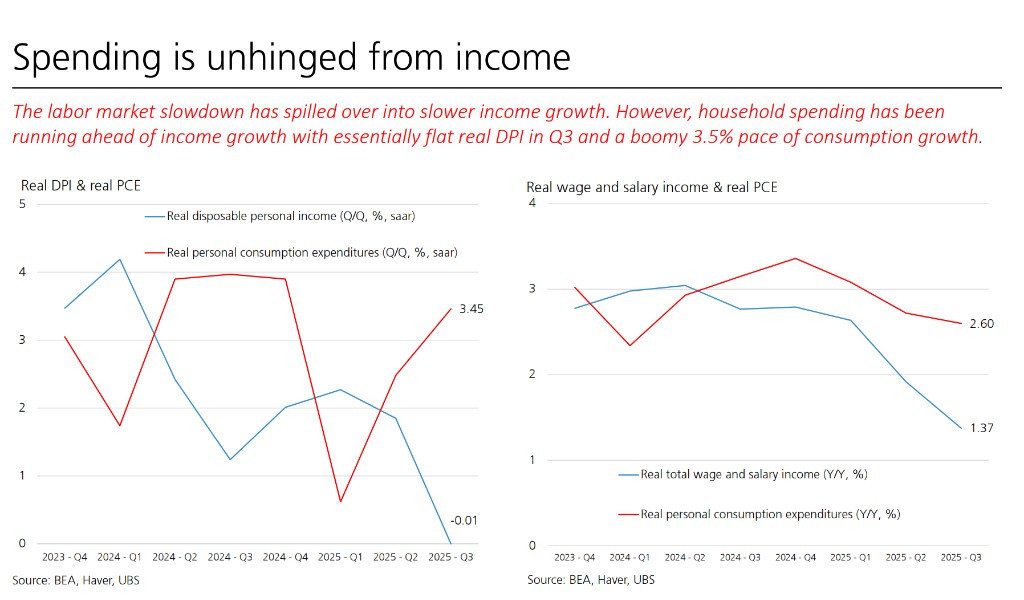
On the consumption side, there is also a sharp K-shaped divergence. In the second quarter, the proportion of stock market wealth in total household wealth reached a record 37%, and nearly all wealth growth in recent years has come from the stock market. This has led to consumption by high-income groups being supported by the tech stock bull market, while the consumption capacity of other groups is being eroded by inflation and stagnation in real income In short, this is a "rich man's carnival" driven by AI and technology themes, while the broader real economy is on the brink of recession.
The job market has long deteriorated: the private sector is laying off workers excluding healthcare
Although unemployment rate data appears mild, UBS points out that the expansion of the labor market has significantly slowed down, and not just slowed down, but has begun to contract. The most astonishing data is: excluding healthcare and social assistance sectors, non-farm employment has decreased by an average of 41,000 per month in the last four months of 2025.
The broader underutilization of labor indicator (U-6) is not only on the rise but is also more than 2 percentage points higher than the levels in 2019. Additionally, Federal Reserve Chairman Powell has hinted that employment data may be overestimated by about 60,000 per month. Current job growth is even below the breakeven point needed to maintain a stable unemployment rate. These details indicate that the weakness of the labor market far exceeds the superficial headline data.
Tariff headwinds: Inflation resurfaces, essentially a tax on growth
Tariff policies are becoming a major macro headwind. UBS estimates that the current tariff policy means that the weighted average tariff rate (WATR) has soared to 13.2% (based on 2024 import shares), which amounts to a tax of 1.1% on GDP. This has directly pushed up core commodity prices, causing inflation to rebound from 2.61% in April 2025 to 2.91% in August.
UBS expects inflation to peak in the summer of 2026 and then gradually decline in 2027. The cost-push inflation brought about by tariffs not only erodes real income but also limits the Federal Reserve's policy space, making the economic adjustment process more painful. Tariffs are expected to significantly drag down real GDP growth in 2025 and 2026.
Fiscal lifeline: The tax refund wave brought by "One Big Beautiful Bill"
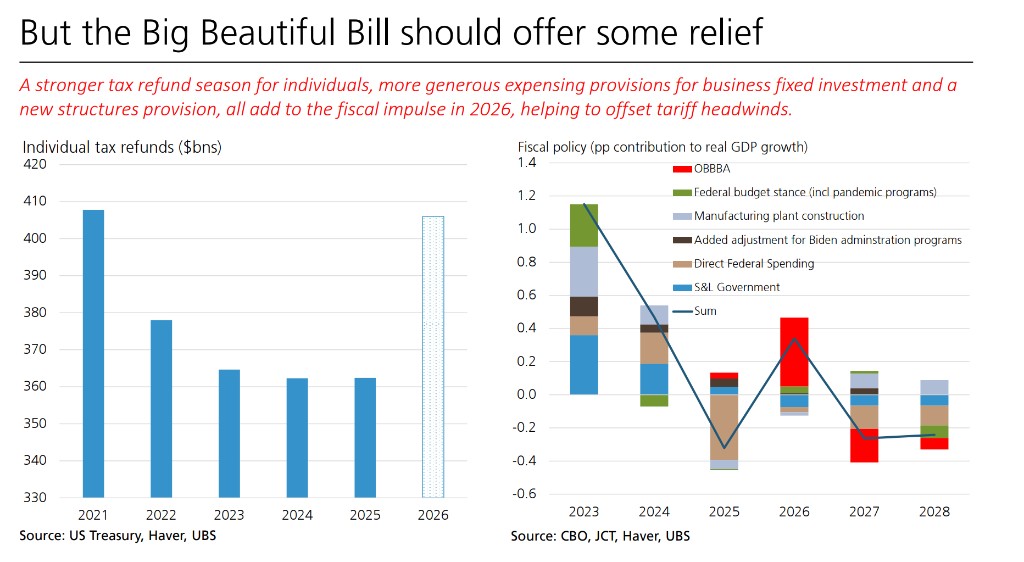
Against the backdrop of weak private sector demand, fiscal policy has once again become a short-term lifeline. UBS expects that with the implementation of the "One Big Beautiful Bill Act" (OBBBA), a massive wave of individual tax refunds will arrive in the second quarter of 2026, with refunds expected to increase by about $50 billion to $60 billion.
Combined with more generous expensing provisions for corporate fixed investments, the fiscal impulse will turn from negative to positive in 2026, providing bottom support for economic expansion. This explains why, despite weak fundamentals, UBS still believes the economy will not collapse immediately—as long as the fiscal blood transfusion continues.
Ultimate Risk: If the AI Bubble Bursts, the Probability of Recession Could Reach 50%
UBS's overall recession model indicates a 50/50 chance of a recession occurring in the future. The core risk lies in the economy's excessive reliance on the "AI narrative." UBS simulated a scenario of "AI collapse": if investments and market support related to AI fade, GDP growth is expected to be 1 percentage point lower than the baseline, the unemployment rate is projected to rise by more than 1 percentage point, and the federal funds rate may be forced back to the zero lower bound.
In this highly uncertain period, the U.S. economy is walking a tightrope: on the left is the abyss of the AI bubble bursting, on the right is the cliff of tariffs and inflation, barely maintained by fiscal stimulus and the Federal Reserve's careful balancing act.