JPMorgan temporarily shelves bullish copper price outlook: US-China inventories surge, facing correction risk before the Spring Festival

JPMorgan Chase has lowered its short-term copper price rating, as China's copper inventory is currently at its highest pre-holiday level since 2021, and the LME structure has also turned into a contango. Although the medium-term outlook is optimistic due to supply shortages caused by tariff policies, the short-term is constrained by the simultaneous increase in inventories in both China and the U.S. and the "demand vacuum period" before the holiday. The bank maintains a cautious stance until mid-February, expecting $12,000 per ton to become a key support level
In the latest issue of Metals Weekly published on January 23, the commodity research team at JPMorgan Chase, led by Gregory Shearer, provided a pessimistic assessment: Copper prices remain high, but the fundamentals supporting them are clearly weakening.
According to the news from the trading desk, the research report explicitly states that the reason copper prices have been able to maintain around USD 13,000 per ton since the beginning of the year is more due to macro funds and sentiment support rather than improvements in spot supply and demand. As inventories in both China and overseas markets rise synchronously, this state of "prices running ahead of fundamentals" is becoming increasingly difficult to sustain.
China's refined copper production hits a record high, inventory surges out of season
The report places the heaviest emphasis on China.
From the supply side, the situation is not tight. In December 2024, China's refined copper production is expected to be about 1.18 million tons, a year-on-year increase of 7.5%, with the rebound in scrap copper imports providing additional raw materials for smelters. However, the problem lies in the downstream.
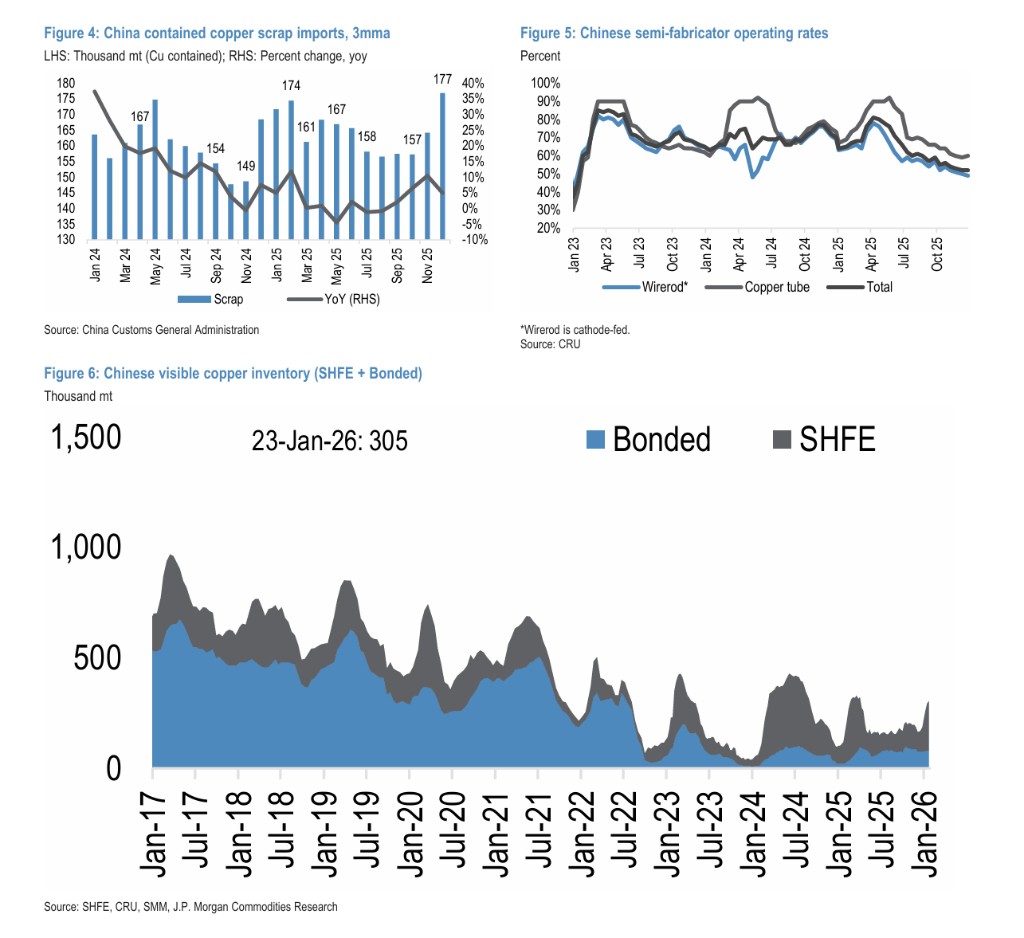
The report describes not a "cliff-like decline," but a more subtle and troublesome state:
- Weak downstream orders
- Procurement behavior clearly shifting to "demand-driven"
- Cathode copper rod operating rates falling below 50%
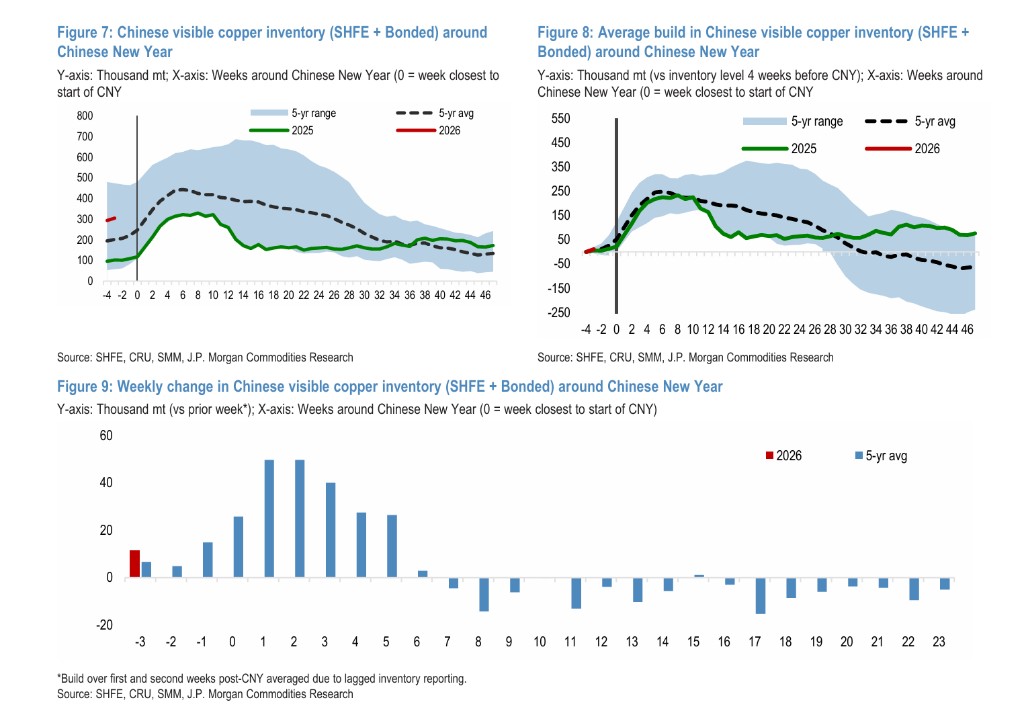
The result is an out-of-season inventory change. Since the end of November, China's copper inventory has increased by more than 118,000 tons, currently around 300,000 tons—more than 200,000 tons higher than the same period last year, and significantly above the five-year average.
It is noteworthy that this inventory accumulation has not occurred against a backdrop of surging imports. On the contrary, in December, China's refined copper net imports fell by about 50% year-on-year, while exports remained at a relatively high level. Based on this, the report concludes that the rise in inventory reflects more of a delayed domestic procurement due to high prices.
Before and after the Spring Festival: Data will be "distorted," only inventory can be monitored
The report's judgment for the next month or so is quite restrained.
The Spring Festival falls on February 17, which means that China's macro and industrial data will enter a "semi-blind" state. JPMorgan Chase clearly warns that it will be difficult to obtain a "clean" demand reading before and after the Spring Festival, and the market can only indirectly assess through inventory changes.
The problem is that this year, entering the Spring Festival cycle, the starting point for inventory is already relatively high. According to historical patterns, copper inventories typically peak 5-7 weeks after the festival, with an average seasonal accumulation of about 250,000 tons over the past five years. If this rhythm repeats, China's copper inventory could rise to over 500,000 tons by mid to late March.
This also means that China may enter the traditional peak season in the second quarter with a considerable "buffer."
According to a previous article from Wall Street News, Morgan Stanley also stated in a research report on the 22nd that in December last year, China's refined copper exports remained strong, with inventory accumulating out of season The data vacuum period before the Spring Festival has increased market uncertainty. With the Lunar New Year approaching in mid-February, the market will not receive limited data on China's demand situation until mid-March.
Overseas: The LME curve has already "voted against"
Outside of China, the signals are also weak.
The research report mentions that the COMEX/LME arbitrage structure has reversed at the front end, leading to copper flowing back into U.S. LME warehouses. In just one week, U.S. LME inventories increased by over 10,000 tons; at the same time, nearly 20,000 tons were delivered in Asian warehouses.
Driven by the inventory rebound, the LME copper price curve quickly shifted from deep spot premiums back to discounts:
- Cash-three month spread
- From a backward market close to $100/ton
- Reversed to a forward structure of about $75/ton
This is a typical signal of "the fundamentals are speaking."
That more aggressive bullish story has been temporarily put on hold
JP Morgan has not completely denied the longer-term bullish logic.
The research report still believes that if the U.S. ultimately pushes for phased copper import tariffs, there may be a severe misalignment between COMEX and LME again, potentially triggering a new round of inventory depletion and price surges. However, they also emphasize that this story cannot be told at least around the Spring Festival—because it ultimately still requires China to become the "pulling end."
Before that, the team's judgment is:
- Copper prices face short-term correction risks driven by fundamentals
- But around $12,000/ton, there may still be phase support
Not just copper: Aluminum and zinc are also celebrating the New Year in a "high inventory" state
The research report finally expands its perspective to aluminum and zinc, and the conclusions are not surprising.
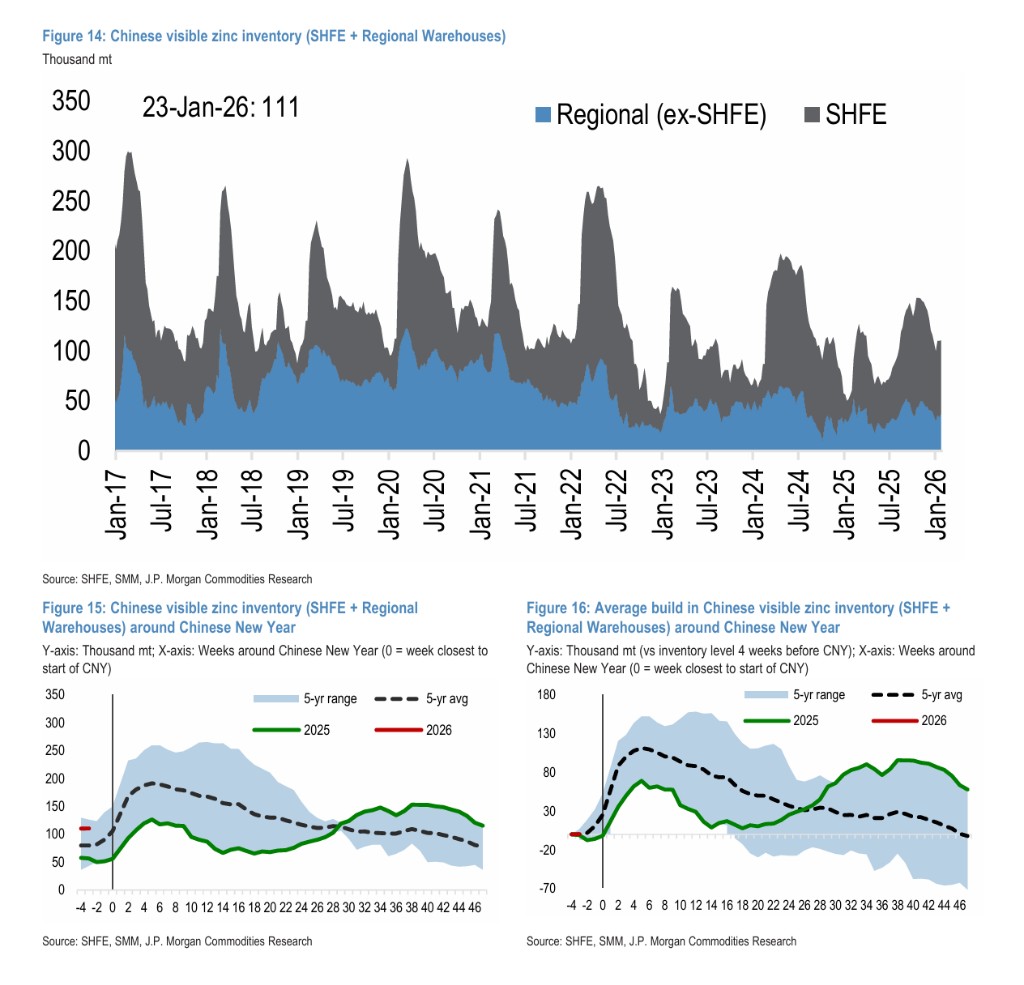
In terms of aluminum, China's inventory increased by about 165,000 tons within a month, currently around 740,000 tons, which is 250,000 tons higher than the same period last year; zinc inventory is about 110,000 tons, roughly double that of the same period last year. Both exhibit characteristics of price sensitivity, weak demand, and early inventory buildup.
JP Morgan's implicit judgment is that if these metals experience a slower inventory reduction than historical averages after the Spring Festival, the market's assumption that "demand is just delayed" may need to be reassessed.