


The yen continues to rise! Kōshi Sōmai strengthens signals for foreign exchange market intervention, and the ruling coalition will resign if it loses the majority in the Diet

Japanese Prime Minister Sanae Takaichi warned against market speculation, promising to take action if necessary, and hinted that she would resign if the ruling coalition loses. As a result, the yen continued its upward trend to the 154 level, putting pressure on short positions. The market speculates that "Plaza Accord 2.0" may become a possibility, alleviating the previously collapsing pressure on ultra-long-term U.S. and Japanese bonds. The Japanese market is currently undergoing a policy-driven dramatic reset ahead of the election
Japanese Prime Minister Sanae Takaichi warned on Monday about the recent severe market fluctuations, promising to monitor speculative trends and take action when necessary. This is a clear signal regarding market speculation, following her statement last weekend that she would take "all necessary measures" to address abnormal volatility.
On the 26th, Takaichi stated regarding market trends, "There are various factors behind market fluctuations, but I emphasize that we will monitor speculative trends and take action when necessary." She revealed that Japan's basic budget balance has reached a surplus for the first time in 28 years. She stated that she would pay attention to fiscal sustainability.
Takaichi also stated:
"If the ruling coalition cannot win a majority of seats, I will not serve as Prime Minister."
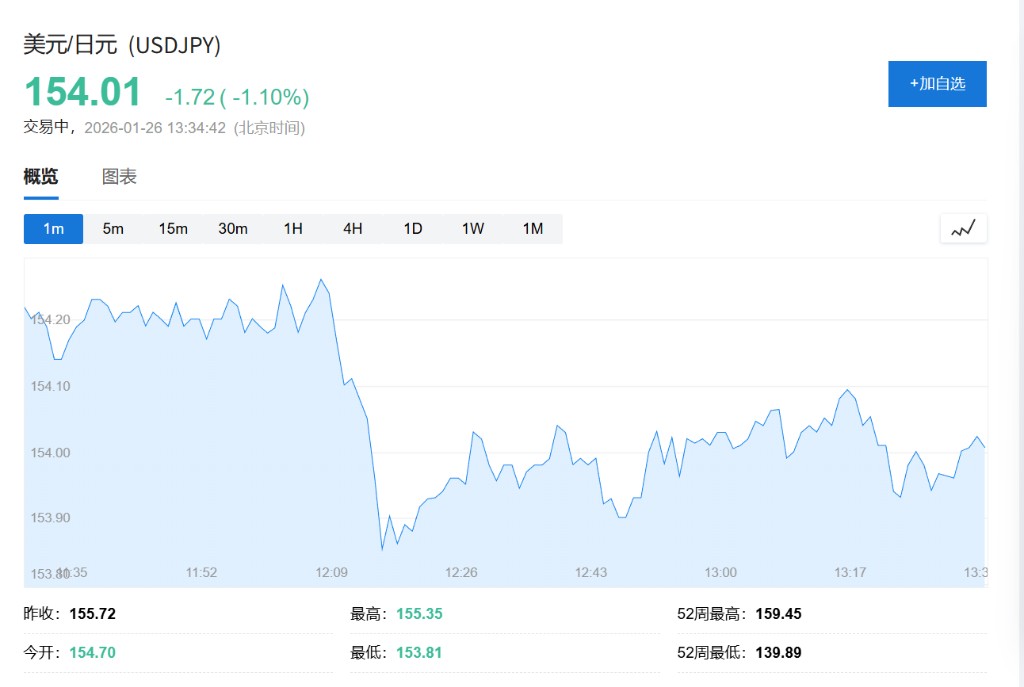
As a result of this news, the yen continued to rise, with the dollar falling more than 1% against the yen, currently reported at 154.01. Wall Street Journal previously mentioned that there was severe market turbulence last Friday, with the dollar-yen exchange rate plunging about 1.75% at one point, marking the largest single-day gain for the yen in five months. The market generally speculates that the catalyst for this reversal came from the New York Fed's extremely rare "rate check" action.
Takaichi Warns Against Market Speculation
Although Takaichi stated during her comments that, as Prime Minister, she cannot comment on "matters that should be decided by the market," Finance Minister Shunichi Suzuki has already made it clear that Japan has the "discretionary power" to take action when necessary, including intervening in the market. Reports citing trader accounts indicate that the New York Fed has contacted financial institutions to inquire about the yen's exchange rate, coupled with Finance Minister Suzuki's close communication with U.S. Treasury Secretary Janet Yellen recently, suggesting that the possibility of joint intervention is rising. State Street Global Advisors' senior fixed income strategist Masahiko Loo stated:
"Historically, inquiries from the Finance Ministry are a precursor to action. If no follow-up action is taken, it will fuel speculative pressure."
Mizuho Securities' chief strategist Shoki Omori pointed out that the coordinated policy warning for the foreign exchange and bond markets indicates that "the authorities are not defending specific levels but are sending a signal: disorderly, speculative, or excessively rapid fluctuations may trigger non-linear responses," which significantly reduces the attractiveness of one-sided bets.
State Street's Loo stated, "This is forming a controlled, policy-driven reset." He added that if no follow-up action is taken, the market will actively test the official resolve, further suppressing the yen and fueling speculative pressure.
Joint Intervention Evokes Memories of the Plaza Accord
For some traders, the actions of Japan and the U.S. evoke memories of the Plaza Accord of 1985—when several major economies reached an agreement that effectively devalued the dollar. Discussions about policy responses to address the economic imbalances caused by the "persistent overvaluation of the dollar" had been ongoing for more than a year Anthony Doyle, Chief Investment Strategist at Pinnacle Investment Management, stated:
"Japan cannot fix the yen issue without taking on domestic pressures or global spillover risks, so the idea of coordinated action, a version 2.0 of the Plaza Accord, suddenly doesn't seem so crazy to some. When the U.S. Treasury starts making calls, it usually means this has gone beyond the normal forex story."
According to the New York Federal Reserve website, the U.S. has only intervened in the foreign exchange market on three different occasions since 1996, with the most recent being after the 2011 Japanese earthquake when it sold yen alongside other G7 members to stabilize trading.
Homin Lee, Senior Macro Strategist at Lombard Odier, stated, "Ultimately, if this is a real attempt to stabilize the dollar-yen exchange rate, Tokyo must take actual intervention actions." He added that joint market intervention by both Japan and the U.S. would be "an unusually public display of bilateral coordination."
Short Positions Face Squeeze
Short positions in the yen have risen to their highest level in over a decade, and the current rebound could lead to massive short covering. The volatility in the forex market is accompanied by severe fluctuations in the Japanese government bond market, where long-term bond yields surged to a historic high before retreating earlier last week.
Japan's benchmark 10-year government bond further rebounded on Monday, with yields falling 3 basis points to 2.225%. The government will auction 40-year bonds on Wednesday, which is expected to be closely watched, as yields for that maturity broke the critical 4% level last week.
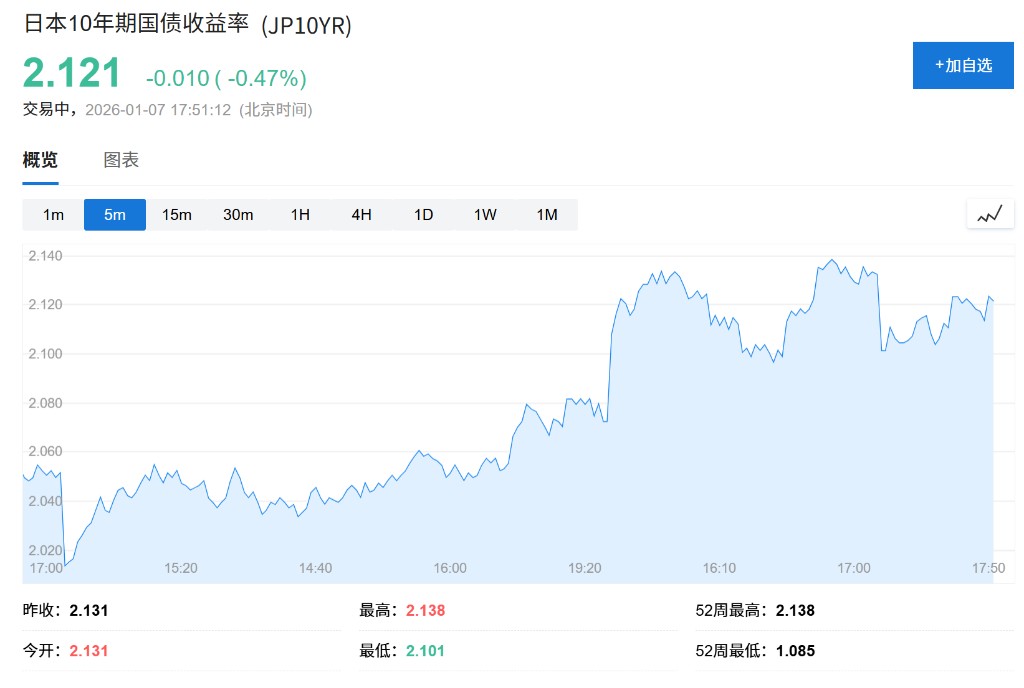
According to Bloomberg strategists, with the help of a stronger yen, this week's 40-year bond auction looks set to go smoothly, which would be a huge relief for the global G10 fixed income market. Less than a week ago, Japan's ultra-long bond issuance seemed like an unbearable burden for the global bond market.
Market Turbulence Ahead of Elections
These latest developments come as Japan prepares for a surprise election on February 8. Regarding tax policy, Sato Masami expressed hopes to submit a bill to postpone the collection of food taxes in the fiscal year 2026, aiming to implement a reduction in the food consumption tax in that fiscal year. She personally hopes to see a reduction in the food consumption tax as soon as possible and stated that she will continue to support businesses in achieving wage growth.
The Japanese government is spending nearly $100 billion in 2024 to buy yen to support the currency. In four interventions, the yen exchange rate has hovered around 160 to the dollar, setting a rough marker for possible future actions.
The yield on 40-year government bonds surged to a new high since its introduction, marking the highest level for the country's sovereign bonds across all maturities in over thirty years. The significant rise in the yen has also put pressure on the dollar, thereby helping to boost some emerging market currencies like the Korean won and Singapore dollar
