


5 months 10 times! Sandisk transformed from "USB Lady" to "AI Sweetheart"

SanDisk's stock price surged nearly 1000% due to the shift of AI bottlenecks to storage. The core logic is that the surge in AI interactions has made storage the new bottleneck, leading to NAND prices skyrocketing over 300%, which brings significant "operating leverage" to SanDisk—price increases directly translate into profits. The market expects that the storage demand driven by AI will be sustainable, and the supply-demand imbalance will continue until 2026, with its scarcity value being systematically reassessed
Just five months ago, SanDisk was seen as a traditional storage card company struggling due to outdated technology, with its main products, USB flash drives and digital camera memory cards, considered "antiques" in the tech industry. However, an unexpected market storm has allowed the company to achieve an astonishing return of nearly 1000% in a short period, making it the best-performing stock in the S&P 500 index and firmly establishing itself at the core of AI trading.
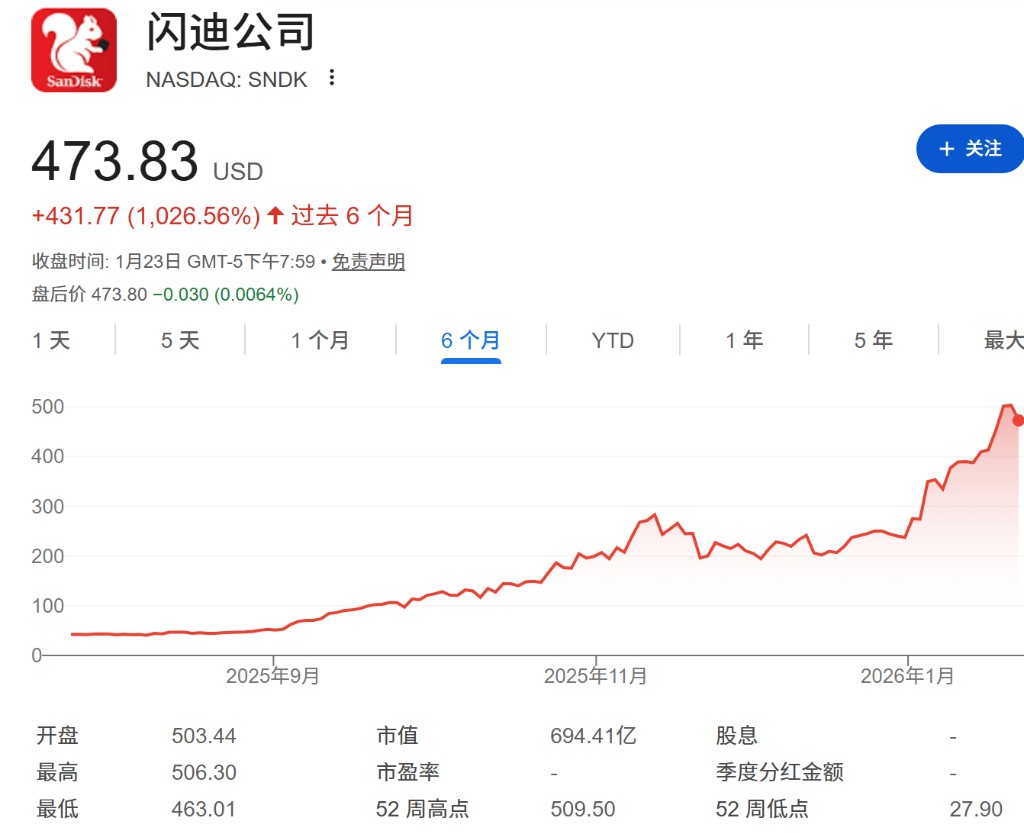
This dramatic shift stems from a transfer of the computing power bottleneck brought about by the surge in AI applications. As enterprises and consumers delve deeper into AI usage, the massive data generation has forced the market to reassess the demand for storage chips. Since September of last year, the urgent need for "contextual" storage has caused memory chip prices to soar across the board. SanDisk's stock price skyrocketed accordingly, reaching an all-time high by the close of trading this Tuesday, with an increase of up to 976% since August of last year, adding over $50 billion to its market capitalization.
The outbreak of this market trend caught Wall Street off guard. At an industry conference last August, analysts and suppliers generally believed that the market would slow down in winter and not recover until 2026. However, just a month later, a chip buying frenzy erupted, and prices surged. NVIDIA CEO Jensen Huang pointed out, "As the length of AI interactions increases, systems must store and continuously reference data to respond correctly, making storage the new technological bottleneck."
This supply-demand imbalance has granted storage manufacturers like SanDisk significant pricing power, allowing them not only to escape past sluggishness but also to surprise industry insiders, including the company's own management and seasoned hedge fund managers. Currently, market momentum is concentrated on memory chip manufacturers like Micron and data storage product manufacturers like SanDisk that utilize these chips, with the previously quiet storage sector becoming an indispensable key to addressing AI technology challenges.
AI Bottleneck Triggers Chip "Super Cycle"
The catalyst for this round of market activity lies in the changing underlying logic of hardware demand driven by AI technology. Jeongdong Choe, a storage chip expert at TechInsights and former Samsung engineer, bluntly stated, "Without storage, there is no AI." This view was echoed by Jensen Huang, who emphasized at the Consumer Electronics Show in Las Vegas that "context is the new bottleneck," and that existing high-bandwidth memory (HBM) products are insufficient to meet this challenge.
This bottleneck demand has directly led to significant price increases for key chip types—DRAM and NAND—since September. Initially, TSMC reported about a 10% price increase, which SanDisk quickly followed. Subsequently, Micron took more aggressive measures, retracting previous quotes and notifying customers of price increases of up to 30%.
A report by Bernstein Research based on TrendForce data shows that as of now, the spot price of NAND flash has risen over 300% since the end of September, while the cost of DRAM used for AI HBM has increased by about 280% compared to the third quarter This price surge has created what Jeongdong Choe refers to as a "super cycle."
The "Free Lunch" Brought by Operating Leverage
For commodity producers like SanDisk, the price surge means huge profit margins, thanks to "operating leverage." Intel veteran and consultant Mark Webb points out that companies do not need to incur additional costs for hiring or equipment investment to meet demand; the extra sales generated by price increases are almost entirely converted into profits.
"This is basically free money," Webb states, "They haven't done anything different. No new factories, no new transportation, nothing. All they've done is take in twice the money compared to a year ago."
This "free capital" effect has triggered a collective rise in global storage stocks, with Micron rising 40% in September, South Korea's SK Hynix up 56%, and Japan's Kioxia soaring over 85%. However, SanDisk's performance has even overshadowed these competitors. Analysts believe SanDisk's outstanding performance can be attributed to two factors: first, its enterprise-grade solid-state drive (SSD) business perfectly aligns with the demands of AI hyperscale cloud computing firms; second, its 20-year joint venture with Kioxia provides it with a lasting cost advantage, allowing it to acquire core NAND chips at lower costs than its competitors.
"Smart Money" Exits Early
Ironically, the driving force behind SanDisk's independent listing—the renowned activist hedge fund Elliott Management—missed out on most of this feast. SanDisk spun off from Western Digital and went public last February, primarily as a result of Elliott's long-term pressure. Elliott believed that the merger of Western Digital and SanDisk led to undervaluation and argued that a spin-off could unlock value.
At that time, Elliott's highest valuation expectation for SanDisk was $20 billion, while SanDisk's market capitalization is now approximately $65 billion. Regulatory filings show that Elliott held 750,000 shares of SanDisk after the spin-off, with a cost basis of $49.71. However, the fund had completely exited its position by the end of September. While Elliott may have captured a rebound in September, had it held on to the shares until now, their value would have soared from around $84 million at that time to approximately $340 million. This indicates that even the smartest money on Wall Street failed to foresee this AI-driven surge in storage chip prices.
Supply-Demand Gap Remains in 2026
Looking ahead, SanDisk's earnings report to be released on January 29 will be the focus of market attention. Analysts expect its adjusted earnings per share to grow over 170% year-on-year, with sales expected to surge by about 40%. Given the frenzied state of the storage market, some observers believe SanDisk's performance may surprise the market once again.
Bernstein Research's technology hardware analysts recently listed SanDisk as a "top pick" for 2026, citing "unprecedented NAND shortages and price increases." They anticipate strong demand will last for at least six quarters and predict its earnings per share for fiscal year 2026 will exceed Wall Street consensus by more than 40%. **
At the same time, Goldman Sachs analysts raised the target price for Sandisk on January 9, noting that "the industry will be in a significant supply-demand imbalance by 2026, and investors expect substantial price increases throughout the year." As the AI boom enters its fourth year, market focus has shifted from the initial Nvidia to more segmented areas, with Sandisk at the center of this new trend.
