The largest increase since last August! The yen surged twice in one day, is a joint intervention in the foreign exchange market by Japan and the U.S. coming?

During the European stock market session on Friday, after the Japanese yen fell below 159 against the US dollar and approached the 160 "red line" for government intervention in 2024, it suddenly rebounded and rose, with the increase at one point expanding to 1.75%, erasing the decline since Christmas. The market suspects that the Japanese Ministry of Finance conducted a currency check, which is typically seen as a warning signal from the government to traders. Subsequently, media reports cited some traders saying that the yen's surge coincided with the New York Federal Reserve calling financial institutions to inquire about the yen exchange rate, which Wall Street interpreted as a sign that the Fed is prepared to assist Japanese officials in directly intervening in the market to support the yen
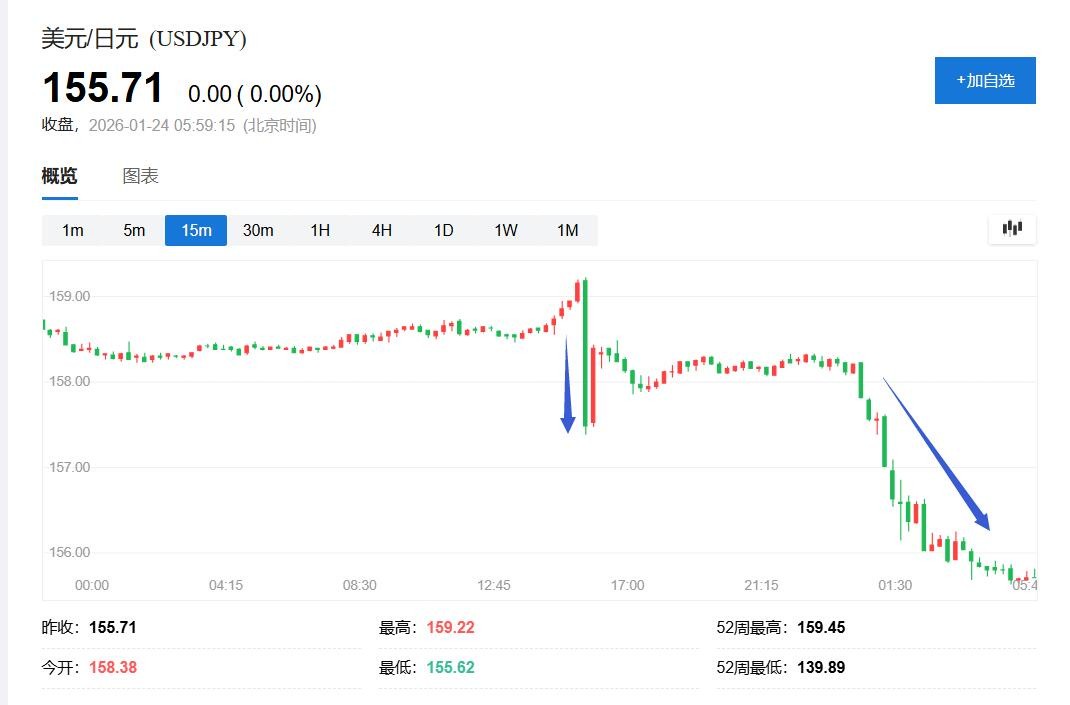
This Friday, the yen staged a sharp rebound after three consecutive declines, with two waves of upward momentum during the day. The dollar against the yen saw a maximum intraday drop of about 1.75%, indicating the yen's largest increase since August last year. This sudden movement has sparked widespread speculation in the market about the possibility of intervention by the Japanese government in the foreign exchange market, and even potential joint intervention with the U.S. government.
The first wave of the yen's rise occurred in the early European trading session, where the dollar against the yen previously rose to 159.23, breaking above 159.00 for the first time since January 14. It then plummeted, quickly dropping below 157.50 within about ten minutes, a decline of nearly 0.6% for the day, and continued to trend downward. During the U.S. stock market's midday session, the yen experienced a second, more intense surge, erasing losses since last Christmas, with the dollar against the yen accelerating its decline to 155.63, refreshing the low since December 24 of last year.
Japanese officials have not confirmed the speculation of intervention. Jun Mimura, head of foreign exchange affairs, declined to comment on whether there would be intervention in the yen, while Finance Minister Shunichi Suzuki avoided discussing intervention, only stating that they are closely monitoring the dynamics of the foreign exchange market with a sense of urgency, "always maintaining urgent attention." This ambiguous statement has left the market in a fog regarding the reasons for the volatility.
The yen's significant rise comes amid political turmoil in Japan. According to CCTV News, the cabinet of Prime Minister Sanae Takaichi passed a resolution to dissolve the House of Representatives on Friday, the 23rd. In the afternoon, the House of Representatives officially announced its dissolution, marking the first time in 60 years that the House has been dissolved on the opening day of a parliamentary session. The announcement for the House of Representatives election will be made on January 27, with voting and ballot counting taking place on February 8. The interval from official dissolution to voting and counting is 16 days, setting a post-war record for the shortest duration.
Federal Reserve Inquiry Sparks Market Discussion
Some media outlets have pointed out that the rise of the yen on Friday was due to traders betting that the Japanese government would soon directly intervene in the foreign exchange market to support the yen. Reports cited some traders saying that the yen's surge coincided with the New York Federal Reserve calling financial institutions to inquire about the yen's exchange rate, which Wall Street interpreted as a sign that the Fed was preparing to assist Japanese officials in directly intervening in the currency market to support the yen. A representative from the New York Fed declined to comment.
Jason Furman, a Harvard University economics professor who served as the chairman of the White House Council of Economic Advisers during the Obama administration, commented:
"Both the U.S. and Japanese governments seem dissatisfied with the value of the yen. Everyone is highly alert, waiting for any factors that might change the status quo."
Karl Schamotta, Chief Market Strategist at Corpay, stated:
"I haven't heard confirmation of official buying (of yen) actions, but if a duck looks like, walks like, and quacks like it's being intervened, then it probably is being intervened. The dollar (against other currencies) is broadly declining, while the yen's movement in the past few hours has been unusually rapid and significant, indicating that the Japanese government is intervening—or traders are anticipating an action in advance."
Exchange Rate Check Signals Trigger Nervousness
Reports indicate that during Friday's European stock market session, the sudden halt and rebound of the yen led traders to speculate that the Japanese Ministry of Finance may have conducted interest rate inquiries with banks. Such exchange rate checks are typically signals of preparation for intervention. This move has historically been viewed as a warning signal from the government to traders, indicating that they believe currency fluctuations are excessive and are prepared to buy and sell in the foreign exchange market to influence the yen's price. They usually occur when volatility increases and verbal interventions fail to curb the trend.
Valentin Marinov, a strategist at Crédit Agricole, stated:
"This reaction indicates that when the yen exchange rate is so close to the so-called 'red line'—the level at which interventions have previously occurred—the market behaves like a startled bird. This situation easily leads one to believe that we may currently be in the early stages of official intervention."
Marc Chandler, chief market strategist at Bannockburn Capital Markets, remarked, "Given the lack of news, the only thing I can see is this potential bearish sentiment and fear of intervention." Erik Bregar, director of foreign exchange and precious metals risk management at Silver Gold Bull, pointed out, "It's the eve of the weekend, and no one has a clear grasp of what is happening. I think that's what makes the trend more anxiety-inducing."
Bipan Rai, managing director at BMO Capital Markets, noted that speculation about the New York Fed conducting an exchange rate check has driven the yen higher. "It is also important to note that past exchange rate checks do not necessarily mean that intervention is imminent, but the fact that the New York Fed has made inquiries means that any potential intervention regarding the dollar-yen exchange rate will not be unilateral."
160 Threshold: The "Red Line" for Japanese Intervention
The yen previously approached the critical level of 160, which is roughly the level at which Japanese authorities intervened four times in 2024. The Japanese government spent nearly $100 billion buying yen to support its currency in 2024, with the exchange rate around 160 yen per dollar during each intervention, setting a rough marker for potential future actions.
Earlier this month, Japanese Finance Minister Shunichi Suzuki and the country's top currency officials issued new warnings to speculators following the yen's depreciation. The last time Japan intervened in the foreign exchange market to support its currency was in 2024 when the yen fell below the 160 threshold against the dollar. Brendan Fagan, a strategist at Bloomberg Markets Live, noted, "A psychological barrier seems to be forming again. Under pressure from fiscal uncertainty, rising yields, and ongoing capital outflows, the path for the dollar-yen to rise will become increasingly narrow."
However, Harvard University's Furman believes that exchange rate checks, and even actual interventions, "historically have not produced lasting effects," and that "real policy changes are needed to achieve that."
Since Fumio Kishida took office as Japan's Prime Minister in October last year, the yen has been under persistent pressure, falling over 4% due to fiscal concerns and hovering around levels that have triggered verbal warnings and intervention fears. The recent turmoil in the bond market earlier this week highlighted investors' anxiety over Japan's fiscal situation when Kishida announced early elections in February and promised tax cuts, leading to historic highs in Japanese government bond yields
The Federal Reserve's Actions Release Key Signals
According to the New York Fed's official website, the Federal Reserve has only intervened in the foreign exchange market on three different occasions since 1996, with the most recent instance occurring after the 2011 earthquake in Japan, when the U.S. sold yen alongside other G7 countries to help stabilize market trading in Japan post-quake.
Economists at Evercore ISI, including Krishna Guha, stated:
"In the current situation, U.S. intervention is reasonable, with the common goal of preventing excessive weakness of the yen while also hoping to indirectly help stabilize the Japanese bond market. Regardless, U.S. participation in foreign exchange intervention is justified, and even if no actual intervention occurs, it could accelerate the unwinding of yen short positions."
Ed Al-Hussainy, a global interest rate strategist at Columbia Threadneedle Investment, noted: "The market's focus on the yen stems from volatility in the Japanese bond market earlier this week. The U.S. Treasury may be concerned about the spillover effects of Japanese government bonds into the U.S. Treasury market and is exploring currency intervention as a stabilizing tool. Whether this risk is substantive remains an open question."
Leah Traub, a portfolio manager at Lord Abbett & Co., pointed out: "Given the government's past concerns about currency intervention, if Japan indeed needs to intervene more forcefully, the U.S. seems to be giving the green light."
The Return of the Bank of Japan's YCC Will Weaken the Local Currency; A Strong Yen May Trigger U.S. Stock Sell-off
Earlier on Friday, the Bank of Japan signaled its readiness to continue raising currently low borrowing costs amid a tense political atmosphere. The Bank of Japan raised its growth forecast on Friday and maintained a hawkish inflation outlook while keeping interest rates unchanged, demonstrating confidence that a moderate recovery would justify further increases in still-low borrowing costs.
Bank of Japan Governor Kazuo Ueda hinted that overall inflation would soon weaken to below 2%, but he also left the possibility of an early rate hike open. He stated:
"April is a month with relatively many price revisions. We have some interest in this, although it is not the most important factor in deciding the next rate hike, it is one of the factors."
However, Ueda expressed caution regarding market functionality at a press conference, indicating discomfort with the speed of long-term trends and a willingness to act if volatility becomes disorderly. Ueda stated that if necessary, the central bank might operate flexibly to smooth out fluctuations in the bond market.
Rich Privorotsky, head of Goldman Sachs' Delta-One trading department, remarked that from a technical standpoint, the Bank of Japan's actions on Friday should be viewed as "status quo under a hawkish stance." Financial blog Zerohedge noted that Ueda has not formally restored Yield Curve Control (YCC), but it does retain a soft backstop, which led to the yen being sold off before rebounding on Friday, as if people believe YCC is about to return, the yen could weaken significantly.
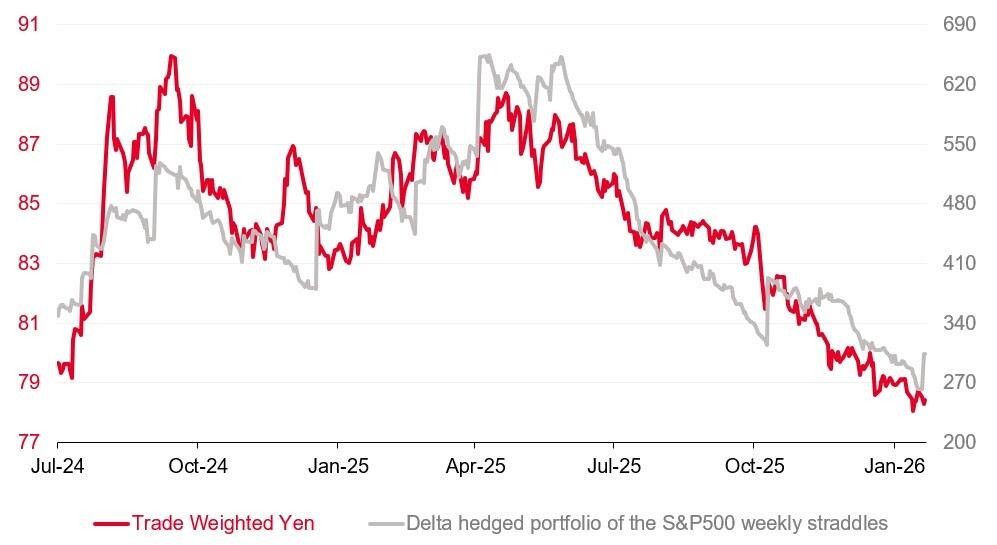
If the yen strengthens, it may trigger a sell-off in U.S. stocks. Société Générale pointed out that since the summer 2024 stock market sell-off (unwinding of yen carry trades), a peculiar correlation has emerged between the yen exchange rate and short-term volatility in the U.S. stock market The gray line in the chart below represents the returns from buying the S&P 500 Index ultra-short-term volatility, which has significantly underperformed since June 2025. From this perspective, if this correlation continues, a strengthening of the yen trade-weighted exchange rate may become an important catalyst for triggering broader market risk aversion.