


Wall Street comments on Intel's earnings report: Supply constraints suppress short-term performance, with a turning point possibly not arriving until the second half of the year

Citigroup pointed out that if supply is sufficient, sales in the fourth quarter should have been higher. The core contradiction lies in the insufficient supply masking the real demand, with a key turning point expected in the second half of 2026: by then, the yield of the 18A process is expected to reach industry standards, and customers may make firm supplier decisions
Intel's latest financial report presents a clear divide: despite exceeding expectations in the fourth quarter, a weak guidance for the current quarter has triggered a market sell-off. Wall Street analysts generally believe that supply constraints are the core reason for the guidance falling short of expectations, a factor that temporarily overshadows the strong market demand driven by artificial intelligence.
The chip giant reported an adjusted earnings per share of 15 cents for the fourth quarter, with revenue reaching $13.7 billion, both exceeding the LSEG (London Stock Exchange Group) consensus expectations of 8 cents and $13.4 billion. However, its outlook for the first quarter disappointed Wall Street. Intel expects revenue for the current quarter to be between $11.7 billion and $12.7 billion, with adjusted earnings per share only at breakeven. Both figures are significantly below analysts' expectations of $12.51 billion in revenue and 5 cents per share earnings.
As a result of the disappointing guidance, Intel's stock price plummeted 13% in pre-market trading on Friday. Although Intel's data center and artificial intelligence business shows signs of accelerated growth, the company's inability to meet this demand due to manufacturing capacity constraints has become a focal point for investors.
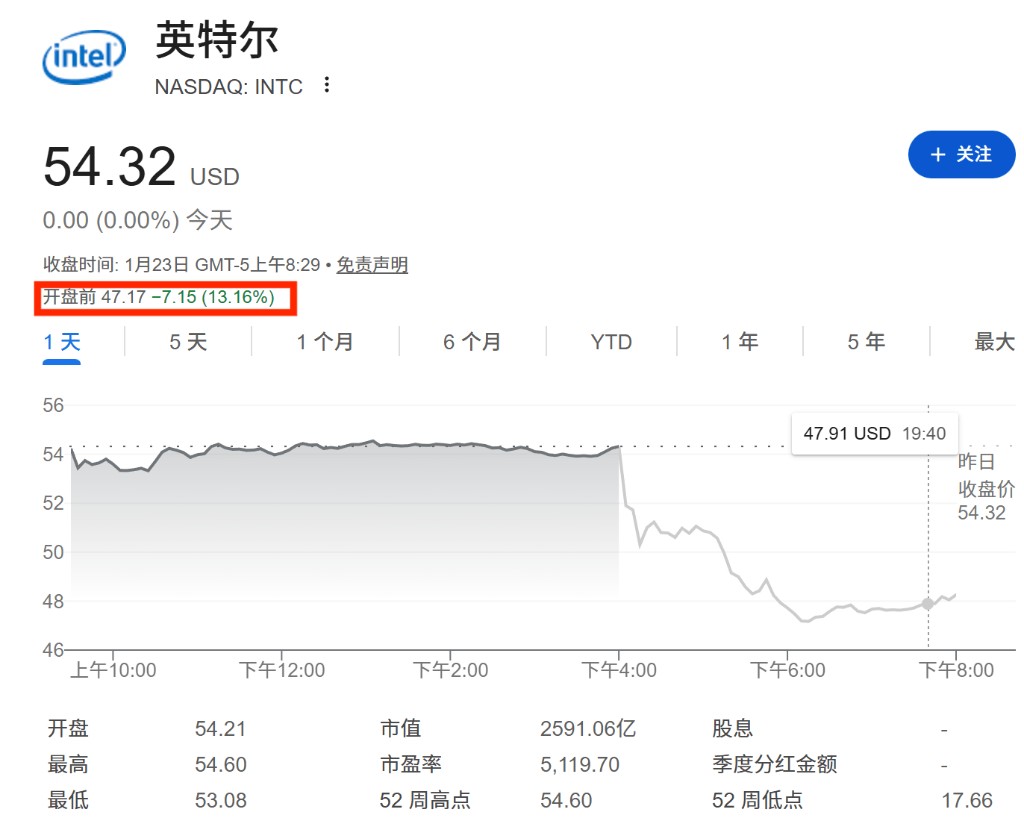
Currently, Wall Street's sentiment towards Intel remains cautious. LSEG data shows that among the 47 analysts covering the stock, 33 have given a "hold" rating, while only 8 have rated it as "buy" or "strong buy." The general market view is that while the first quarter may mark an annual low, key turning points, including commitments from foundry business customers and improvements in product availability, may not materialize until the second half of 2026.
Supply Bottlenecks Mask Strong AI Demand
Analysts generally point out that Intel's current revenue pressure primarily stems from supply-side constraints rather than insufficient demand. Citigroup analyst Atif Malik noted that if supply were unconstrained, sales should be above seasonal levels, as the demand for general server CPUs driven by artificial intelligence upgrades appears very strong.
Despite facing short-term challenges, Intel's performance in key growth areas has still received some recognition. Roth analyst Suji Desilva pointed out that Intel's data center and artificial intelligence (DCAI) segment revenue grew significantly by 16% quarter-over-quarter, reflecting demand from AI data center customers that exceeded expectations.
Desilva stated that if capacity were sufficient, the performance of data center revenue would have significantly outperformed seasonal levels. The company is currently taking necessary measures to address this bottleneck, with expectations for improved manufacturing yields at key points in the next quarter, thereby enhancing product availability.
Catalysts May Arrive in the Second Half of 2026
Regarding when supply constraints might ease, the market is generally looking towards later this year. Jefferies analyst Blayne Curtis believes that March will mark the bottom of supply constraints. Cantor Fitzgerald shares a similar view, believing that the first quarter of 2026 should mark the low point for that year, although Intel may still face constraints for one or two quarters. And may lead to a portion of market share flowing to competitors.**
Stifel views the second half of 2026 to the first half of 2027 as a potential "catalyst window." The firm's analysts noted that Intel will hold its first Investor Day during this period, which could become a turning point for long-term commitments to 14A process yield and advanced packaging capacity ramp-up. Citigroup analysts also expect that customers will make firm vendor decisions in the second half of 2026 or the first half of 2027.
Progress in Foundry Business and 14A Timeline
Intel's progress in its foundry business remains a core logic for its long-term valuation. Citigroup pointed out that the yield of the 18A process is improving, with the company's goal to reach industry-standard yield by the second half of 2026. Meanwhile, Intel is actively engaging with customers regarding the 14A process, with customers currently testing chips. However, it will still take time to generate substantial revenue, as Citigroup expects that risk trial production for 14A will begin by the end of 2028, with mass production waiting until the end of 2028 to 2029.
RBC Capital Markets commented that management sounds optimistic about the progress of the foundry business and hinted at the possibility of announcing 14A customers in the second half of 2026. KeyBanc Capital Markets analyst John Vinh is even more optimistic; although Intel has not confirmed Apple (AAPL) as a customer for its foundry business, he raised his price target to $65 based on expectations that Apple could become an 18A customer and potential wins for 14A, maintaining an "overweight" rating.
Wall Street Discrepancies Remain Obvious
Despite the potential for long-term turnaround, there are significant discrepancies among institutions regarding Intel's short-term outlook. Jefferies maintains a "hold" rating, noting that despite strong server business, guidance remains bleak, and the recovery of margins has been delayed again. The firm believes that given further market share loss, a lack of a clear AI strategy, and uncertainties in foundry opportunities, Intel currently lacks a clear path forward.
In contrast, Evercore ISI believes the risk-reward ratio is relatively balanced. Analyst Mark Lipacis pointed out that Intel's multi-year transformation still has a lot of work to do, and improvements in execution and favorable geopolitical factors are offset by high valuations and the years of effort required to win foundry customers. The firm set a price target of $45, believing that after-hours trading levels are slightly above its valuation in an optimistic scenario
