


Commercial rockets welcome a critical validation window: engines determine the depth of space exploration, while 3D printing is the core of cost reduction!

Guojin Securities believes that the key to industry competition lies in whether it can overcome the profit hard threshold of "800 kilometers track load of 2.8 tons." This is essentially a decisive factor in upstream hard technology: the engine (full-flow reheat cycle) determines the capacity limit and is the cornerstone of performance; 3D printing (reducing production cycles by 80% and weight by over 50%) is the core of cost reduction. Together with material innovation, these two factors form the most certain investment mainline
With the global commercial space industry resonating, China's commercial space sector is entering a critical development phase. Market analysis indicates that 2026 to 2027 will be the most crucial verification window for Chinese commercial rocket companies. This period not only marks the maiden flights of several medium to large liquid rockets but also represents a significant test for the transition of reusable technology from theory to practice.
On January 23, Guojin Securities' latest report pointed out that with the approaching demand for large-scale satellite internet networking (such as the GW constellation and Yuanxin), launch capacity and cost control have become core competitive advantages. Companies that can cross the profitability threshold of "2.8 tons payload to 800-kilometer orbit" will gain market pricing power. Behind this space race, the iteration of engine technology (full-flow staged combustion) and the manufacturing revolution brought by 3D printing are the most certain investment logic in the industry chain.
This process has profound and direct implications for the investment market. To achieve commercial profitability, rocket launch capacity faces strict financial thresholds: without recovery, the payload capacity for 800-kilometer near-polar orbit must reach at least 2.8 tons. This means that not only are complete rocket manufacturers under pressure for technological iteration, but the high-value segments upstream in the industry chain—especially engine manufacturing and 3D printing technology—are becoming decisive forces for cost reduction and efficiency improvement.
As rockets evolve from small solid to medium and large liquid reusable designs, the supply chain structure is undergoing profound changes. In addition to complete rocket manufacturing, core component segments represented by 3D printing, large storage tanks, and servo systems are attracting increasing market attention due to their critical roles in high reliability and low-cost manufacturing.
2026-2027: The "Big Test" of Launch Capacity and Recovery Technology
The success record of commercial rocket launches and their payload capacity are fundamental standards for measuring their commercial value. Looking back, China's commercial space launches have mainly relied on small to medium solid rockets, such as the "Lijian No. 1" from China Aerospace Science and Technology Corporation and the "Vesta No. 1" from Star River Dynamics. However, for the future demand for large-scale satellite networking, liquid rockets and reusable technology are the main battlegrounds.
2026 is seen as a critical watershed. By then, medium to large liquid rockets, including Tianbing Technology's "Tianlong No. 3," Dongfang Space's "Yinli No. 2," and China Aerospace Science and Technology Corporation's "Lijian No. 2," are all planned for their maiden flights. As a pioneer, Blue Arrow Aerospace's "Zhuque No. 3" has already completed a first-stage return recovery field test in December 2025. It is expected that by 2026, most leading commercial rocket companies will enter the reusable verification phase.
Payload capacity is directly linked to profitability. According to estimates, taking the "one rocket 18 satellites" bidding requirement as an example, under the assumption that the cost of a non-reusable first-stage rocket is about 110 million yuan and the second stage about 30 million yuan, the rocket must have a payload capacity of no less than 2.8 tons for 800-kilometer near-polar orbit to achieve profitability. For the higher orbit GW constellation (about 1100 kilometers), the payload capacity must exceed 5.9 tons and the cost must be controlled within 160 million yuan. Additionally, although recovery technology can significantly reduce launch costs, it requires carrying extra fuel, thus sacrificing part of the payload, which further drives rockets towards larger diameters and higher thrust. Some companies, such as Yushi Space and Deep Blue Aerospace, have begun to explore recovery methods similar to "chopstick" capture arms to further reduce the weight and cost associated with landing legs
Engine Evolution: High Thrust and Full Flow Staging Become Trends
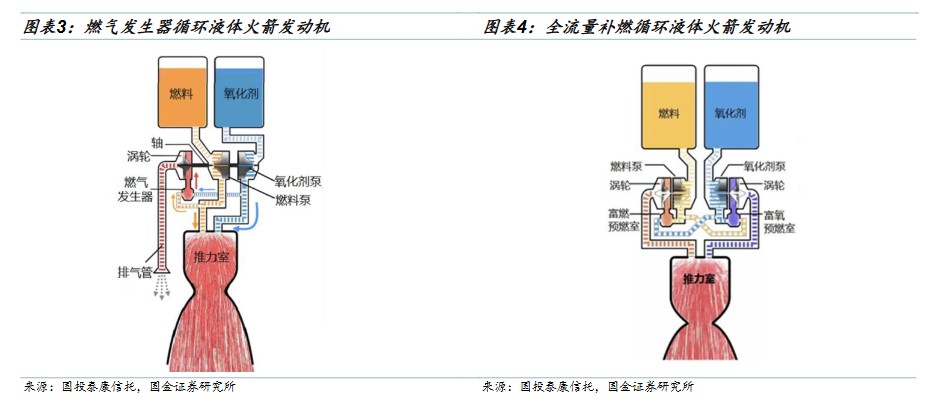
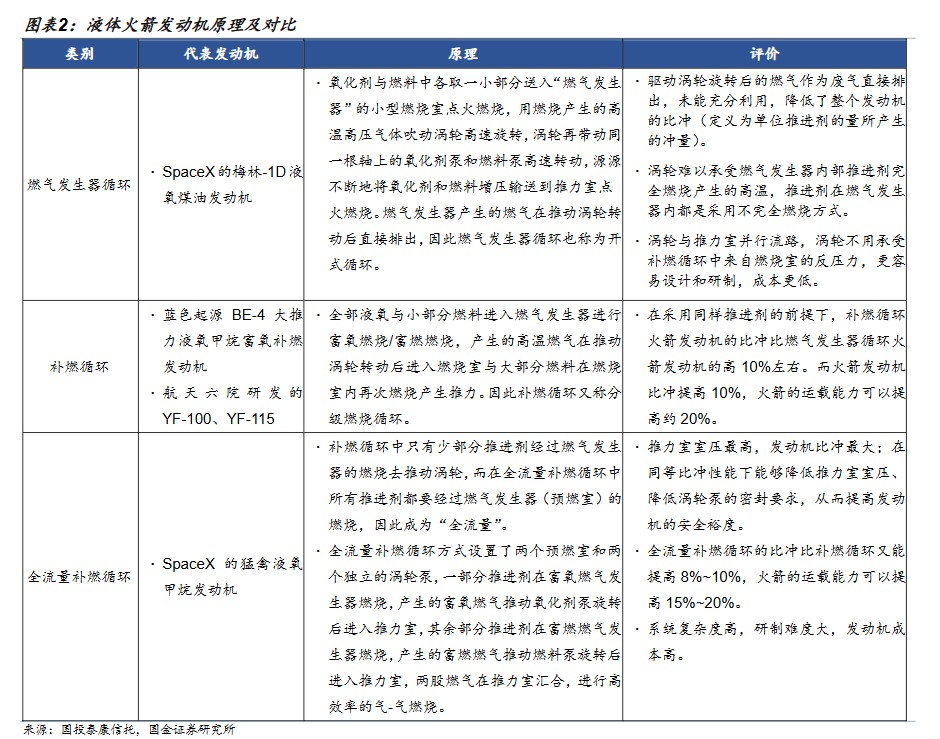
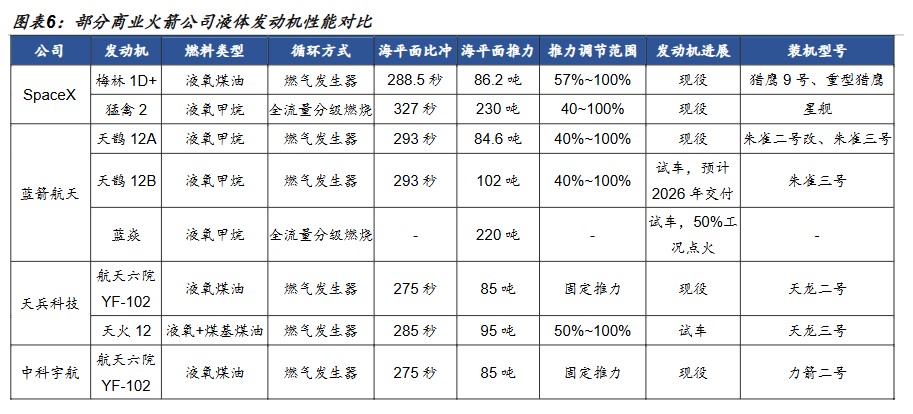
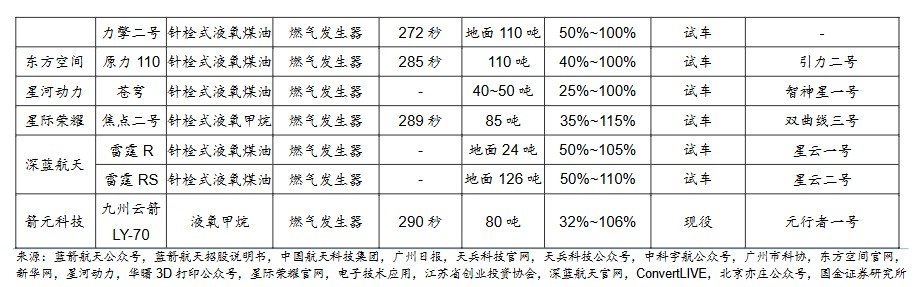
As the heart of the rocket, the design capability, thrust, and parallel capability of the engine directly determine the performance ceiling of the rocket. Currently, China's commercial rocket engines mainly adopt the gas generator cycle, but the technological route is evolving towards more efficient full flow staged combustion and high thrust.
In terms of fuel selection, both short-term and long-term logic coexist. In the short term, liquid oxygen and kerosene, with their high density and specific impulse advantages, are suitable as fuel for rocket launch stages, effectively reducing tank volume. In the long term, liquid oxygen and methane, due to their clean characteristics and potential for in-situ resource utilization on Mars, have become the inevitable path for deep space exploration. Currently, Blue Arrow Aerospace's Tianque series and Jiuzhou Yunjian's LY-70 have achieved orbital verification of liquid oxygen and methane engines.
Guojin Securities believes that increasing thrust is an inevitable requirement to adapt to the larger size of satellites. As the weight of satellites generally increases to 300-600 kilograms or even higher, the thrust demand for rocket launches is rising. To meet the carrying efficiency, the take-off thrust of a single engine is moving towards the 120-ton level, and parallel design has become mainstream. At the technological frontier, full flow staged combustion cycles have become a research hotspot due to their significant improvement in specific impulse (approximately 10%-20% increase in carrying capacity), with companies like Blue Arrow Aerospace and Jiuzhou Yunjian actively promoting related product development. As for longer-term deep space exploration, nuclear-powered engines are seen as a disruptive technology that could shorten the travel time from Earth to Mars from 7 months to 45 days.
3D Printing: The "Killer App" for Cost Reduction and Efficiency Improvement in Commercial Space
Since the successful manufacture of the first fuel nozzle by GE in the U.S. in 2012, 3D printing has been widely applied in the commercial space sector. Blue Arrow Aerospace's rockets are equipped with 3D printed stainless steel and high-temperature alloy parts, while the dual-curve No. 2 of Interstellar Glory features a manifold and injector completed using 3D printing technology. The 3D printed components of the Deep Blue Aerospace Thunder RS engine account for over 85% of its weight, and 85% of the components of the Terran1 rocket launched by Relativity Space in the U.S. are manufactured using 3D printing technology.
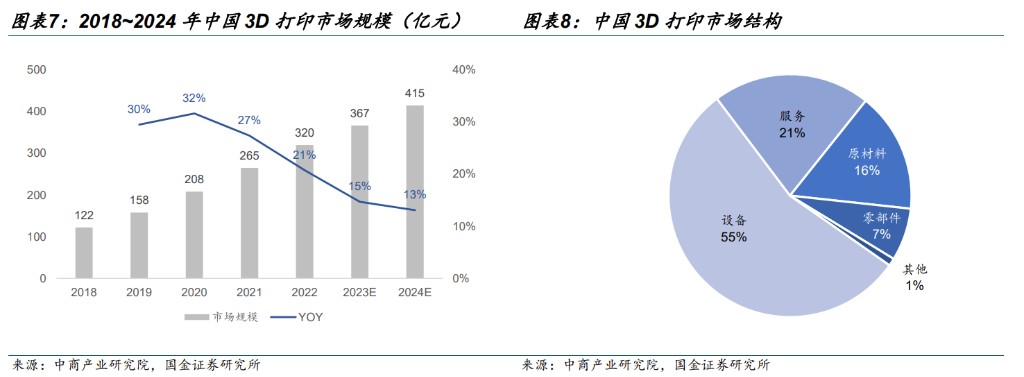
According to Wohler Associates, there are 328 global industrial-grade additive equipment manufacturers in 2023, with 44 in China, second only to the 63 in the U.S.; in 2024, the installation of industrial-grade additive manufacturing equipment in China will account for 11.5% of the global total, again second only to the U.S. at 31.0% According to data disclosed by the China Business Industry Research Institute, the market size of China's 3D printing industry is expected to reach approximately 41.5 billion yuan in 2024, with the aerospace sector accounting for about 16.7%, corresponding to 6.93 billion yuan. In terms of market structure, the shares of equipment, printing services, and raw materials are 55%, 21%, and 16%, respectively.
In the commercial aerospace sector, which pursues extreme lightweight and low cost, 3D printing (additive manufacturing) is no longer an auxiliary technology but a core productivity tool. Data shows that over 60% of the components in the newly developed rocket engines by China Aerospace Science and Technology Corporation can be produced through 3D printing, significantly reducing the production cycle from 50 hours to 10 hours, and achieving over 50% weight reduction through structural optimization.
This technology has been widely applied in the manufacturing of core components by leading companies. Companies such as Landspace, Galactic Energy, and Deep Blue Aerospace have adopted 3D printing technology in critical areas such as engine injectors and thrust chambers, with the 3D printed components of Deep Blue Aerospace's Thunder RS engine accounting for over 85% of its weight.
With the explosive demand for commercial aerospace, the 3D printing market is rapidly expanding. According to data from the China Business Industry Research Institute, the market size of China's 3D printing industry is expected to reach approximately 41.5 billion yuan in 2024, with the aerospace sector accounting for about 16.7%, reaching 6.93 billion yuan. In the industry chain, equipment manufacturers represented by Platinum Technology and Huashu High-Tech, as well as printing service providers like Fei'er Kang and New Space, are becoming high-value segments in the commercial rocket supply chain.
Large-scale Structural Components and Control System Upgrades
As the payload capacity of rockets increases, the structural components of the rocket body are accelerating towards larger sizes. Generally speaking, structural components account for 25%-30% of the cost of commercial rockets, with tank costs accounting for over 60%. To support the payload demands of reusable rockets, the diameter of the rocket body is advancing from 3.35 meters to 4 meters and even 6 meters.
Material innovations are also occurring simultaneously. Due to the technical difficulties and high costs of welding traditional aluminum alloys at large diameters, stronger and lower-cost stainless steel is becoming a new choice for tank materials. Although stainless steel has a higher density, effective weight balance can be achieved through wall thickness reduction technology and increased engine thrust. Currently, private tank companies such as Tianjin Yuefeng and Jiutian Xingge have begun collaborations with leading rocket manufacturers. Meanwhile, in the fairing sector, carbon fiber composites, which can achieve approximately 30% weight reduction, are gradually replacing metal materials.
In addition, the "nervous system" of rockets is also being upgraded. In control systems, servo systems account for about 6%-10% of the rocket's value. To meet the high-frequency launch demands of commercial aerospace, servo technology is evolving from traditional electric servos to electromechanical static pressure servos (motor control + hydraulic execution), with related supply chain companies such as Starry Sky Technology and Aerospace Chenguang welcoming new market opportunities
