


Another giant after Baidu! Alibaba is reportedly planning to spin off T-head for an independent listing, with its stock price surging over 7% during intraday trading

Reports indicate that Alibaba will first transform Pingtouge into an entity partially owned by employees, and then explore the possibility of an IPO. As Alibaba's long-hidden "nuclear weapon," the listing of Pingtouge is not only significant for Alibaba but will also have a profound impact on China's semiconductor industry. In September last year, CCTV News reported on a smart computing center project by China Unicom, revealing the AI chip PPU developed by Pingtouge. This chip surpasses NVIDIA's A800 and mainstream domestic GPUs in key parameters, with overall performance comparable to NVIDIA's H20
Following Baidu, another domestic internet giant is preparing to independently list its chip company, and this time Alibaba may officially bring its long-hidden "nuclear weapon" into the public market.
On January 22nd, Eastern Time Thursday, media reports indicated that Alibaba Group is preparing to advance the independent listing of its AI chip subsidiary, Pingtouge. Boosted by this news, Alibaba's U.S. stock opened 4.6% higher on Thursday, with the stock price briefly reaching $181.1, marking a new intraday high since October 28, 2025, with an intraday increase of up to 7.4%, and a market value increase of nearly $29.7 billion. The gains later narrowed, closing with a rise of just over 5%, setting a new closing high since late October last year.
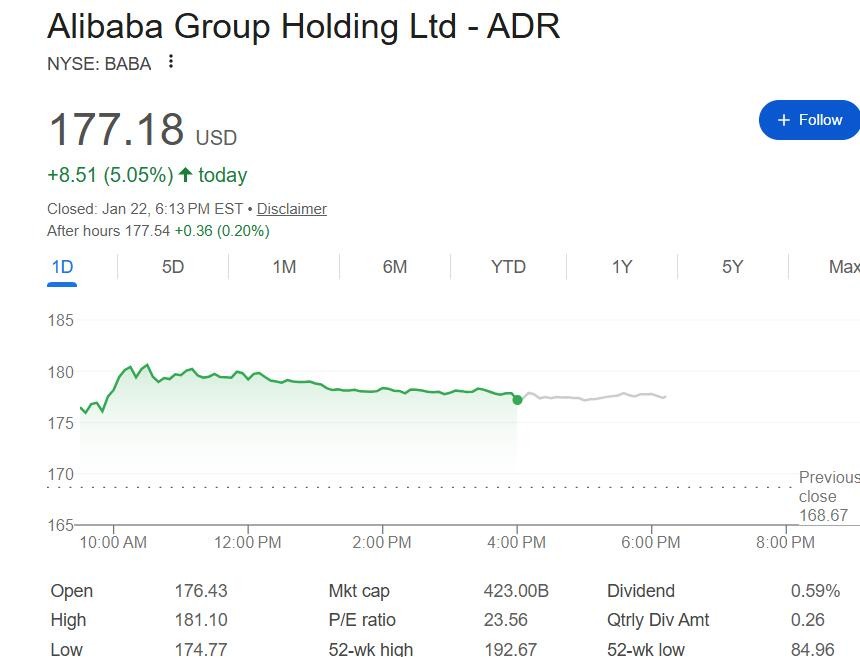
According to reports from the Science and Technology Innovation Board Daily, when asked about the above news regarding Pingtouge, Alibaba did not comment.
This potential listing plan comes at a time when the AI chip market is experiencing a wave of listings. Baidu's Kunlun Chip has already submitted a listing application to the Hong Kong Stock Exchange in a confidential manner this January, with a target fundraising scale reportedly up to $2 billion. The listings of competitors like Moore Threads have attracted strong investor interest, reflecting that overseas investors are betting on China to support domestic industries as alternatives to U.S. technology.
Restructuring Plan Still in Early Stages
According to reports on Thursday, Alibaba will first conduct an internal restructuring of Pingtouge's chip business, transforming it into a business entity partially owned by employees, and then explore the possibility of an IPO. The specific listing timeline has yet to be determined, and the action is still in the preparatory stage.
As the listing action is still in its early and exploratory stages, the valuation that Pingtouge may achieve remains unclear. However, investor interest in Chinese chip manufacturers has remained strong.
According to the Securities Times, a report released by the Hurun Research Institute on Monday titled "2025 Hurun China AI Enterprises Top 50" shows that the top-ranked Cambricon has a market value of approximately 630 billion yuan, followed by Moore Threads with a value of 310 billion yuan, and Muxi Co., Ltd. with a value of 250 billion yuan. Among the top three, Cambricon has focused on the research and development of AI core processor chips since its establishment in 2016, while Moore Threads and Muxi Co., Ltd., founded in 2020, focus on full-function GPU R&D and full-stack GPU R&D, respectively.
Reports on Thursday suggest that Alibaba hopes to leverage strong investor demand for the AI accelerator market through this plan.
Currently, there are only a handful of companies globally attempting to develop AI chips that can compete with NVIDIA. The independent listing of Pingtouge is not only significant for Alibaba but will also have a profound impact on China's semiconductor industry. As an important layout of Chinese tech giants in the chip field, it will enhance the overall competitiveness of China's AI chip industry and help reduce dependence on foreign technology
The Technical Accumulation and Market Position of T-head
T-head is a semiconductor chip company established by Alibaba in September 2018, formed by integrating the chip team from Alibaba's DAMO Academy and the acquired Zhongtian Micro Systems. It focuses on AI chips and RISC-V ecosystem technology. According to Sina Technology, T-head has remained very low-key in the industry and is regarded as Alibaba's "nuclear weapon" that has been kept under wraps for many years.
T-head's strength was prominently showcased in September 2025. CCTV News reported on the China Unicom Sanjiangyuan Green Power Intelligent Computing Center project that month, revealing T-head's latest AI chip, the PPU. The report showed that this GPU chip, named PPU, has a memory of 96GB HBM2e, an inter-chip interconnect bandwidth of 700GB/s, an interface of PCIe 5.0×16, and a power consumption of only 400W, surpassing NVIDIA's A800 and mainstream domestic GPUs in these key parameters, with overall performance comparable to NVIDIA's H20.
Sina Technology cited other reports stating that the first-generation PPU developed by T-head can rival NVIDIA's best-selling H20, while the upgraded version of the PPU outperforms NVIDIA's A100. Due to its excellent stability and outstanding cost-performance ratio, T-head's PPU chip has a good reputation in the industry.
In terms of product layout, T-head has successively launched the "Hanguang" series AI chips, the "Yitian" series general-purpose server CPUs, and the enterprise-grade SSD controller chip Zhenyue 510, among others. Self-developed CPU chips like Yitian 710 and AI inference chips like Hanguang 800 have been scaled up on Alibaba Cloud. In the edge chip sector, T-head's Yuzhen IoT chip has achieved shipments in the hundreds of millions.
Recent reports indicate signs that T-head's performance is making progress. According to the Science and Technology Innovation Board Daily, industry insiders in intelligent computing have stated that T-head's AI chips have "good performance and are widely used by Alibaba," while others in the intelligent computing industry chain noted that "the T-head PPU is mainly aimed at inference scenarios and was just recently launched, so there isn't much news about external applications yet."
Other reports mentioned that Alibaba signed a contract with China Unicom, the second-largest wireless operator in China, to deploy T-head AI accelerators. These chips will compete with accelerators provided by rivals such as MetaX and Biren Technology, entering China Unicom's large new data center in the northwest region.
According to footage reported by CCTV News last September, several domestic AI chip companies, including Muxi Co., Biren Technology, Zhonghao Xinying, Taichu, Suiruan Technology, and Moore Threads, have signed projects totaling 1,747 devices and 22,832 computing power cards, with a total computing power of 3,579P. Among them, Alibaba Cloud has a total of 1,024 devices, 16,384 T-head computing power cards, and a total computing power of 1,945P.
The Key Piece of the AI Full-Stack Layout
The potential listing of T-head is an important part of Alibaba's AI strategy.
Media outlets believe that Alibaba has long been exploring chip design, seeking to ensure the supply of key components that support its data centers and cloud services similar to AWS. AI chips are one aspect of its broader strategy to become a leading AI company competing with OpenAI and others According to Sina Technology, industry insiders believe that Alibaba and Google will lead AI development in China and the United States, as both have a full-stack layout from AI chips, cloud computing, large models to AI applications. In Google's AI layout, the self-developed chip TPU is an important part. With the initiation of the listing process, the strength accumulated by PingTouGe in the underlying chip field over the years has finally emerged, revealing the last piece of the puzzle in Alibaba's AI full-stack layout.
The release of DeepSeek's R-1 in January 2025 marked a turning point in China's AI development, triggering a profound transformation of the open-source model globally and promoting the comprehensive rise of Chinese models in terms of downloads and influence. Since then, Alibaba has been one of the most active investors and advocates in the AI field.
In February 2025, Alibaba announced plans to invest at least 380 billion yuan (over 53 billion USD) in cloud computing and AI infrastructure over the next three years, an amount exceeding Alibaba's total investment in cloud and AI infrastructure over the previous decade. These initiatives have helped Alibaba's stock price perform better than many competitors over the past year, although its market value of over 400 billion USD is still lower than Tencent Holdings, which ranks first domestically with over 690 billion USD.
The Surge of AI Chip IPOs
PingTouGe's listing plan aligns with the current IPO boom in the AI chip sector.
Before Alibaba, another internet giant, Baidu, had already announced the spin-off plan for Kunlun Chip. According to media reports on January 7, Kunlun Chip has selected an investment banking team to prepare for its Hong Kong initial public offering, with a target fundraising scale of up to 2 billion USD. On January 2 of this year, Baidu officially confirmed that Kunlun Chip had secretly submitted its IPO application.
According to Baidu's public statements, Kunlun Chip is one of the few companies in China capable of designing high-performance accelerators. According to Tencent Technology, a research minute previously indicated that Kunlun Chip's revenue for the entire year of 2025 is expected to be around 5 billion yuan, a significant increase from 2 billion yuan in 2024. IDC data shows that Kunlun Chip's shipment volume is expected to rank second in the industry in 2024.
Domestic GPU companies MuXi Co., Ltd. and MoEr Thread have already landed on the STAR Market in December 2025. BiRan Technology and TianShu ZhiXin, like Kunlun Chip, have chosen to go public in Hong Kong, while SuiYuan Technology's STAR Market IPO was accepted this Thursday, and HanBo Semiconductor has completed the listing guidance for the STAR Market.
On January 2, 2026, AI chip design company Shanghai BiRan Technology surged 76% on its first day of listing in Hong Kong, while related companies that went public in the mainland at the end of last year saw first-day gains reaching triple digits. These market performances provide a positive valuation reference for subsequent companies' listings. This reflects the high demand from investors for the artificial intelligence sector and the market's bet that Beijing will continue to support the development of AI-related enterprises regarded as strategic industries
