


Up 37% this year, what to look for in tomorrow's Intel earnings report?

Intel will release its fourth-quarter financial report after the U.S. stock market closes on the 22nd local time. On the eve of the report's release, market focus has shifted from short-term performance to three core drivers: server CPU demand driven by AI Agents, progress in mass production of the 18A advanced process, and whether the wafer foundry business can achieve breakthroughs with external clients
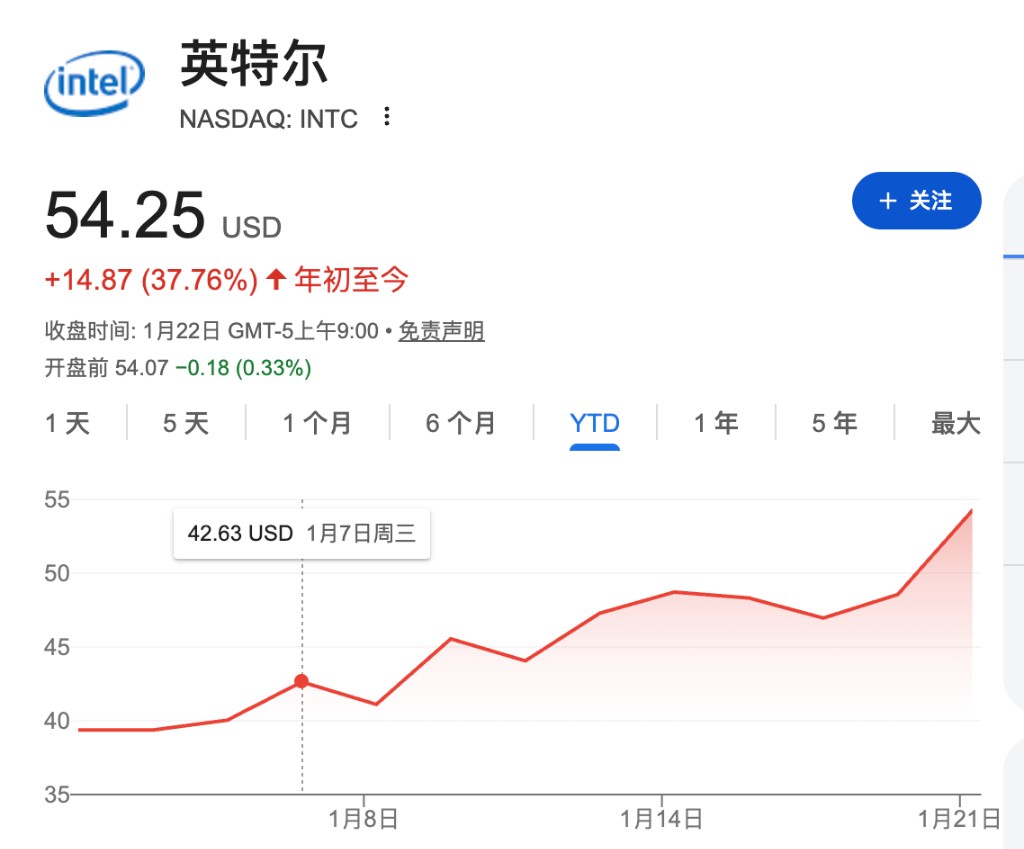
Since the beginning of this year, Intel's stock price has increased by 37%, closing at $54.25 on January 21, reaching a new high since January 2022. After the market close on January 22, local time, Intel will release its latest quarterly financial report.
On the eve of the earnings report, market attention has shifted beyond short-term revenue performance, focusing more on three core drivers: the growth in CPU demand driven by AI Agents, the advancement of the 18A process, and breakthroughs in the foundry business customer base. These factors are becoming key to determining whether its stock price can maintain its strength.
Currently, Intel's market logic is no longer limited to the traditional PC cycle. On one hand, the AI Agent scenario has generated new "out-of-domain CPU" demand, driving the server business to become a growth engine; on the other hand, the substantial progress in the 18A process and foundry business will determine whether Intel can close the gap with TSMC in advanced manufacturing. The capacity layout and order visibility revealed in this earnings report will serve as important evidence to validate this growth narrative.
Highlight 1: How will the "Agent Dividend" for server CPUs materialize?
The market generally views AI Agents as a key growth driver for Intel's server business. A report from KeyBanc indicates that Intel's server CPU capacity for 2026 is nearly sold out; HSBC predicts that the growth rate of server CPU demand driven by Agentic AI could reach as high as 30%-40%, significantly exceeding the market's original expectation of 4%-6%.
This quarter's earnings report will focus on two key indicators:
-
DCAI (Data Center and AI) business revenue: Morgan Stanley expects this business to grow by 11.5% quarter-over-quarter in Q4; if the actual data exceeds expectations, it will directly validate that Agent-related demand has begun to materialize;
-
Average Selling Price (ASP) of server CPUs: Western Securities previously pointed out that Intel has raised prices for related products by 10%-15%; if the ASP increase in the earnings report is significant (e.g., over 10%), it will strongly enhance the overall gross margin level.
Morgan Stanley warns that if Intel cannot meet all demand due to capacity constraints, it may lead to some market share being captured by AMD, resulting in short-term performance growth accompanied by long-term structural concerns.
Highlight 2: Progress on the 18A process and Panther Lake
Intel's 18A process is a core battle for its return to a leading position in manufacturing processes, and the newly announced Panther Lake processor will be its first product to adopt this process. In this earnings report, the market will focus on the following two key signals:
- Yield and mass production pace of 18A: Deutsche Bank analysis points out that the speed of yield improvement for 18A will directly relate to Intel's gross margin recovery process and cost competitiveness;
- Market Feedback on Panther Lake: If the financial report reveals that PC manufacturers' early orders or cooperation intentions for this processor exceed expectations, it will be a strong proof of the actual commercialization capability of the 18A process.
It is worth noting that recent research shows that storing large models with hundreds of billions of parameters in CPU memory can achieve low-latency inference, further highlighting Intel's potential advantages in the "CPU-memory" collaborative architecture. If the financial report reveals progress in cooperation with AI manufacturers in related technological directions, it may become an important catalyst for stock prices.
Point Three: Is There Progress in "Customer Breakthrough" for the Foundry Business?
Intel's foundry business (IFS) is seen as a key growth curve for its valuation reshaping, but the market remains cautious about its ability to successfully expand external customers. HSBC pointed out in its research report that Intel's potential cooperation with leading companies like Apple and NVIDIA still "lacks visibility"; Morgan Stanley also warned that if capacity bottlenecks persist, it may lead to external customers' lack of confidence in its foundry capabilities and supply stability.
In the financial report and conference call, if management can provide any of the following progress, it will significantly boost market expectations:
-
Securing clear external major customers: For example, confirmation that Apple's M-series chips will adopt Intel's 18A or subsequent 14A process;
-
Advanced packaging receiving actual orders: Such as EMIB and other technologies obtaining actual design and mass production orders from AI chip customers.
This breakthrough will be a key test to verify whether Intel can transition from the "IDM 2.0" strategy to a truly market-oriented foundry enterprise.
Currently, Intel's stock price already reflects the market's high expectations for its successful transformation in the coming years. In this round of financial reports, if the "Agent dividend" for server CPUs is effectively realized and the mass production of the 18A process progresses smoothly, there is still room for further upward movement in stock prices; conversely, if the foundry business fails to see customer breakthroughs and capacity bottlenecks repeatedly become the focus, short-term performance growth may not fully alleviate market concerns about its medium- to long-term competitiveness, and upward momentum may face pressure
