


The $5,000 gold threshold is in sight! The market has begun discussing $6,000, $7,000, and even $10,000!

Gold prices are roaring towards the $5,000 mark, with geopolitical tensions and the resurgence of tariff clouds pushing gold to become the ultimate safe haven. Institutional forecasts are becoming increasingly aggressive, with calls rising from $7,000 to the "ten-thousand-dollar" era. As private capital takes over from central banks as the main buying force, analysts believe that this non-speculative long-term bull market feast seems to have just begun
Under the shadow of escalating geopolitical friction and trade protectionism, gold prices are surging with astonishing momentum, with the $5,000 mark within reach.
On Wednesday, spot gold prices strongly surpassed $4,880 per ounce, with an intraday increase of 2.46%, continuing to set new historical highs. The direct catalyst for this latest surge came from the White House's tariff threats regarding Greenland, reigniting market concerns over a global trade war and forcing investors to seek safe havens amid an increasingly uncertain international situation. As of the time of writing, spot gold has retreated to $4,860 per ounce.
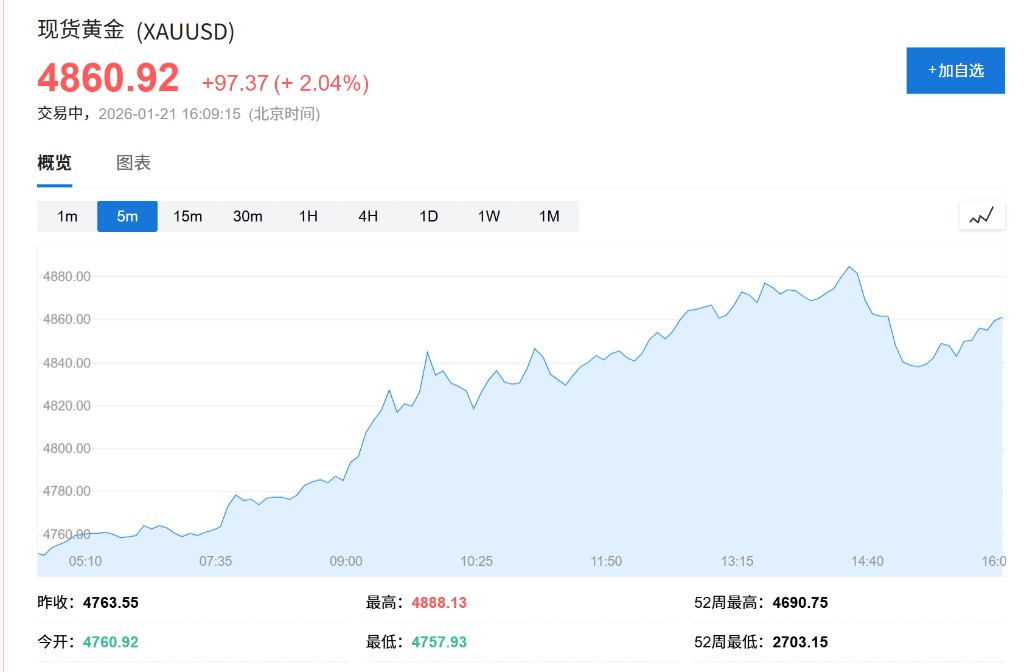
Following a historic increase of over 60% in 2025, gold has maintained its momentum into 2026. Analysts point out that geopolitical tensions, declining real interest rates, and the ongoing "de-dollarization" diversification strategies by central banks and private investors are collectively forming the core logic supporting the rise in gold prices. The market generally believes that, in the current macro context, gold's role as the "ultimate safe-haven asset" remains solid.
In the face of this aggressive momentum, global financial institutions and market observers are recalibrating their expectations, with discussions shifting significantly upward. The calls for gold prices reaching $6,000, $7,000, and even $10,000 are increasingly gaining traction, highlighting the unprecedented strengthening of gold's status as a strategic safe-haven asset in a turbulent macro environment.
Market Expectation Reassessment: From $7,000 to "Roaring" $10,000
In light of gold's strong performance, predictions from analysts and institutions are becoming increasingly aggressive. A survey by the LBMA shows that the interviewed analysts generally expect gold prices to surpass $5,000 this year. Some strategists have a longer-term outlook, with Julia Du, a senior commodity strategist at ICBC Standard Bank, believing that gold prices could rise to $7,150.
Bolder predictions point to five figures. According to a previous article by Wall Street Insight, Ed Yardeni of Yardeni Research believes the market is in a "roaring 2020s," and suggested that if the S&P 500 index reaches 10,000 points by the end of this decade, gold, as a portfolio balancing tool, could also reach $10,000 per ounce.
Renowned economist Jim Rickards also stated in an interview that the factors driving the metal market upward will continue to exert influence next year, and he would not be surprised if gold prices reach $10,000 by 2026. Additionally, [Saxo Bank's "Outrageous Predictions" for 2026](https://wallstreetcn.com/articles/3760553? keyword=10000), and even envisioned a scenario where breakthroughs in quantum computing trigger panic in the financial markets, driving gold prices to soar to $10,000.
Goldman's annual institutional survey further corroborated this bullish sentiment. The survey revealed that despite a significant surge in gold prices previously, bulls remain strong, with 42% of respondents believing that gold prices will rebound to the $5,000-$6,000 range, and 10% of respondents expecting prices to exceed $6,000, while the proportion of those who believe gold prices will significantly correct is only in the single digits.
Geopolitical Drivers: Non-Speculative Peak
For many gold bulls, geopolitics remains a key backdrop defining the current market. Nicky Shiels, head of metals strategy at MKS PAMP, pointed out that the current cycle does not resemble a speculative peak but rather a long-term trend trade. She expects gold prices to reach $5,400 this year, which means a further increase of 30% on top of last year's historic rise.
Shiels emphasized that geopolitical tensions have not dissipated; instead, they have increasingly become the norm. From U.S. actions in Venezuela to Washington's attempts to exert control over Greenland, these recently erupted conflict points have deepened the trend of investors flocking to gold. She believes the world is entering an era with a strong demand for securing supplies of key metals and commodities, and this structural demand will support gold prices to continue rising, rather than experiencing the typical "peak after a boom" scenario seen in commodities.
Changing Capital Flows: Private Sector Takes Over from Central Banks
In the funding structure driving gold price increases, significant changes have also been observed in the market. Daan Struyven, co-head of Goldman’s global commodities research, reiterated a bullish stance, ranking gold as the bank's "highest conviction" trade, and noted that the buyer demographic is shifting.
Struyven analyzed that while central bank gold purchases dominated the increases in 2023 and 2024, the acceleration in price increases since 2025 has been primarily driven by private sector demand. Currently, private investors are diversifying their asset allocations into gold through various channels such as ETFs. Goldman's data shows that demand mainly comes from private wealth firms, asset management companies, hedge funds, and pension investors. This shift from official reserves to widespread private capital buying further solidifies the market foundation for gold's current rally
