


Spending money relentlessly! Netflix is making a "full cash" bid in the Warner acquisition battle, vowing to create a subscription empire of 450 million users

The new terms eliminate Paramount's main criticism of Netflix's acquisition proposal—the stock payment portion makes its offer less competitive than its rivals. If Netflix successfully acquires, the two companies will have approximately 450 million subscribers combined, providing Netflix with a vast content library to compete against rivals like Disney and Amazon
Streaming giant Netflix has changed the terms of its acquisition of Warner Bros. Discovery's film and streaming business to an all-cash payment, countering Paramount with a price of $27.75 per share.
According to Bloomberg on Tuesday, Netflix's previously proposed acquisition plan included a mixed payment method of cash and stock, which has now been revised to a full cash payment. Warner Bros. plans to hold a special shareholder meeting to approve the transaction, and Netflix stated that shareholders could complete voting as early as April. This adjustment aims to expedite the transaction process and respond to Paramount's doubts about its bid.
If Netflix successfully acquires, the two companies will have a combined total of approximately 450 million subscribers, providing Netflix with a vast content library to compete against rivals like Disney and Amazon.
All-Cash Proposal Eliminates Key Obstacle
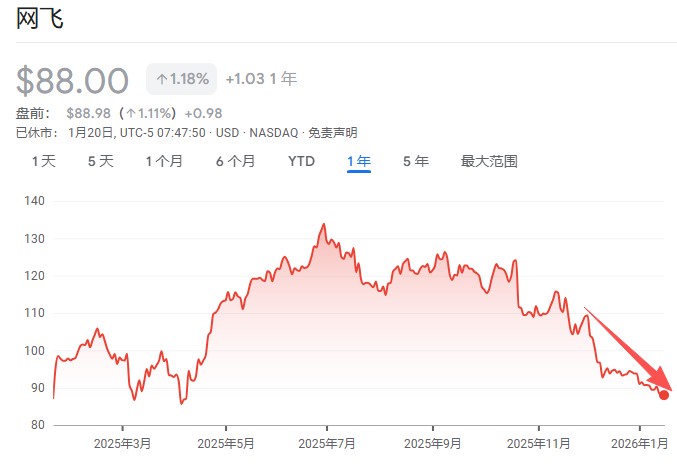
The new terms eliminate Paramount's main criticism of Netflix's bid—the stock payment portion made its offer less attractive than competitors. Since the announcement of the merger on December 5 last year, Netflix's stock price has fallen nearly 15%, closing at $88 per share, well below the original plan's stock pricing lower limit of $97.91.
Netflix co-CEO Ted Sarandos stated in a statement that the Warner Bros. board "continues to support and unanimously recommend our deal, and we believe this will bring the best results for shareholders, consumers, creators, and the broader entertainment community."
Warner Bros. emphasized in regulatory filings that the acquisition consideration is a fixed cash amount paid by an investment-grade company, providing shareholders with value certainty and immediate liquidity. Netflix has a market capitalization of $402 billion and holds an investment-grade credit rating, while Paramount's market capitalization is only $12.6 billion, with its bonds rated junk by S&P.
Cable Asset Valuation Becomes Controversial Focus
Warner Bros. disclosed for the first time in its filings the valuation of the spun-off cable networks, which will be separated into an independent company, Discovery Global, for shareholders. According to consultant assessments, the value range for the cable networks is between $0.72 and $6.86 per share.
Paramount previously claimed these assets were worthless, despite the cable networks accounting for the largest share of its own sales and profits. Paramount had applied to the Delaware court on January 12 to expedite information disclosure, but the judge rejected the request, stating that Paramount failed to demonstrate that it would suffer irreparable harm.
According to the filings, Discovery Global will have $17 billion in debt as of June 30, 2026, which will decrease to $16.1 billion by the end of the year. Due to better-than-expected cash flow last year, Discovery Global's debt will be reduced by $260 million compared to the initial plan. The filings project the company will have revenue of $16.9 billion in 2026, with adjusted EBITDA of $5.4 billion.
Leverage Advantage Highlights Financial Strength
The merger with Netflix will result in a total debt of approximately $85 billion for the combined company, lower than the $87 billion with Paramount. However, the difference in financial leverage is significant—Netflix's proposal has a leverage ratio of less than 4 times, while Paramount's proposal is around 7 times Warner Bros. reiterated in a document its reasons for rejecting Paramount's offer, stating that the all-cash bid of $30 per share is insufficient after considering "price as well as numerous risks, costs, and uncertainties." The Warner Bros. board has repeatedly rejected Paramount's offers, which has threatened to initiate a proxy battle and filed a lawsuit demanding that Warner Bros. disclose more information regarding Netflix's acquisition proposal and the value of its cable assets.
Institutional investors have differing opinions on the two bids, with some investors calling for Paramount to raise its offer. Warner Bros. shares fell less than 1% to $28.50 in pre-market trading in New York, while Netflix shares rose 1.2%.
Regulatory Approval as the Final Hurdle
Executives from Netflix and Warner Bros. met with regulators in Europe last week, attempting to persuade them to approve the deal. Sarandos and co-CEO Greg Peters expressed to investors at a UBS conference on December 8 last year that they are "very confident" the deal will be approved.
Hollywood unions and theater operators have expressed concerns that the deal would harm their members and business interests. Netflix is set to announce its fourth-quarter earnings after the U.S. stock market closes on Tuesday.
David Ellison argues that a merger with Paramount would preserve a more traditional Hollywood structure and maintain some of Warner Bros.' traditions. He has been conducting his own lobbying campaign but has yet to persuade the overwhelming majority of the Warner Bros. board or company shareholders.
This bidding war, which began last September, intensified after Warner Bros. announced its sale in October. The emergence of streaming leader Netflix as an unexpected bidder has made this contest one of the largest media deals in recent years
