


China's January LPR remains unchanged for the eighth consecutive month: the 5-year LPR is 3.5%, and the 1-year LPR is 3%

The 5-year LPR is 3.5% as of January, and the 1-year LPR is 3%. Regarding monetary policy for 2026, the deputy governor of the central bank recently stated that there is still some room for reserve requirement ratio cuts and interest rate reductions this year
On January 20, Tuesday, China's January LPR quotation was released, remaining unchanged for the eighth consecutive month.
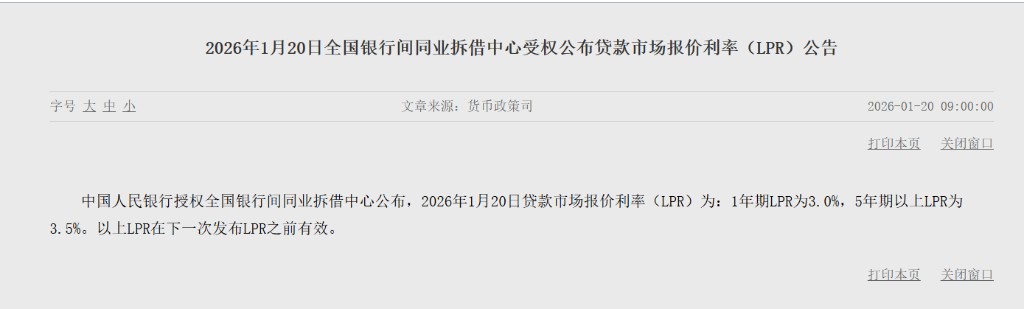
The People's Bank of China authorized the National Interbank Funding Center to announce that the Loan Prime Rate (LPR) is: the 1-year LPR is 3.0%, and the LPR for 5 years and above is 3.5%. The above LPRs are effective until the next LPR announcement.
Regarding the monetary policy for 2026, at the press conference of the State Council Information Office on January 15, the deputy governor of the central bank stated that there is still room for reserve requirement ratio cuts and interest rate reductions this year.
Currently, a rate cut is expected at the beginning of 2026, and subsequent reserve requirement ratio cuts are also anticipated. On January 15, the central bank issued four announcements: first, reducing the re-lending and rediscount rates by 0.25 percentage points; second, increasing the re-lending quota for technological innovation and technological transformation by 400 billion yuan; third, increasing the re-lending quota for agriculture and small enterprises by 500 billion yuan, and allowing the re-lending quota for agriculture and small enterprises to be used interchangeably with the rediscount quota; fourth, including projects with direct carbon reduction effects, such as energy-saving transformations, green upgrades, and green low-carbon transitions, into the support areas of carbon reduction support tools.
In addition, the recent Central Economic Work Conference emphasized the need to continue implementing a moderately loose monetary policy. The conference pointed out that promoting stable economic growth and a reasonable rebound in prices should be important considerations for monetary policy, flexibly and efficiently using various policy tools such as reserve requirement ratio cuts and interest rate reductions, maintaining ample liquidity, smoothing the transmission mechanism of monetary policy, and guiding financial institutions to strengthen support for expanding domestic demand, technological innovation, and small and micro enterprises.
Wang Qing, chief macro analyst at Dongfang Jincheng, stated that the Central Economic Work Conference clearly required that in 2026, "a moderately loose monetary policy should continue to be implemented," and "promoting stable economic growth and a reasonable rebound in prices should be important considerations for monetary policy." Considering the latest changes in economic growth momentum and the high base from the same period last year, it is expected that the monetary policy in the first quarter of 2026 is likely to end the observation period and enter a phase of action
