


Anthropic just released a report titled "AI Job Displacement Report": The higher the education level, the more "displaced" one is

The "AI Job Displacement Report" released by Anthropic reveals that AI significantly improves efficiency in complex tasks, especially in jobs that require higher education. The report points out that AI not only replaces some human thinking but also leads to a phenomenon of de-skilling. Data shows that AI accelerates performance in high-difficulty tasks even more dramatically, with work speed increasing by up to 12 times. Human-machine collaboration will be key in the future workplace, and those who know how to work with AI will be more competitive
Your job's "value" is being drained by AI. Anthropic's latest report reveals the counterintuitive truth: the more complex tasks are measured by years of education, the faster AI accelerates. More frightening than direct replacement is "de-skilling"—AI takes away the joy of thinking, leaving you with only menial tasks. But the data also points to the only way out: understanding human-machine collaboration can increase your success rate tenfold. In this era of surplus computing power, this is a survival guide you must understand.
Anthropic just released the "Economic Index Report" on their official website yesterday.
The report not only focuses on what people are doing with AI but also on the extent to which AI is truly replacing human thought.
This time, they introduced a new dimension called "Economic Primitives," attempting to quantify task complexity, required education level, and the autonomy of AI.
The future of the workplace reflected by the data is much more complex than simple "unemployment theory" or "utopian theory."
The harder the task, the faster AI works
In our traditional understanding, machines are usually good at repetitive simple labor, while they appear clumsy in fields requiring advanced knowledge.
But Anthropic's data provides a completely opposite conclusion: the more complex the task, the more astonishing the "acceleration" brought by AI.
The report shows that for tasks that can be understood with only a high school education, Claude can increase work speed by 9 times;
Once the task difficulty rises to the threshold requiring a college education, this acceleration factor skyrockets to 12 times.
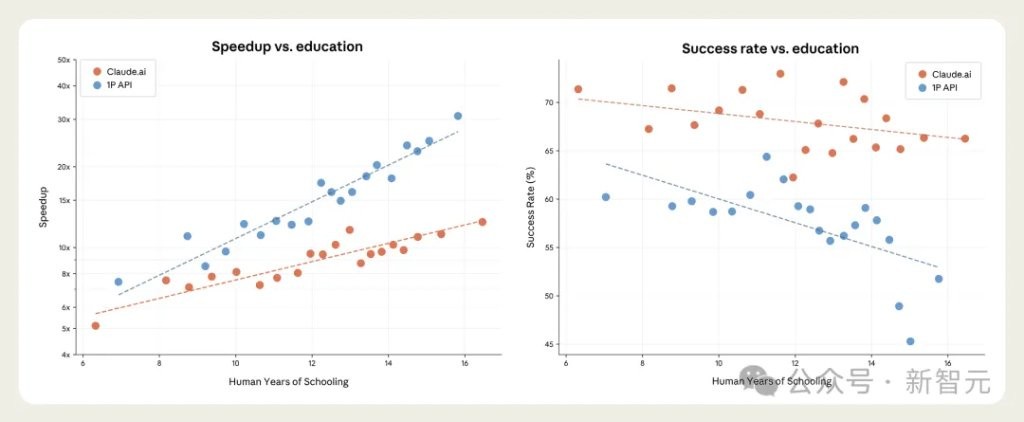
This means that the white-collar elite work, which originally required humans to ponder for hours, is currently the area where AI "harvests" efficiency the most.
Even considering the occasional hallucination failure rate of AI, the conclusion remains unchanged: the efficiency surge brought by AI for complex tasks is enough to offset the repair costs of its errors.
This explains why today's programmers and financial analysts are more dependent on Claude than data entry clerks—because in these high-intelligence-density fields, the leverage effect exhibited by AI is the strongest.
19 hours The "New Moore's Law" of human-machine collaboration
The most shocking data in this report is the test of AI's "durability" (task horizons, measured at a 50% success rate).
Typical benchmark tests like METR (Model Evaluation & Threat Research) believe that the current top models (like Claude Sonnet 4.5) can handle tasks that would take humans 2 hours to complete, The success rate will fall below 50%.
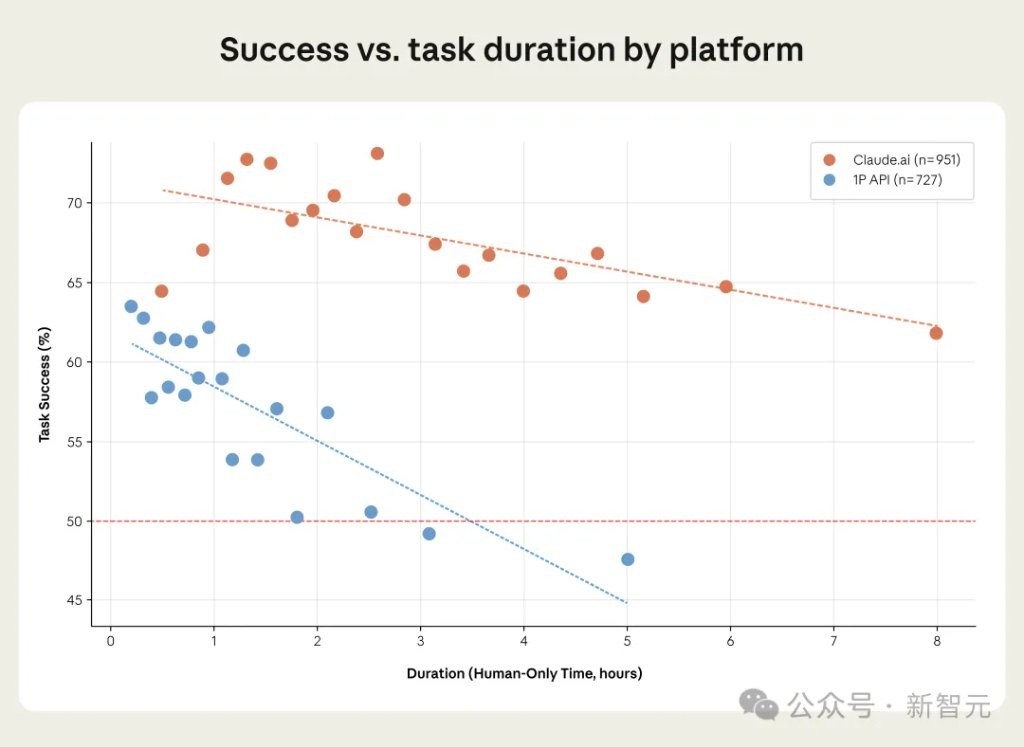
However, in the actual user data from Anthropic, this time boundary has been significantly extended.
In the commercial scenario of API calls, Claude can maintain a success rate of over 50% in tasks involving a workload of 3.5 hours.
In the dialogue interface of Claude.ai, this number is astonishingly pushed up to 19 hours.
Why is there such a huge gap? The secret lies in the involvement of "humans."
Benchmark tests are where AI faces the exam alone, while real-world users break down a large complex project into countless small steps, continuously correcting the AI's course through feedback loops.
This human-machine collaborative workflow pushes the task duration limit (measured by a 50% success rate) from 2 hours to about 19 hours, nearly 10 times.
This may be what the future of work looks like: not AI completing everything independently, but humans learning how to harness it to run a marathon.
Folding on the World Map, the Poor Learn Knowledge, the Rich Engage in Production
If we broaden our perspective to a global scale, we will see a clear and somewhat ironic "adoption curve."
In developed countries with higher per capita GDP, AI has been deeply embedded in productivity and personal life.
People use it to write code, create reports, and even plan travel itineraries.
But in countries with lower per capita GDP, Claude's main role is as a "teacher," with a large number of applications concentrated in homework and educational tutoring.
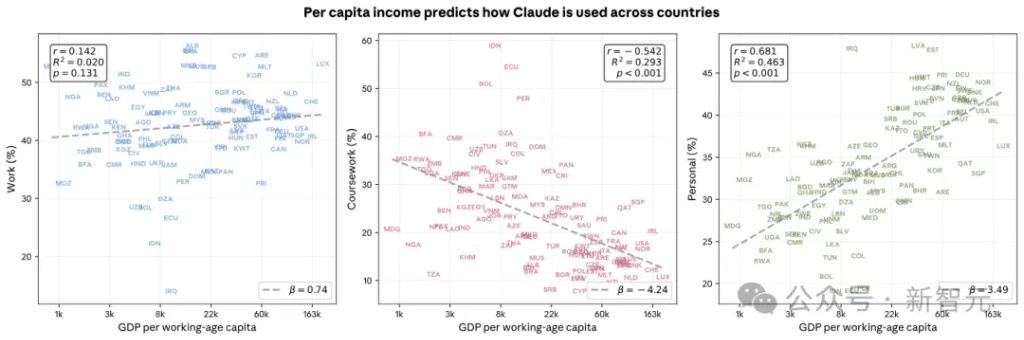
Beyond the wealth gap, this is also a reflection of a technological generational gap.
Anthropic mentioned that they are collaborating with the Rwandan government to help people there move beyond the simple "learning" phase into broader applications.
Because without intervention, AI is likely to become a new barrier: people in affluent areas exponentially amplify their output using it, while those in underdeveloped areas are still using it to supplement basic knowledge.
Workplace Concerns: The Ghost of "Deskilling"
The most controversial and concerning part of the report is the discussion on "deskilling."
Data shows that the tasks currently covered by Claude require an average educational background of 14.4 years (equivalent to an associate degree), which is significantly higher than the 13.2 years required for overall economic activities.
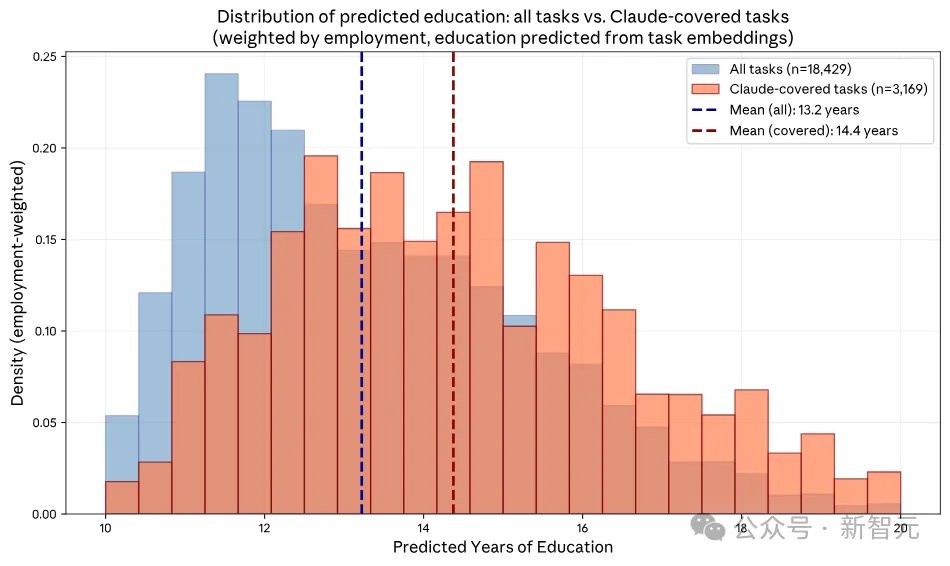 AI is systematically eliminating the "high-intelligence" aspects of work.
For technical writers or travel agency agents, this could be catastrophic.
AI has taken over tasks that require "brainpower," such as analyzing industry trends and planning complex itineraries, leaving humans with only trivial tasks like sketching and handling invoices.
Your job still exists, but the "value" of the work has been drained.
Of course, there are beneficiaries.
For instance, real estate managers can focus their energy on high-emotional-intelligence tasks like client negotiations and stakeholder management after AI handles tedious administrative work like bookkeeping and contract comparisons—this is, in fact, a form of "upskilling."
Anthropic cautiously states that this is merely a projection based on the current situation, not an inevitable prophecy.
However, the alarm it sounds is real.
If your core competency is merely processing complex information, you are at the eye of the storm.
Is Productivity Returning to the "Golden Age"?
Finally, let’s return to the macro perspective.
Anthropic has revised its forecast for U.S. labor productivity.
After accounting for potential errors and failures of AI, they expect AI to drive productivity growth by 1.0% to 1.2% annually over the next decade.
This appears to be a one-third reduction from the previous optimistic estimate of 1.8%, but do not underestimate this 1 percentage point.
This is enough to bring the growth rate of U.S. productivity back to levels seen during the late 1990s internet boom.
Moreover, this is based solely on the model capabilities as of November 2025. With the arrival of Claude Opus 4.5 and the gradual dominance of the "enhanced mode" (where people no longer try to offload all work to AI but instead collaborate more intelligently with AI) in user behavior, there is significant upside potential for this number.
Conclusion
Flipping through the entire report, what is most striking is not how powerful AI has become, but how quickly humans adapt.
We are undergoing a migration from "passive automation" to "active enhancement."
In this transformation, AI acts like a mirror, taking over tasks that require high education but can be completed through logical reasoning, thereby forcing us to seek out values that cannot be quantified by algorithms.
In this era of surplus computing power, the most scarce human ability is no longer finding answers, but defining problems.
Risk Warning and Disclaimer
The market has risks, and investment requires caution. This article does not constitute personal investment advice and does not take into account the specific investment goals, financial situation, or needs of individual users. Users should consider whether any opinions, views, or conclusions in this article align with their specific circumstances. Investing based on this is at your own risk.
