


Will Greenland be the next "black swan"? Deutsche Bank summarizes four scenarios for future directions

Deutsche Bank warns that the geopolitical risks in Greenland are sharply rising and could become a market "black swan." The United States has strong intentions regarding its strategic resources (Arctic shipping routes, rare earths), and Deutsche Bank has outlined four possible scenarios: from security agreements, long-term leases, free associations to military coercion. If there is a tail risk of military intervention, it will severely impact NATO stability and trigger global market turbulence
Deutsche Bank believes that Greenland could become a "black swan" impacting global markets.
According to CCTV News, President Trump has publicly reiterated the United States' long-standing interest in acquiring or controlling Greenland. It is worth noting that this policy backdrop is built on the recent pattern of unilateral military actions by the U.S.—including actions against Iran in 2025 and Venezuela in 2026. The White House has confirmed that military options are still under review.
According to the Wind Trading Desk, on January 15, Deutsche Bank released a research report indicating that the situation in Greenland has reached a critical point. Although Greenland is located on the North American continent with a population of less than 60,000, its land area is equivalent to four times that of the largest European country excluding Russia. To help investors intuitively understand this ratio, Deutsche Bank pointed out that France's population is over 1,000 times that of Greenland, yet its land area is only a quarter of Greenland's. This stark contrast between population and territory makes it particularly vulnerable and enticing in the geopolitical landscape. Greenland is rapidly becoming a strategic focus for global markets, and the geopolitical risks here are sharply escalating.
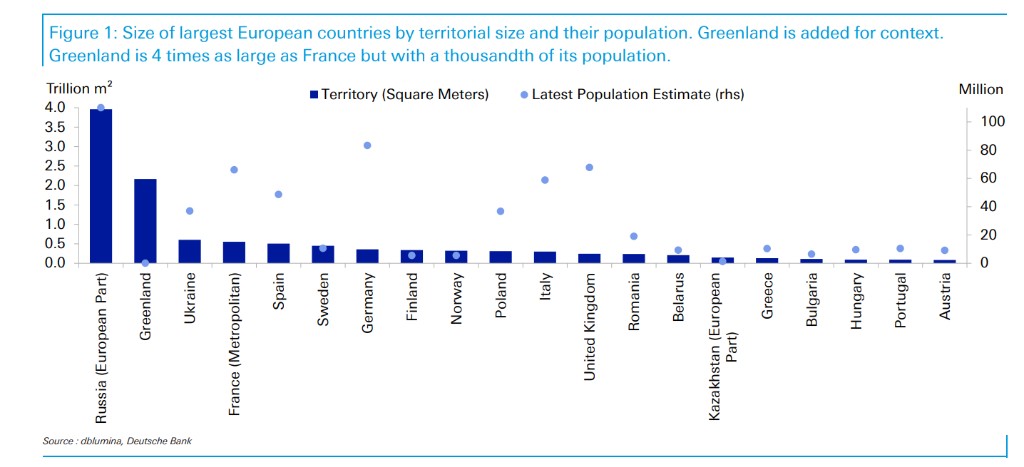
According to Global Market Report, senior U.S. officials JD Vance and Marco Rubio's meetings with high-level representatives from Denmark and Greenland failed to resolve core sovereignty disputes. This deadlock not only highlights political opposition but also means that investors must confront the increasingly imminent tail risks.
Strategic Asset Competition: The Deadly Temptation of Rare Earths and Trade Routes
Why is the U.S. willing to risk diplomatic rupture to control Greenland? Deutsche Bank's research report clearly identifies three driving factors: national security, critical minerals, and Arctic trade routes.
From a strategic perspective, Greenland offers unique Arctic advantages to the U.S. and its competitors. The island not only hosts a key missile tracking system located at Pituffik but is also adjacent to emerging Arctic maritime routes. It is predicted that in the coming decades, these routes could reduce shipping times from Asia to Europe by up to 50%, fundamentally reshaping the global logistics landscape. Additionally, Greenland possesses vast rare earth reserves, estimated at up to 1.5 million tonnes. In the context of the U.S. striving to reduce its dependence on China's dominance in mineral resources, this resource reserve constitutes another irresistible incentive.
Deutsche Bank's Scenarios: Four Paths to Determine the Future
In the face of such a complex situation, Deutsche Bank's Head of Geopolitical Research, Helen Belopolsky, has outlined four possible scenarios for Greenland's future direction, which will directly determine the pricing of market risks:
The first is a negotiated security agreement. This is a relatively mild path that focuses on strengthening the U.S. security presence on the island through diplomatic means, without touching on fundamental sovereignty changes.
The second is long-term leasing by the United States. This scenario is akin to a long-term geopolitical real estate transaction, where the U.S. gains actual control through leasing to circumvent the legal and political obstacles of direct sovereignty transfer.
The third is a free association agreement. This resembles the current relationship model between the U.S. and its Pacific territories, where Greenland would gain some form of semi-independent status but would be constrained by the U.S. in defense and foreign affairs.
The final scenario, which investors must be wary of as a "tail risk," is military coercion. Given recent U.S. actions in Iran and Venezuela, if diplomatic avenues are completely blocked, military intervention is not entirely out of the question.
Deutsche Bank warns that any form of "kinetic escalation" could trigger a serious crisis within NATO, threaten transatlantic economic relations, and cause severe turbulence in the markets. This volatility would not be limited to the foreign exchange market but would directly impact energy, shipping, and key mineral stocks
