


Single-chip power exceeds 1 kilowatt, data centers are brewing a quiet revolution of 800V

CITIC Construction Investment pointed out that the power breakthrough of AI chips is driving the transformation of data center power supplies towards an 800V high-voltage direct current architecture, which is an industrial chain revolution involving the reconstruction of the power supply system. Investment should focus on high-barrier segments, including 800V power hosts, solid-state circuit breakers that solve direct current arc extinction, and core incremental components such as third-generation semiconductors
CITIC Construction Investment believes that as the power of a single AI chip breaks through the 1000W barrier, traditional power architectures are nearing their physical limits. To support future GW-level computing power demands, data center power supplies are at a critical point of transitioning from AC to 800V high-voltage direct current (HVDC). This is not just an upgrade in voltage levels, but a supply chain revolution involving architectural reconstruction.
On January 15th, CITIC Construction Investment pointed out in its latest report that investors should focus on the segments of this transformation where value is most concentrated and technological barriers are highest, especially those that can provide 800V power supply units (PSU/HVDC/SST), as well as essential incremental components such as solid-state circuit breakers and third-generation semiconductors (SiC/GaN) that are crucial for solving the problem of DC arc extinction. For investors, this is not only a technological iteration but also a redistribution of real industrial dividends.
Physical Limits Force Architectural Reconstruction: From "Coke Bottle" to "Lipstick" Slimming Revolution
CITIC Construction Investment pointed out the fundamental driving force behind this power revolution: the exponential growth of computing power density.
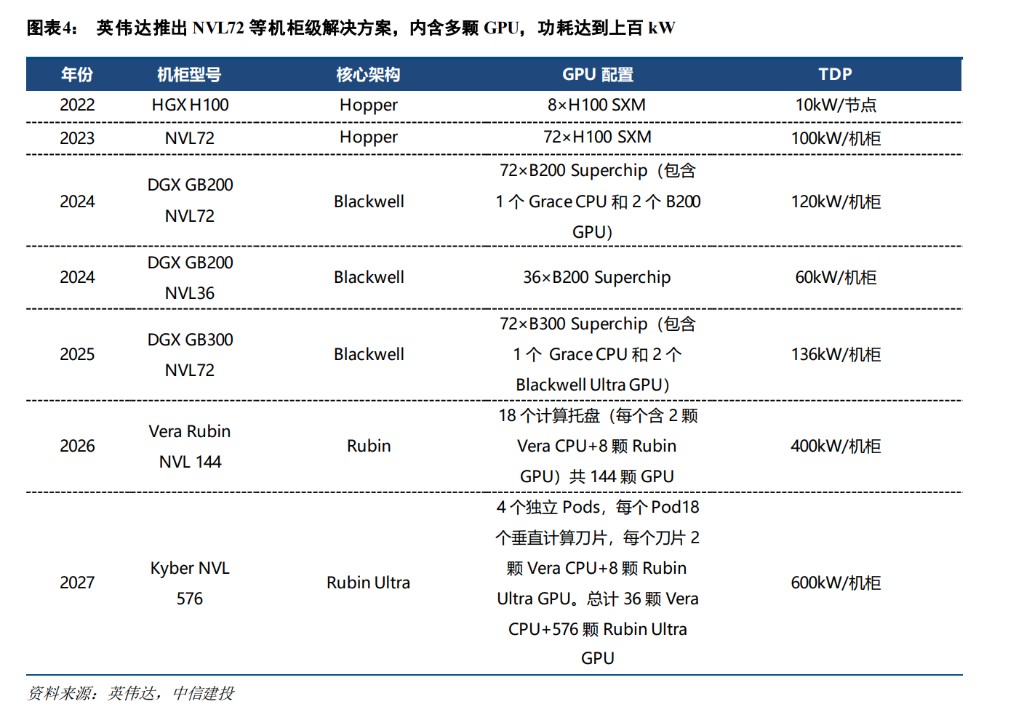
With the power of chip units represented by NVIDIA's Blackwell B200 breaking through 1000W, and the potential further enhancement of the future Rubin architecture, the power per rack is moving towards the MW (megawatt) level. The report analyzes that the existing 415V AC power supply system is already struggling to cope with such terrifying power densities. 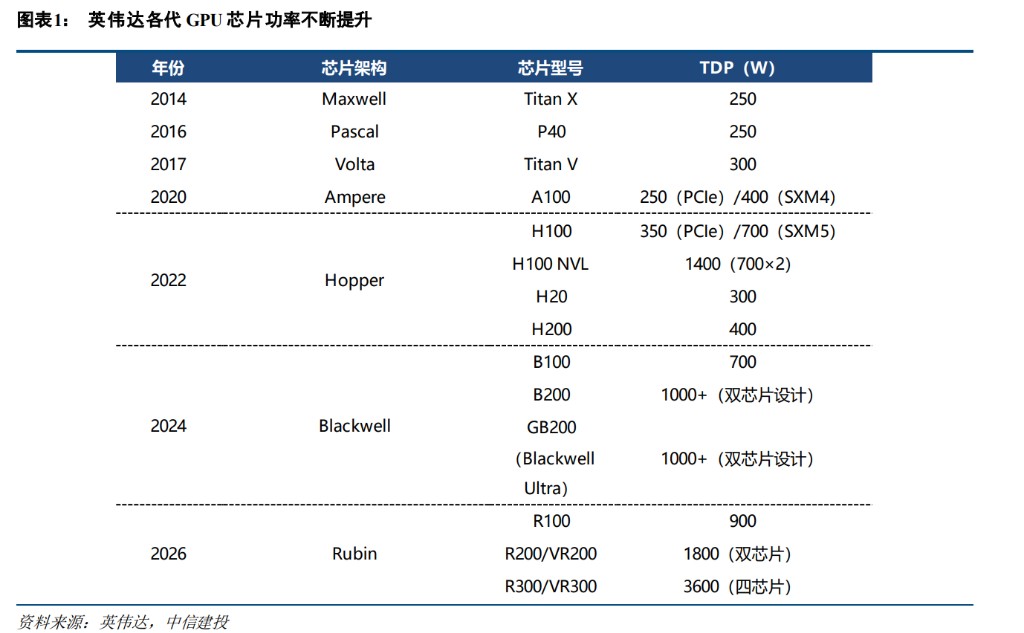
The report cites striking data comparisons to illustrate the necessity of upgrading to 800V: when transmitting power at the 500kW level, if the traditional 50V voltage level is used, the required copper busbar diameter would reach an astonishing 56mm, comparable to a coke bottle, which is completely unacceptable in the space-constrained server cabinets. However, once the voltage is raised to ±400V (i.e., 800V system), the wire diameter will plummet to 14mm, only equivalent to the thickness of a lipstick.
The report believes that this significant advantage at the physical level makes high-voltage and direct current no longer an option, but an inevitable direction for the development of data centers. By using 800V direct current power supply, not only is the use of copper significantly reduced, but the power supply structure is also simplified, making it possible to transmit greater power.
NVIDIA White Paper Sets the Tone: The Ultimate Path of Sidecar and SST
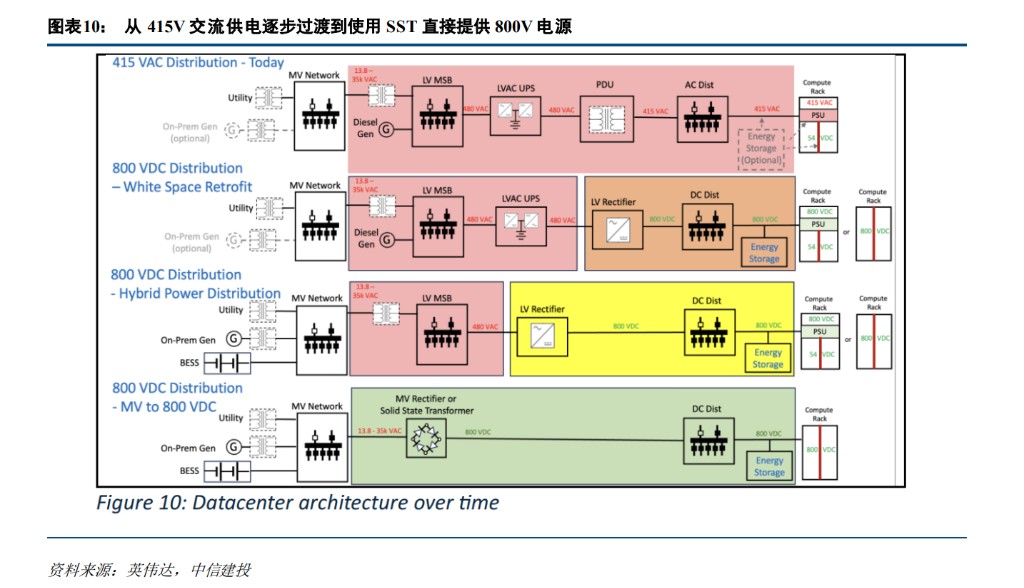
The report delves into NVIDIA's released white paper on 800V power supply, believing that it establishes a clear evolutionary path for the industry. The roadmap planned by NVIDIA shows that the power supply scheme will evolve from "AC" to "800V DC (transition)", then to "800V DC (Sidecar scheme)", and ultimately evolve to the ultimate form of "solid-state transformer (SST)"
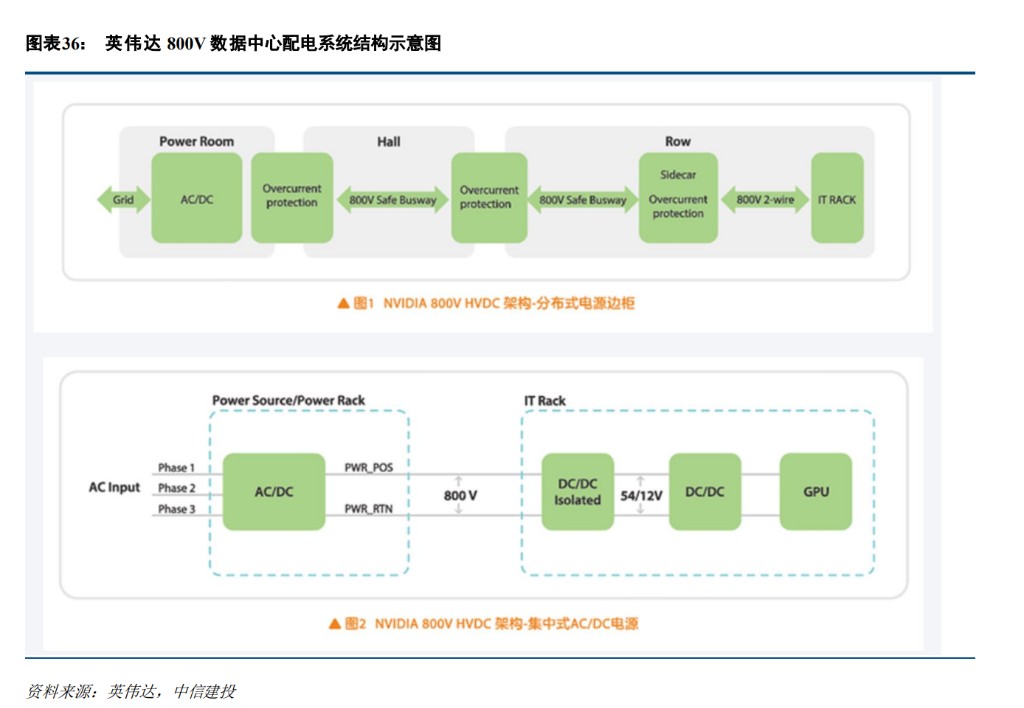
It is particularly noteworthy that the trend of "external power supply" is emerging. As power levels soar, the space occupied by power modules in racks is increasing significantly. If traditional solutions continue to be adopted, power supplies will occupy nearly half of the cabinet space, leading to a decrease in computing power density.
Therefore, NVIDIA and OCP (Open Compute Project) are inclined to separate the power supply, forming the so-called Sidecar solution. The report analyzes that this architectural change directly gives rise to a new hardware demand: HVDC hosts and SST (Solid State Transformer). In particular, SST is viewed in the report as the ultimate power supply solution, capable of directly converting medium-voltage AC from the grid to 800V DC. Although the technology is still in the pilot stage, its potential to save transformers and improve efficiency is enormous.
The Dividend of Hardware Upgrades: The Rise of 30kW Modules and Solid State Circuit Breakers
At the specific hardware level, the CITIC Securities report emphasizes the leap in power density of PSUs (Power Supply Units). To adapt to the 800V architecture, the single-unit power of PSUs is evolving from the current 3kW/5.5kW to the 30kW level. This process greatly enhances the technical barriers and value, as achieving such high power conversion in a limited volume requires extensive use of third-generation wide bandgap semiconductor devices such as SiC (Silicon Carbide) and GaN (Gallium Nitride).
Additionally, the report specifically highlights a key new incremental component: solid state circuit breakers. Due to the absence of zero-crossing in DC, traditional mechanical switches generate difficult-to-extinguish arcs when interrupting high-voltage DC, posing significant safety hazards.
NVIDIA explicitly proposes the use of solid state circuit breakers for protection in its 800V white paper, utilizing semiconductor devices to achieve microsecond-level rapid shutdown and arc-free interruption. The report believes this is the best choice to address the challenges of interrupting HVDC and is a necessary component in the future safety system of data centers.
Investment Barometer: Locking in High Barriers and Core Incrementals
Based on the above industrial logic, the CITIC Securities report recommends that investors closely track targets that align with the trends of 800V high voltage and DC.
The report believes that investment opportunities are mainly concentrated in four major directions: first, the AIDC power host segment, which has the highest concentration of value and the highest technical barriers, including PSU, HVDC, and SST equipment; second, core components born to address the pain points of high-voltage DC, particularly solid state circuit breakers, cabinet-level DC/DC, and electronic fuses as new incremental components; Finally, the underlying materials that support the entire high power density realization—third-generation semiconductors (GaN, SiC).
The report firmly believes that companies capable of providing high-voltage direct current solutions will achieve significant alpha returns in this round of energy revolution driven by AI computing power.
