


Morgan Stanley has delayed its expectation for the first interest rate cut this year, stating that the Federal Reserve's focus has shifted from employment to inflation

Morgan Stanley has pushed back its expectations for the Federal Reserve's interest rate cuts this year from January and April to June and September, each by 25 basis points. The core logic has shifted from "stabilizing employment" to "fighting inflation," and policy actions need to wait until the full impact of tariffs is realized and inflation clearly returns to the 2% target. The bank maintains its forecast for the terminal rate at 3.0%-3.25%
Morgan Stanley has delayed its expectations for the Federal Reserve's first interest rate cut from the previously predicted January and April to June and September. The bank believes that the core logic for rate cuts has shifted from the labor market to inflation.
According to the Wind Trading Desk, on January 12, Morgan Stanley stated in its Global Macro Forum report that, given the recent improvement in economic momentum and the decline in unemployment rates, the urgency for the Federal Reserve to stabilize the labor market has decreased. Future policy actions will depend on two key signals: the comprehensive impact of tariff adjustments by the Trump administration on prices, and whether inflation data can show a clear downward trend.
The report suggests that the interest rate market needs to reprice overly optimistic expectations for rate cuts. Although the current market is close to its baseline forecast, it is insufficiently pricing in tail risks such as inflation stickiness. The bank maintains its forecast for the Federal Reserve's ultimate interest rate target range at 3.0%-3.25%.
“Employment-driven” shifts to “Inflation-driven”
The report points out that, given the recent improvement in economic momentum and the decline in unemployment rates (the labor force participation rate of foreign-born workers is also accelerating), the urgency for the Federal Reserve to implement emergency rate cuts to stabilize the labor market has significantly decreased. The policy focus has now shifted to inflation, with the specific path being: first waiting for the comprehensive price transmission effects of the tariffs to be completed, and then confirming that inflation shows a clear and sustainable trend back to the 2% target before initiating a rate cut cycle.
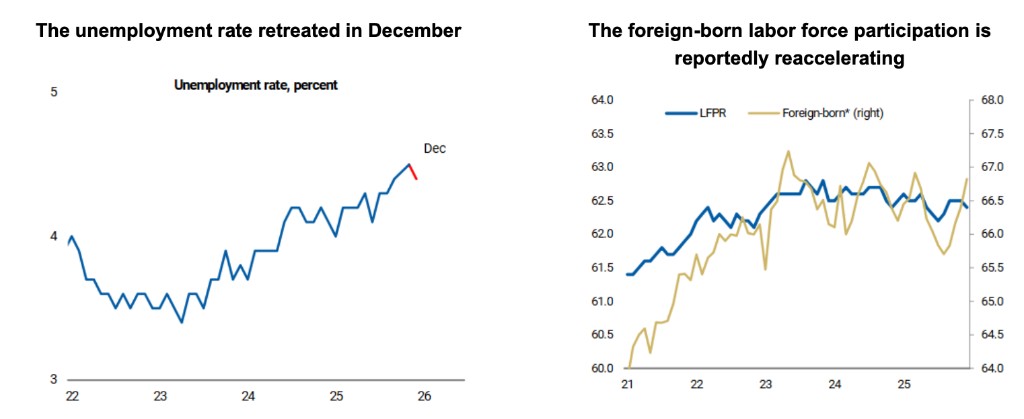
Morgan Stanley expects that this process of inflation slowdown will begin in the second quarter of 2026, and therefore has adjusted the expected timing for the first rate cut from the original January and April to June and September, with each cut still being 25 basis points.
Overall, the report does not change the directional judgment that policy will ultimately shift towards easing. For the market, this means that the trading logic based on a "rapid policy shift" at the beginning of the year needs to be recalibrated, and the core driving factors for asset pricing will once again return to the evolution of inflation data itself. In the context of a resilient labor market and inflation not yet fully under control, the Federal Reserve will demonstrate greater policy patience.
Market pricing is highly aligned with Morgan Stanley's baseline scenario but still underestimates tail risks
The current market pricing for the terminal policy rate (around 3.11%) is highly consistent with the probability-weighted path derived by Morgan Stanley economists through scenario analysis (3.22%). However, the bank believes that there is still room for downward adjustment in the market's expectations for the bottom of interest rates.
The current market pricing structure reflects that investors' probability distribution for various macroeconomic scenarios is: baseline scenario 70%, demand upside 5%, productivity upside 18%, and mild recession only 7%. This distribution shows that the market is significantly underpricing tail risks such as economic slowdown or recession. Morgan Stanley believes that future pricing focus should tilt towards a more dovish path. From the perspective of term premium, the difference between the 10-year U.S. Treasury yield and the market-implied bottom of the policy rate has widened after the "Liberation Day" on April 2, 2025. As of the report's release, the model shows a term premium of 19.0 basis points, which is at the lower end of the volatility range following this event. The bank expects that the term premium will maintain a range-bound fluctuation pattern before key political events such as the renegotiation of the USMCA.
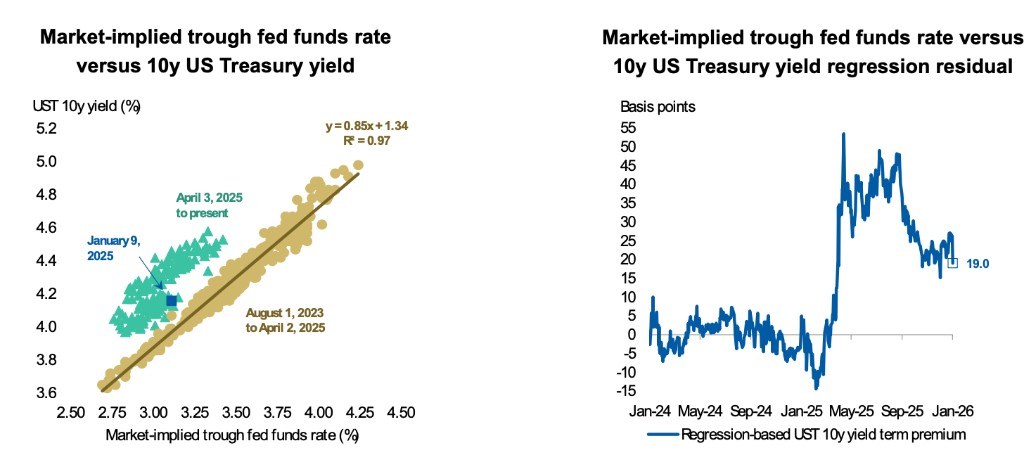
Overall, Morgan Stanley assesses that although the current market pricing is largely consistent with its baseline forecast, coverage of downside risks remains insufficient. As time goes on, if economic or inflation data shows unexpected changes, there is still a possibility for further downward adjustment in the market's pricing of the policy rate's lowest point, but this adjustment process is more likely to occur after mid-2026 rather than in the short term.
