


U.S. stock volatility is too cheap! Bloomberg strategists warn: be careful of "liquidation" at the 7000-point mark of the S&P

As the US stock market rushes towards 7,000 points, it has fallen into extreme complacency, with index volatility being severely underestimated. Analysts believe that the current short positions on volatility are extremely crowded, highly similar to the situation just before the crash in July 2024. With the CPI data this week and the January 16 options expiration date approaching, policy risks and geopolitical uncertainties could easily trigger a "volatility liquidation," leading to a chain reaction of high-level pullbacks in the market
The US stock market is currently trapped in a dangerous complacency, with the pricing level of implied volatility suggesting that investors have regarded US policy trends as "background noise." Although the S&P 500 index is making a push towards the 7,000-point mark, there is a serious misalignment between the extremely cheap index volatility and the increasingly accumulating policy risks, and the market is facing a "volatility liquidation" triggered by a short squeeze.
According to Bloomberg macro strategist Michael Ball, after the non-farm payroll data was released, despite the intensification of geopolitical and policy games, market volatility remains at extremely low levels. This valuation distortion has led to a crowded position in short volatility, and once a slight shock occurs, the market is likely to fall into a chain reaction of forced liquidations, a spike in the VIX index, and a rapid increase in stock correlations.
Current market sentiment is unusually optimistic, with the S&P 500 index reaching a historic high after the non-farm data. As investors' expectations for an economic re-acceleration heat up, funds are rotating from large-cap stocks to small-cap stocks, the Dow Jones Industrial Average, and equal-weighted S&P indices. However, this stock-picking strategy overlooks the structural risks from a macro perspective.
This fragile balance is facing multiple tests. With the upcoming release of CPI, PPI data, bank earnings reports, and the January 16 options expiration date (OPEX), the cheap index volatility could end at any time. Analysts believe that the current unilateral short volatility position structure is strikingly similar to the levels before the crash in July 2024, and the market is on the edge of a severe pullback.
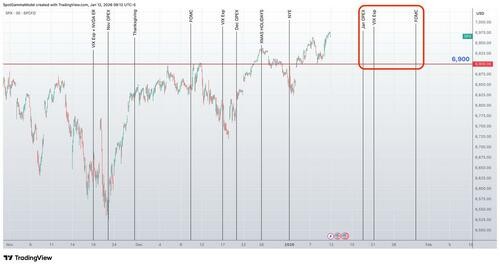
The "Options Gravity" and Complacency at the 7,000-point Threshold
The current optimistic sentiment in the market is significantly reflected in the options positions. According to SpotGamma, market makers hold a large number of long gamma positions in the S&P 500 index between 6,900 and 7,000 points. This technical position structure typically suppresses the intraday volatility of the market and effectively encourages the index to "melt up" in a slow and steady manner.
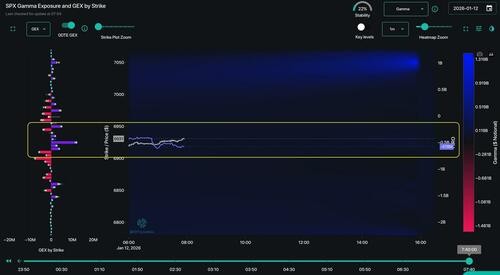
After the release of the non-farm data, the event-driven volatility premium quickly dissipated, and the Vanna effect (the impact of volatility changes on Delta) further enhanced the upward momentum. With a large number of open contracts concentrated at the 7,000-point strike price of the S&P 500 index, this level is exerting a strong market magnet effect before the monthly options expiration date on January 16, attracting the index towards it
Shorting Volatility Trades Become Crowded Again
However, beneath this calm surface lies structural risk. The trading strategy of shorting volatility is becoming crowded again, raising alarms among institutions. Research firm 22V points out that institutional asset management companies have undergone a dramatic reversal in their positions: from a net long position of about 40,000 VIX futures last August, they have significantly shifted to a net short position of about 40,000 last week.
Historical experience shows that such one-sided bets are often a precursor to market reversals. The last time positions exhibited such an extreme one-sided tendency was in July 2024, after which the VIX index surged in the following month. Currently, the VIX/VVIX ratio and tail risk indicators like TDEX have not issued strong pressure signals, and the coexistence of cheap index volatility with high individual stock implied volatility is a typical characteristic seen before past sell-offs. Once volatility suddenly erupts, it will force correlations to rise and quickly close this gap.
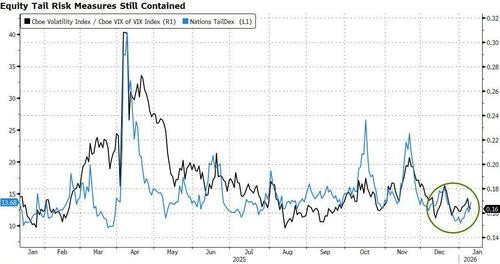
Policy Risks and Pricing Mismatches
Although market pricing reflects extreme complacency, the complexity of the macro environment has not diminished. The volatility drop following the non-farm data did not last long, and market focus quickly shifted back to policy risks. Current risks include the Department of Justice's scrutiny of Federal Reserve Chairman Jerome Powell, the White House's push for housing affordability plans, and government pressure on credit card pricing.
Additionally, this week's economic calendar is extremely packed, with Tuesday's CPI data, Wednesday's PPI data, bank earnings reports, and the subsequent options expiration day, each of which could serve as potential catalysts. Geopolitically, the uncertainty surrounding Iran is increasing the variables for energy prices and interest rate outlooks, which should lead to higher risk premiums in the stock market.
Michael Ball points out that implied volatility is currently at "basement" levels, creating a severe mismatch between reality and pricing, making the market highly susceptible to "reflexive squeezes," where even minor shocks could trigger a chain reaction, rapidly pushing up volatility levels
