CICC: The "narrative" and reality of deposit migration

The CICC report discusses the trend of deposit migration and market misinterpretations, pointing out that "massive" deposits maturing do not equate to all household savings, emphasizing the need to consider the impact of wealth management products. The report analyzes the high growth of household deposits from 2022 to 2023 and its reasons, suggesting that the concept of excess savings is more important, and predicts that household savings propensity will remain high in 2025, indicating that risk appetite has not significantly changed
The Narrative and Reality of Deposit Migration
In our report "What is the Potential for Household Deposit Migration?" from August 2025, we highlighted the trend of deposit migration. At the beginning of this year, the massive amount of deposits maturing and migration once again became a new "narrative" in the rising market. However, we observed that there are some common questions and even misunderstandings in the market regarding this, such as: What does "massive" deposit maturity mean? Why are market estimates so varied? Why does the "grand narrative" of migration not align with micro experiences? Where are the deposits migrating to? What are the similarities and differences between this round and previous ones? In this report, we explore these questions, particularly clarifying seven common misconceptions in the market.
1. Household Savings ≠ Deposits
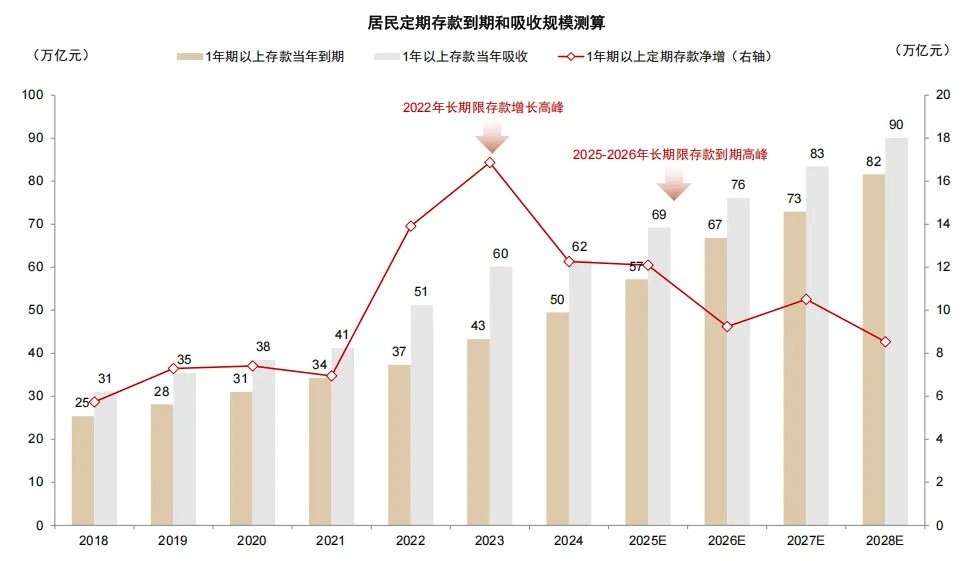
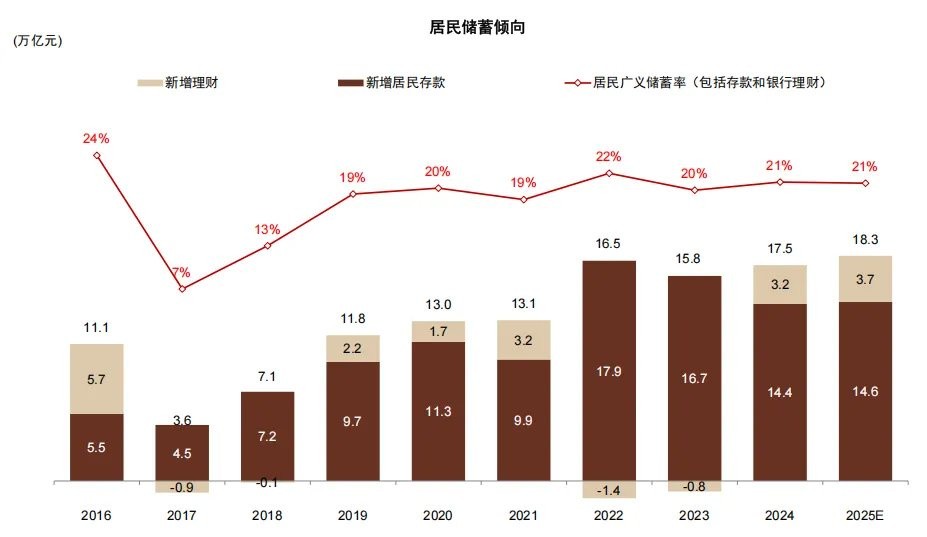
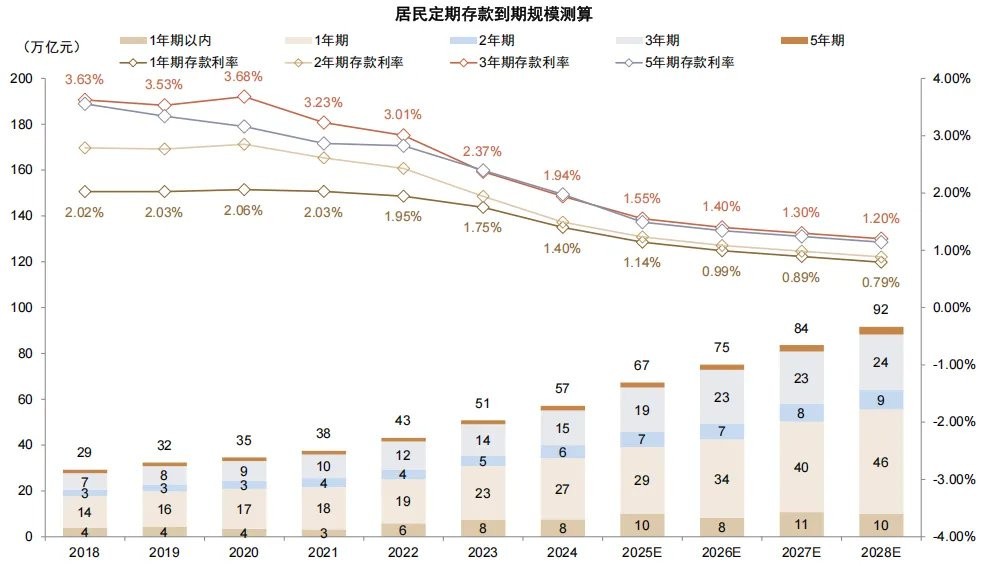
The background of the "massive" deposit maturity narrative. The market's discussion of "massive" deposit maturity can actually be traced back to the high growth of long-term household deposits in 2022-2023: during that time, the net increase in household deposits reached 28 trillion yuan over two years, resulting in about 5 trillion yuan of "excess deposits" compared to the level in 2021. This portion of deposits will gradually mature in 2025-2026. However, we believe that deposits are not the only form of household savings; household savings should also consider deposits and bank wealth management products. In fact, the high growth of deposits in 2022-2023 was mainly due to the reallocation of wealth management, as the rapid rise in bond market interest rates led to a "negative feedback" of net value retracement and redemptions in wealth management products. Therefore, we believe that this portion of "excess deposits" is similar in nature to wealth management products, primarily involving a shift in allocation among low-risk preference assets.
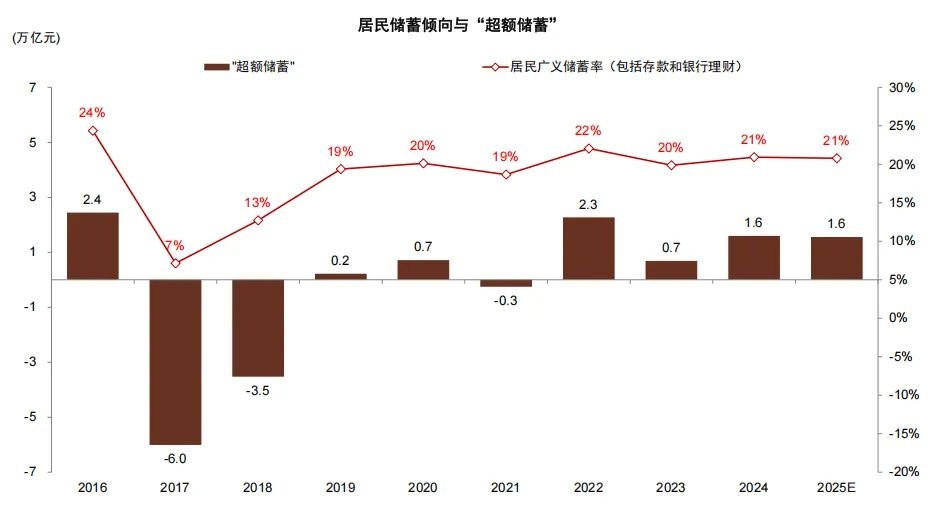
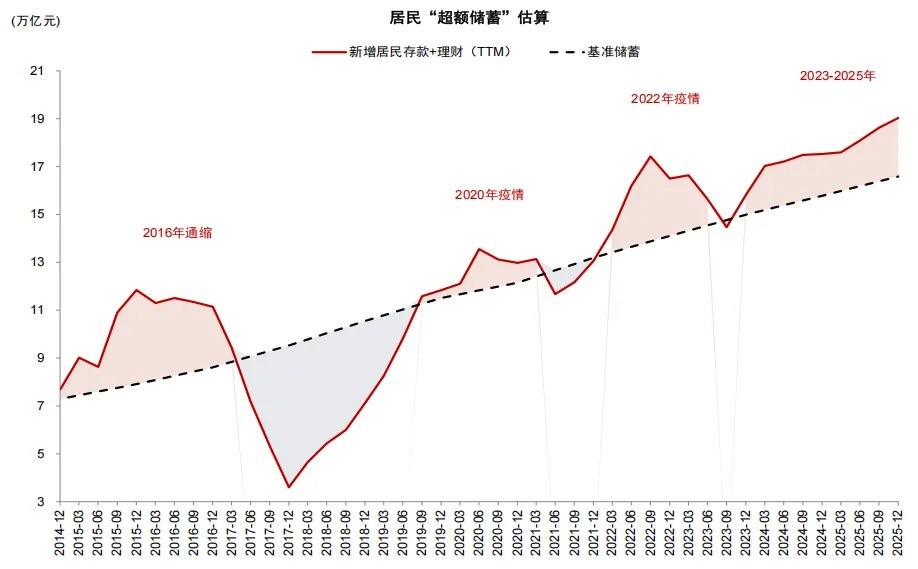
How to measure the potential for deposit migration? Compared to the market's focus on the narrative of deposit maturity, we believe that it is more critical to comprehensively consider "excess savings" from both household deposits and wealth management. We use the annual household savings/disposable income to calculate the savings rate, considering savings that exceed the long-term trend level as "excess savings." According to our calculations, from 2022 to 2025, households formed approximately 6 trillion yuan of excess savings, and the household savings tendency in 2025 remains around a high level of 21%, indicating that although the capital market is recovering, the marginal tendency for household investment and consumption has not significantly increased overall. Therefore, we believe that the current market narrative of "deposit migration" does not imply a substantial change in household risk preference, but rather reflects a marginal adjustment in asset allocation in a low-interest-rate environment.
Chart 1: Long-term household deposits maturing in 2026 stem from the high growth in 2022-2023

Note: Estimated based on the maturity date structure of deposits published by listed banks.
Source: Wind, CICC Research Department
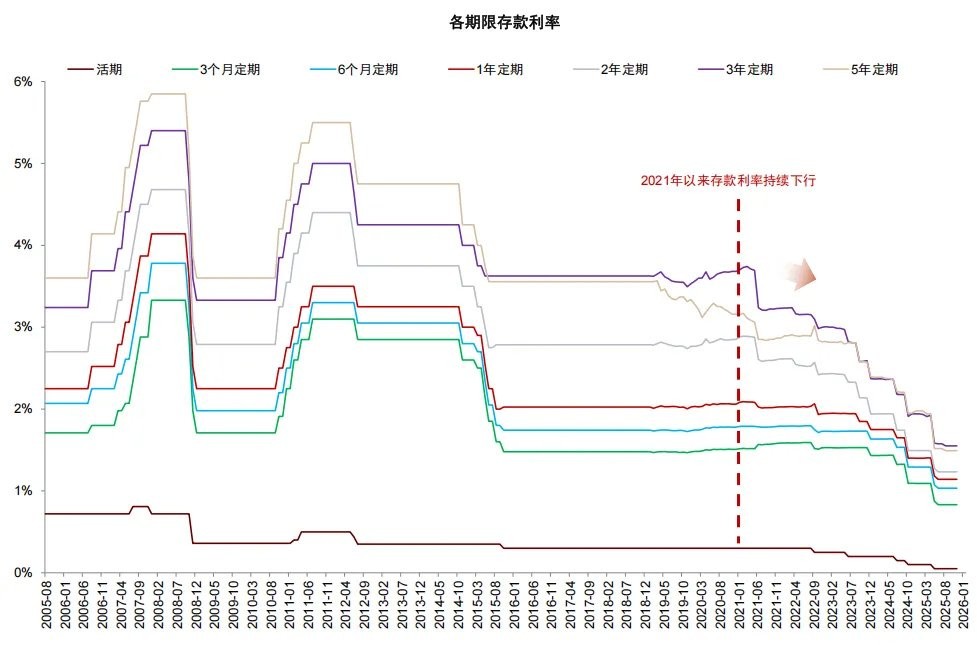
Chart 2: Since 2021, deposit rates have been lowered, with long-term deposit rates decreasing more

Data source: Rong 360, listed company announcements, Wind, CICC Research Department
Chart 3: The high growth portion of resident deposits in 2022-2023 comes from the redemption of financial products

Note: "Excess savings" is defined as new deposits and financial scale exceeding the historical average savings tendency.
Data source: Wind, CICC Research Department
Chart 4: Estimated cumulative excess savings of residents from 2022 to 2025 is about 6 trillion yuan

Note: "Excess savings" is defined as new deposits and financial scale exceeding the historical average savings tendency.
Data source: Wind, CICC Research Department
2. Remaining term of deposits ≠ Contract term of deposits
Market estimates of the scale and structure of maturing time deposits typically use data on deposit maturity dates from listed banks for calculations. However, we note that this calculation has two common biases:
-
Using all deposits rather than just resident deposits as the calculation scope. We believe that corporate and institutional deposits are mainly used for operational turnover and investment reserves, requiring liquidity and stable returns, with limited investment scope. Our calculations only include resident time deposits.
-
Using the maturity term structure of deposits as the contract term structure. Since some long-term deposits also mature in the short term, using the remaining term to estimate the maturity structure of deposits underestimates the proportion of long-term deposits.
Considering the above factors, we estimate that the scale of resident time deposits maturing in 2026 will be about 75 trillion yuan, of which deposits maturing in one year and above will be about 67 trillion yuan, higher than the market estimate of around 50 trillion yuan; we estimate that the growth of all resident time deposits and those maturing in one year and above in 2026 compared to 2025 will be 12% and 17% respectively, an increase of 800 billion yuan and 1 trillion yuan year-on-year.
Chart 5: We estimate that resident time deposits maturing in 2026 will be about 75 trillion yuan

Note: Estimated based on the maturity date structure of deposits published by listed banks.
Data source: Wind, CICC Research Department
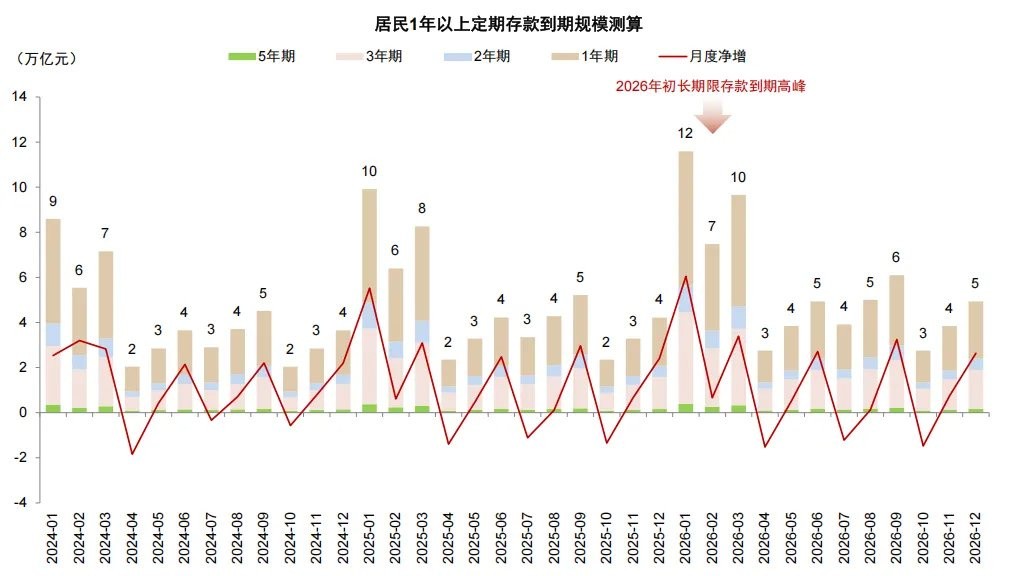
3. Net increase in deposits ≠ Deposit absorption Another common bias in the market's estimation of the maturity of time deposits comes from equating net increases in deposits with deposit absorption and maturity, thereby affecting the judgment of maturity rhythm. For example, in 2022, the net increase in residents' time deposits grew by 70% compared to 2021, but the scale of new deposit absorption only increased by 24% compared to 2021. Similarly, in the first quarter, the net increase in residents' time deposits accounted for about 60% of the annual total, but from the perspective of maturity rhythm, we estimate that the first quarter accounts for 40% of the annual total, while the second, third, and fourth quarters each account for about 20%, with a slightly higher proportion at the end of the quarter; we estimate that the scale of residents' one-year and above time deposits maturing in the first quarter of 2026 will be 29 trillion yuan, an increase of about 4 trillion yuan compared to the same period in 2025.
Chart 6: The maturity rhythm of deposits is more uniform compared to net increases in deposits

Note: Estimated based on data from listed banks; the 2026 data is a forecast.
Source: Announcements from listed companies, Wind, CICC Research Department
4. Deposit maturity ≠ Deposit migration
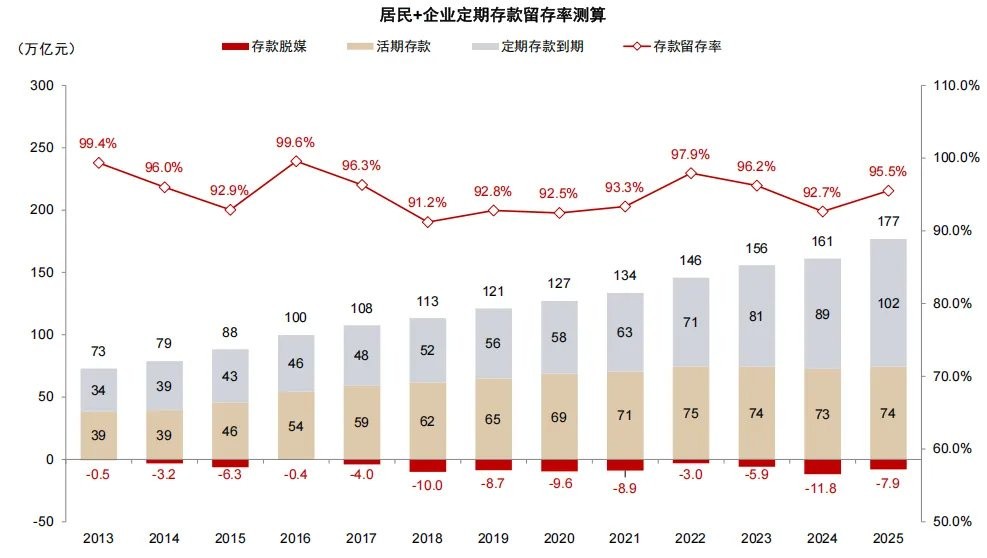
The maturity of deposits does not necessarily mean deposit migration; in fact, due to the stability of residents' risk preferences and the demand for liquidity management, the vast majority of deposits still remain within the banking system. We introduce the concept of a generalized deposit retention rate, calculated as 1 - deposit disintermediation / (maturity scale of deposits + balance of demand deposits) to measure the retention ratio of deposits in the banking system; financial disintermediation is estimated by the difference between the creation of real deposits and actual net increases, representing the net flow scale of real deposits to non-bank products. The results show that in most years, the bank deposit retention rate is above 90%. In certain years, such as 2024, due to the migration of deposits to wealth management products and bond funds, the deposit retention rate dropped to around 93%, while in 2025, the deposit retention rate remained high at 96%. In the past five years, the scale of financial disintermediation has fluctuated between 3 to 12 trillion yuan, representing the actual impact scale of "deposit migration" on the financial market.
Chart 7: We estimate that the actual deposit retention rate each year is above 90%

Note: Estimated based on data from listed banks; the 2025 data is a forecast; financial disintermediation is estimated by the difference between the creation of real deposits and actual net increases;
Source: Announcements from listed companies, Wind, CICC Research Department
5. Deposit migration ≠ Deposit entry into the market
The destinations for residents' deposit migration are also quite diverse, not just entering the stock market. We believe they mainly include the following aspects:
-
Consumption: This is the primary destination for residents' deposits, estimating that in 2025, residents' disposable income will be 61 trillion yuan, with consumption expenditure at 53 trillion yuan [1], accounting for about 68% of consumption, with residents' deposits flowing into the corporate sector or returning to the residents' sector through consumption;
-
Home Purchase: From January to November 2025, the national sales of new residential properties are estimated to be around 7 trillion yuan, plus the sales of second-hand houses (accounting for 45%[2]) are about 12 trillion yuan, estimating that cash payments are approximately 7 trillion yuan;
-
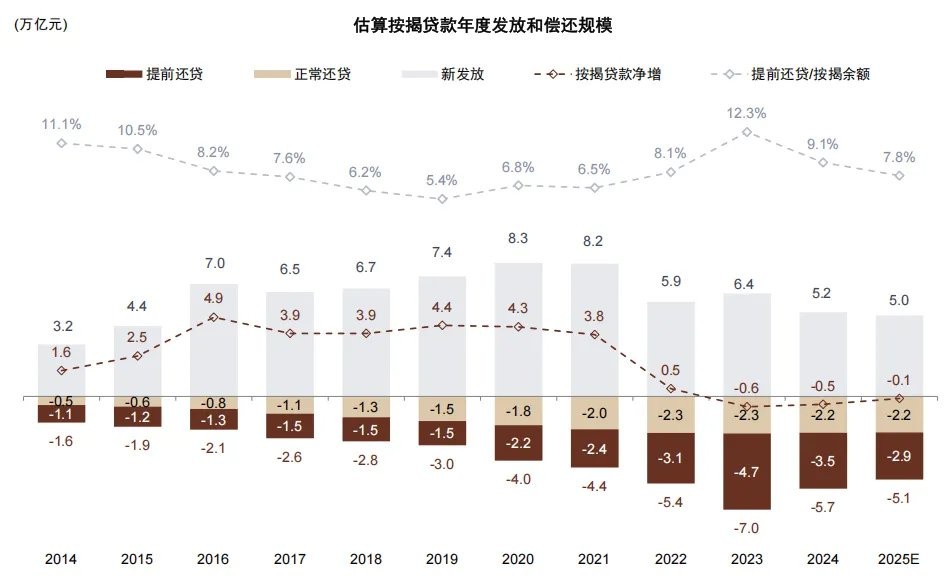
Loan Repayment: We estimate that in 2025, residents will repay about 5 trillion yuan in housing loans, of which early repayments will be 3 trillion yuan;
Chart 8: We estimate that the scale of housing loan repayment by residents in 2025 will be about 5 trillion yuan

Note: The year 2025 is forecast data, and the scale of mortgage issuance and repayment is estimated based on housing sales (including second-hand houses), average down payment ratios, changes in mortgage loan balances, and other data.
Source: Wind, CICC Research Department
-
Bank Wealth Management: Similar to fixed-term deposits, with slightly higher returns but some volatility. Fixed-income wealth management products have yielded around 2.0% over the past year, while cash management wealth products have good liquidity but a yield of only about 1.3%. The net increase in the scale of bank wealth management products in 2025 is about 3.7 trillion yuan;
-
Insurance: After the regulatory standardization of "universal insurance" in September 2016, high-yield, high-liquidity insurance products have basically exited the market. Currently, mainstream life insurance products have a guaranteed yield of about 1.75% plus a demonstration rate of 3.5%-3.75% (affected by the investment capabilities of insurance companies), with yields higher than deposits but lower liquidity, and early withdrawals may result in loss of principal. The cumulative life insurance income in the first 11 months of 2025 is approximately 3.4 trillion yuan.
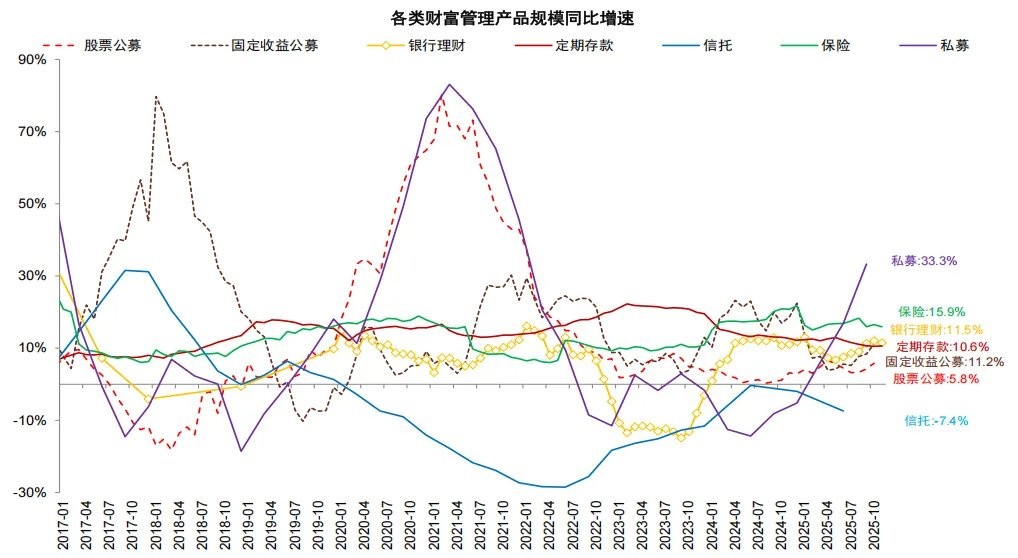
Chart 9: The growth rate of fixed-income financial products declines in 2025, while the growth rate of equity financial products rebounds

Note: The scale of fixed-income and equity public funds is based on shares; private equity only includes securities investment funds; trust products include real estate and infrastructure funds.
Source: Wind, People's Bank of China, Financial Regulatory Administration, China Wealth Management Network, Trust Industry Association, Fund Industry Association, CICC Research Department
-
Public Equity Funds: They have professional investment advantages but are highly volatile. In 2025, the shares of equity-oriented stock funds decreased by 160 billion shares, while the scale of passive index funds increased by 600 billion shares, reflecting a trend towards indexation.
-
Private Equity Funds: In 2025, the scale of securities investment private equity funds grew by 1.8 trillion yuan, making it the fastest-growing category in wealth management. Some quantitative private equity funds can achieve both lower drawdowns and higher returns under market-neutral strategies, and the returns and volatility of index-enhanced strategies typically outperform the market, but the investment threshold is high, suitable for high-net-worth and risk-tolerant investors
-
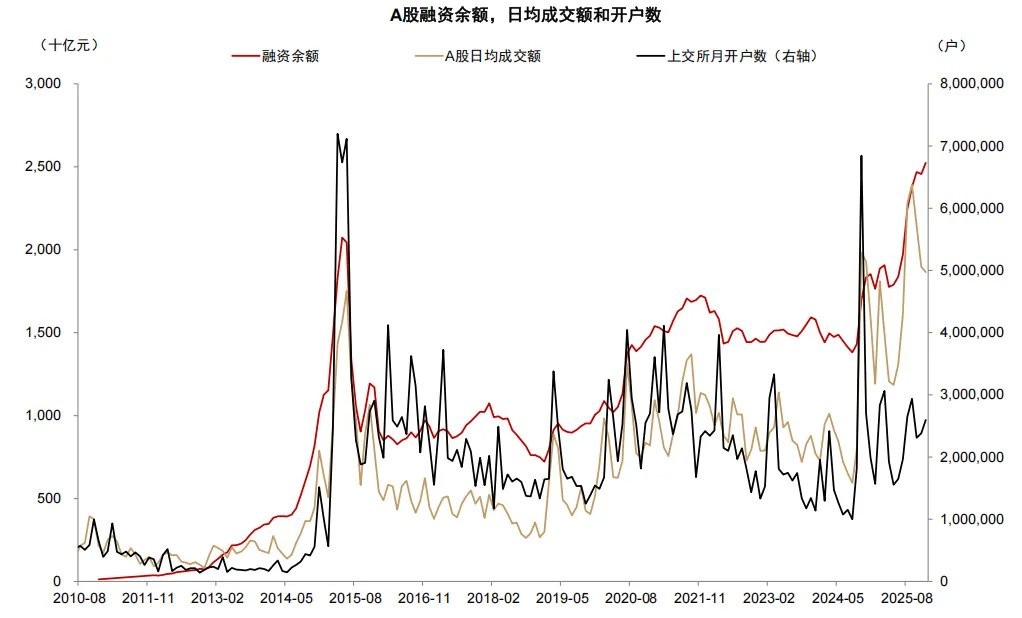
Stock Market: The potential for returns is large, but the volatility is high, making it suitable for high-risk tolerant investors. In the first three quarters of 2025, the margin of securities firms increased by approximately 1 trillion yuan (including institutional funds). Although the financing balance and trading volume in the stock market have significantly increased since September 2024, the growth in the number of new accounts is not obvious, indicating that the participation of residents in the market may not be widespread.
Chart 10: The financing balance and trading volume in the stock market have significantly increased, but the growth in the number of new accounts is not obvious.

Source: Wind, CICC Research Department
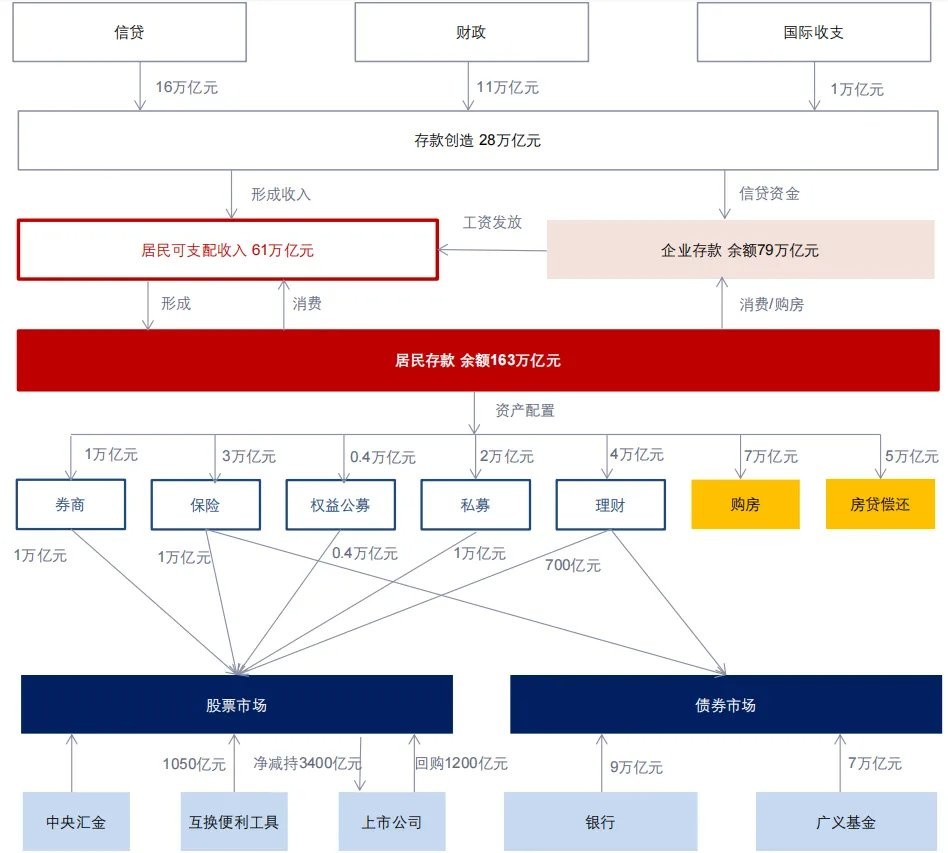
In summary, the main destinations for the 160 trillion yuan in household deposits each year are consumption, home purchases, and loan repayments, with only about 6% of deposits allocated to financial assets each year [3]. This allocation is primarily focused on low-risk financial management and insurance products. Based on the estimated new margin of securities firms, the funds entering the market account for less than 1% of deposits; the categories of financial assets that are growing rapidly mainly include private equity funds, insurance, and bank wealth management, reflecting that the main subjects of asset reallocation are high-net-worth investors with a higher risk appetite, while the movement of deposits from the general public into the market is still not evident.
Chart 11: Analysis of the channels through which household deposits flow into the stock market

Note: The values indicated by the arrows refer to flow data; deposit creation data is for December 2024 - November 2025; deposit balance data is as of November 2025; mortgage repayments and home purchases use estimated data for 2025; deposits entering securities firms use margin data for the first three quarters of 2025; public fund inflows use the growth data of equity funds; premium income includes only life insurance, assuming a 30% inflow into equities; private equity funds assume 90% enter the stock market.
Source: Wind, People's Bank of China, Financial Regulatory Administration, China Wealth Management Network, Trust Industry Association, Fund Industry Association, CICC Research Department
6. Non-bank Deposit Growth ≠ Deposits Entering the Market
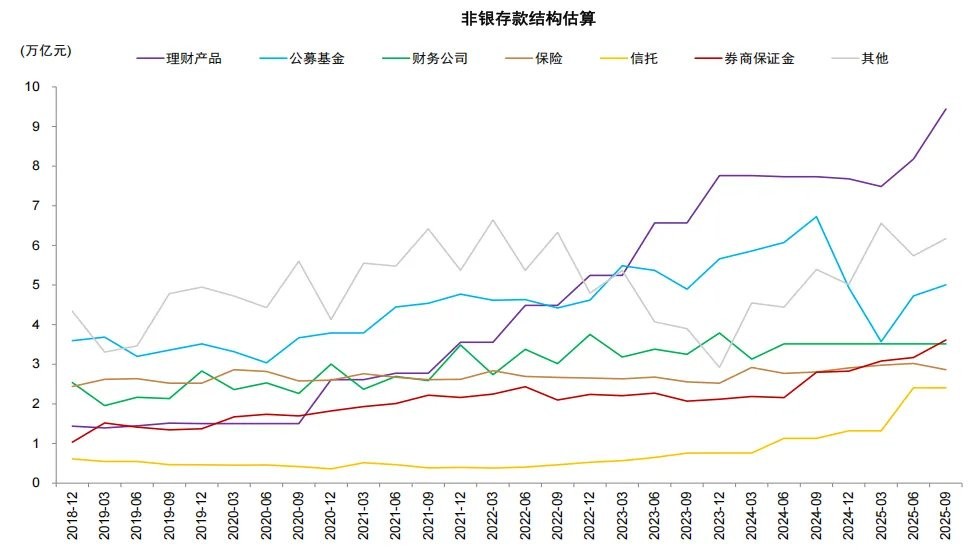
Another commonly used market indicator for observing the movement of deposits into the stock market is the growth of non-bank deposits. We observe that the growth of non-bank deposits correlates with stock market performance, but they do not move in lockstep, mainly due to other interfering factors affecting non-bank deposits. As of the third quarter of 2025, the margin of listed securities firms accounted for only about 11% of non-bank deposits, with the highest proportion of institutions in non-bank deposits being bank wealth management (29%), public funds (15%), finance companies (11%), and insurance (9%); the main contributor to the growth of non-bank deposits in the first three quarters of 2025 was bank wealth management (37%), rather than securities firm margins, primarily due to a preference for stable income interbank deposits in a volatile bond market environment. Nevertheless, non-bank deposits, as a high-frequency indicator for monitoring the movement of deposits, still hold reference value, but it is necessary to distinguish their influencing factors Chart 12: Recent increase in non-bank deposits mainly due to wealth management and public fund allocation

Source: Public company announcements, Financial Regulatory Administration, Trust Industry Association, China Wealth Management Network, Wind, CICC Research Department
7. 2026 ≠ 2017/2021
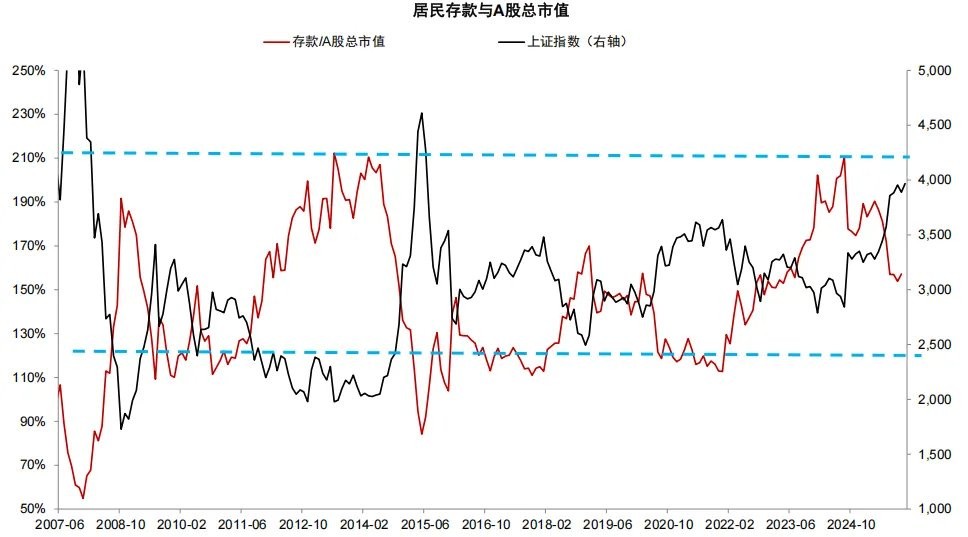
The market's expectation for the migration of deposits also comes from historical experience: 2017 and 2021 serve as typical examples of excessive savings consumption and the migration of deposits into the stock market. Can this be replicated in 2026? We believe that the similarity between 2026 and 2017/2021 lies in the fact that residents accumulated a considerable amount of excessive savings in a low-interest-rate environment, with the ratio of deposits to market value at a relatively high level.
Chart 13: In both 2017 and 2021, there was a phenomenon of residents' excessive savings turning negative

Note: "Excessive savings" is defined as the new deposits and wealth management scale exceeding the historical average savings tendency (2016-2022)
Source: Wind, CICC Research Department
Chart 14: The high ratio of deposits to A-share market value lays the foundation for the migration of deposits

Source: Wind, Public company announcements, CICC Research Department
However, the main difference in this round compared to the previous two rounds lies in the different macro and liquidity environments:
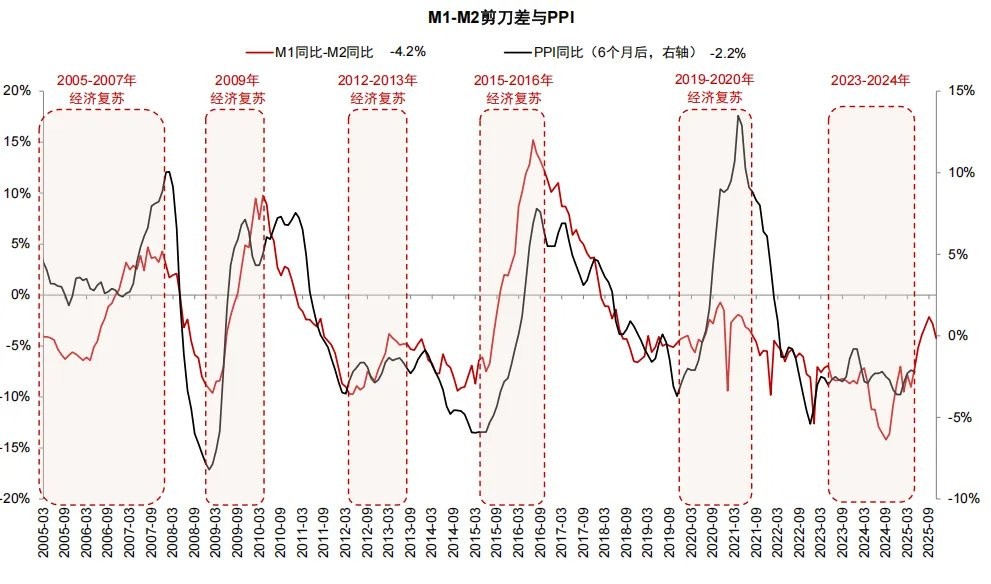
- In the previous two rounds, there was a significant rebound in PPI and improvement in corporate profits, while the current PPI growth has not yet exited the negative range;
Chart 15: The M1-M2 spread has recently declined

Note: M1 data uses the old caliber
Source: People's Bank of China, Wind, CICC Research Department
- In the previous two rounds, the real estate market showed a significant recovery, while the current real estate market still faces supply-demand contradictions;
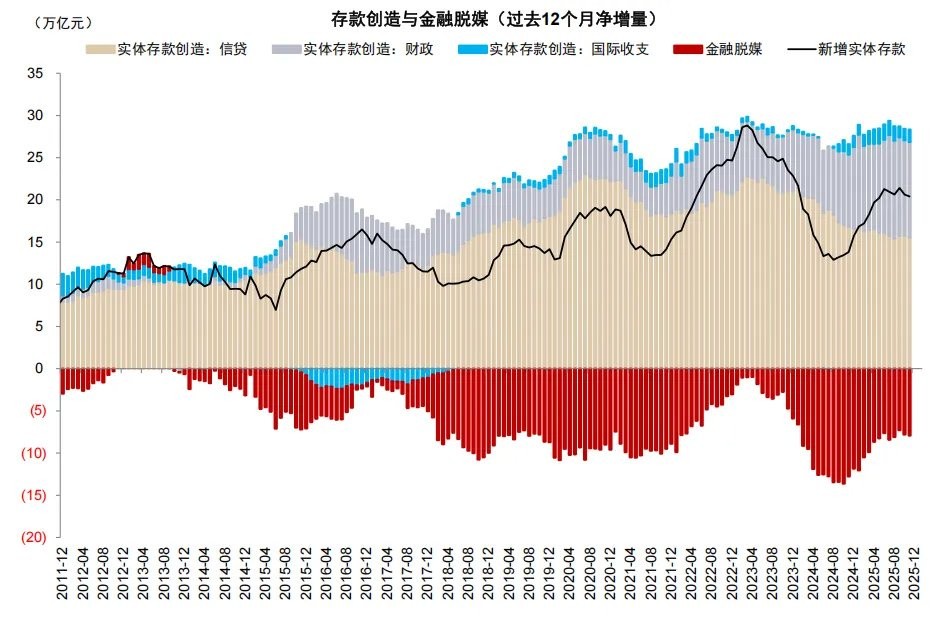
- In the previous two rounds, deposit creation mainly relied on credit contributions, with a high velocity of money circulation and a significant rebound in M1 growth. In this round, the contributions of fiscal input and corporate foreign exchange settlement to deposit creation have increased, leading to more formation of time deposit accumulation. M1 growth has rebounded but the absolute growth rate is still lower than that of time deposits.
Chart 16: In recent years, the contribution of fiscal and corporate foreign exchange settlement to deposit creation has increased, but credit contribution has declined

Data source: People's Bank of China, Wind, CICC Research Department
- In the previous two rounds of stock market rises, foreign capital was in a long-term inflow trend, while in this round, foreign capital has fluctuated and then returned, but a sustained trend has not yet fully formed.
Therefore, we believe that the current trend of "deposit migration" may be lower in momentum and risk appetite compared to 2017 and 2021. The improvement in stock market liquidity and the increase in risk appetite are more dependent on the macro environment and further recovery of the real estate market.
Deposit Migration: Insights from "Narrative" and Reality
In summary, we believe there is still a certain divergence between the market "narrative" of deposit migration and reality. Fundamentally, this "narrative" stems from the adjustment of residents' savings structure from wealth management to deposits from 2023 to 2025, and does not necessarily imply an increase in risk appetite. There is a reallocation demand for the 67 trillion yuan of medium- and long-term fixed deposits maturing, but historically, over 90% of deposits remain in the banking system. In terms of diversion, private equity funds and insurance are attractive to high-net-worth investors with a higher risk appetite and lower liquidity needs, but there are no obvious signs of large-scale deposits entering the market. In conclusion, compared to the "narrative" of the 67 trillion yuan "massive" deposits maturing, we believe the direction of the 6 trillion yuan "excess savings" is more critical. The increase in residents' risk appetite and the release of excess savings depend on further improvement in the macro and liquidity environment.
For banks, the migration of deposits to non-bank deposits means a change in liability form without loss. The cost of non-bank deposits is slightly lower than that of general deposits, but liquidity indicators are under pressure. In a low-interest-rate era, the cost of bank liabilities decreases but volatility increases, placing higher demands on banks' liquidity management.
Risk Warning and Disclaimer
The market has risks, and investment requires caution. This article does not constitute personal investment advice and does not take into account the specific investment goals, financial conditions, or needs of individual users. Users should consider whether any opinions, views, or conclusions in this article align with their specific circumstances. Investing based on this is at one's own risk