Big short Burry shorts Oracle: dislikes its positioning and financing

Famous investor Michael Burry disclosed through Substack that he holds put options on Oracle and has shorted the company over the past six months. He criticized Oracle's strategic positioning and aggressive investments, believing it is engaging in unnecessary heavy asset expansion in an attempt to compete with cloud giants. Burry pointed out that Oracle lacks the safety net of other tech giants and is a fragile "pure AI bubble vehicle." He believes that Oracle's stock price is highly dependent on a single narrative of "surging demand for AI cloud services."
The movie "The Big Short" prototype, well-known investor Michael Burry disclosed in a post on Substack after Friday's market close that he holds put options on Oracle and has directly shorted the company over the past six months. Burry had previously publicly shorted Nvidia and Palantir, and this bet against Oracle further reinforces his judgment that the current AI market is overvalued and in a serious bubble.
Burry bluntly criticized Oracle's current strategic positioning and its aggressive investment behavior. He believes that this veteran database software company is engaging in unnecessary heavy asset expansion in pursuit of the AI hotspot, attempting to compete with cloud giants like Amazon and Microsoft through expensive data center construction.
In response to reader questions, Burry sharply pointed out: “I don’t like its positioning, and I don’t like the investments it is making. It doesn’t need to do what it is currently doing; I don’t know why it is doing this. Maybe it’s out of vanity (Ego).”
“A Pure AI Bubble Vehicle”
The core of Burry's short logic is that he believes Oracle lacks the safety cushion that other tech giants have, making it a fragile "pure AI bubble vehicle."
When explaining why he chose to short Oracle instead of other tech giants, Burry elaborated on his selection criteria. He pointed out that companies like Microsoft, Alphabet (Google's parent company), and Meta have strong core business moats, and even if their AI investments fail, they can still survive and maintain dominance.
“If I short Meta, I am also shorting its dominance in social media and advertising.
If I short Alphabet, I am shorting various forms of Google Search, the Android system, and Waymo, etc.
If I short Microsoft, I am shorting the global office productivity SaaS giant,”
Burry wrote, “These big companies are not pure AI short candidates.”
In contrast, Oracle's current stock price support logic heavily relies on the single narrative of "surging demand for AI cloud services." Burry believes that giants like Microsoft and Google have the ability to control spending over time, absorb losses from overcapacity, and even write down assets while maintaining the profitability of their core businesses. “These three companies will not disappear,” he added. However, Oracle is undergoing a high-risk transformation while burdened with significant debt, and its margin for error is extremely low if AI demand falls short of expectations.
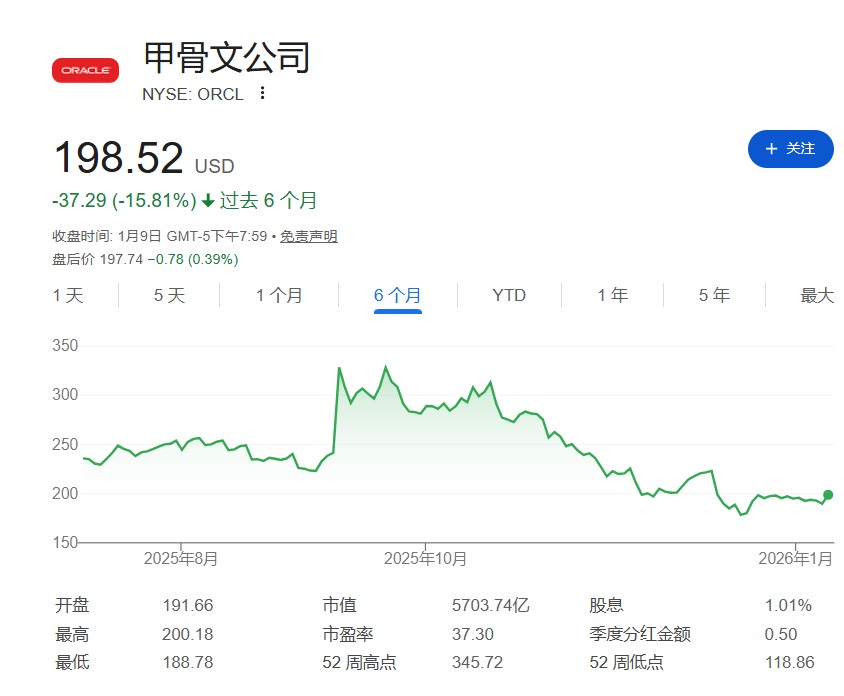
This move has had a direct impact on market sentiment. Oracle's stock price has experienced significant volatility over the past year; although it surged 36% in a single day last September due to expectations of soaring demand for AI cloud services, it has since fallen about 40% from its peak due to investor concerns over its expanding capital expenditures and debt burden. Burry's entry undoubtedly exacerbates market worries about the sustainability of Oracle's "high-leverage bet on the future" model

Debt Concerns Under Aggressive Transformation
Oracle's aggressive capital expenditures and deteriorating balance sheet are another key factor for Burry's bearish outlook.
In order to transform from a traditional database software vendor to a cloud infrastructure provider that can compete with AWS and Azure, Oracle has invested hundreds of billions of dollars in recent years to purchase Nvidia chips and build data centers. This shift from a "light asset" to a "heavy asset" model has resulted in the company taking on a heavy debt burden.
According to Bloomberg data, Oracle currently has approximately $95 billion in outstanding debt, making it one of the largest corporate bond issuers in the Bloomberg high-grade index, excluding the financial sector. The market had previously celebrated Oracle's optimistic forecasts for its cloud business, but with the continued rise in capital expenditures (CapEx) and questions about certain cloud transaction structures and debt expansion, investor enthusiasm is rapidly cooling.
Burry has clearly captured the vulnerabilities in this financial structure. He believes Oracle is engaging in a "needless" gamble, and this debt-driven expansion is particularly dangerous in a high-interest rate environment or during an industry downturn.
Continuing a Comprehensive Assault on the AI Bubble, Also Looking to Short OpenAI
Shorting Oracle is a reflection of Burry's skepticism towards the entire AI industry bubble.
In the article, Burry reiterated his broad skepticism about the speed and economic benefits of AI infrastructure development. He even stated that if OpenAI's valuation reaches $500 billion, he would choose to short it. In his view, the current AI craze is filled with mispricing and unsustainable prosperity.
Regarding his previous short target Nvidia, Burry described it as the "most concentrated" way to express a bearish view on AI trades. "Nvidia is also the most favored and least questioned company," he wrote, "so shorting it is cheap, and its put options are cheaper than those of other large short targets that are more questioned."
Burry has even specifically named "Tesla," calling its valuation absurd and its compensation plan detrimental to shareholders.
As of the time of publication, Oracle has not responded to Burry's comments and shorting actions.
Risk Warning and Disclaimer
The market has risks, and investment requires caution. This article does not constitute personal investment advice and does not take into account individual users' specific investment objectives, financial situations, or needs. Users should consider whether any opinions, views, or conclusions in this article align with their specific circumstances. Investing based on this is at one's own risk