


Waiting for non-farm payrolls and tariff rulings! U.S. stock futures remain flat, the U.S. dollar index breaks above 99, and base metals copper and aluminum continue to rise

On January 9th, most Asia-Pacific stock markets closed higher, European stock markets rose slightly, and U.S. stock futures remained flat as investors focused on non-farm payroll data and tariff decisions. The U.S. dollar index rose to 99, and base metals copper and aluminum continued to climb. Spot gold hovered around $4,470, and silver saw a slight increase. U.S. Treasury yields rose to 4.18%. The market expects approximately 70,000 new non-farm jobs in December, with the unemployment rate slightly decreasing to 4.5%
On January 9, most Asia-Pacific stock markets closed higher, European stock markets opened slightly higher, and the three major U.S. stock index futures were basically flat as investors awaited non-farm payroll data and the U.S. Supreme Court's tariff ruling. This will be one of the biggest tests for global stock markets since the rebound following the tariff-driven decline in April.
In commodities, spot gold hovered around the $4,470 mark, while silver saw a slight increase. Basic metals like copper and aluminum continued to rise on Friday, driven by supply concerns and optimistic demand.
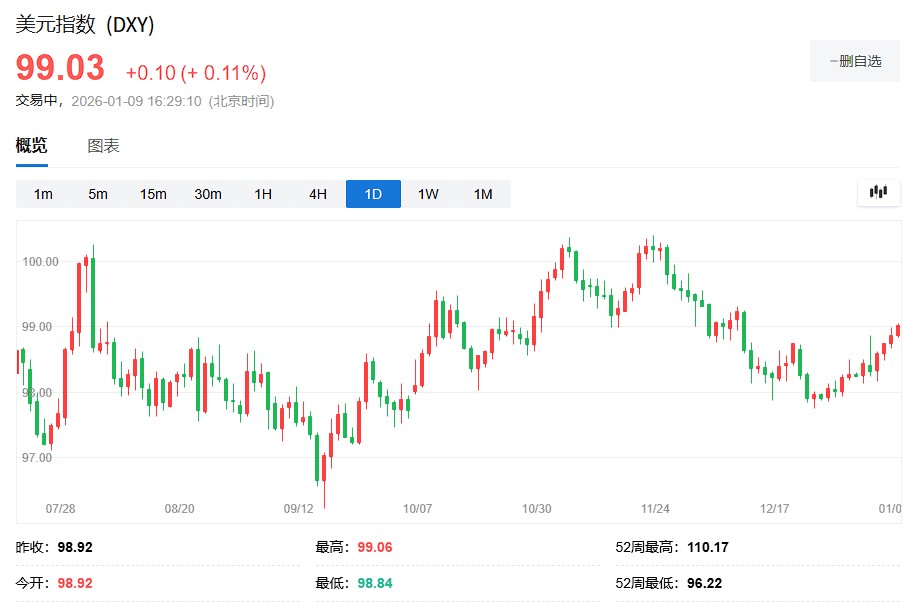
In the foreign exchange market, the U.S. dollar strengthened against all G10 currencies, poised to record its best weekly performance since November last year.
In the bond market, the yield on the 10-year U.S. Treasury rose by 1 basis point to 4.18%. The U.S. Treasury market has been stuck in a narrow range for a month, with the 10-year yield fluctuating between 4.1% and 4.2%, marking the narrowest monthly range since 2020.
Core Market Trends:
S&P 500 futures, Nasdaq 100 futures, and Dow Jones Industrial Average futures were nearly flat
MSCI Asia-Pacific Index rose 0.2%, MSCI Emerging Markets Index was nearly flat;
The U.S. Dollar Index rose 0.1%, peaking at the 99 mark, the euro was nearly flat at $1.1651, and the yen fell 0.3% to 1 dollar to 157.38 yen;
The yield on the 10-year U.S. Treasury was nearly flat at 4.18%;
The yield on the UK 10-year government bond fell by 1 basis point to 4.40%;
The yield on the Japanese 10-year government bond rose by 1.5 basis points to 2.090%;
Spot gold was nearly flat at $4,474.75 per ounce, and spot silver rose 0.84% to $77.66 per ounce;
London copper futures rose over 1% to $12,866 per ton, and London aluminum also rose over 1% to $3,130 per ton;
Bitcoin fell 0.2% to $90,994.85, while Ethereum rose 0.1% to $3,120.83.
According to an article from Wall Street Insight, the current market consensus expects about 70,000 new non-farm jobs in December, with the unemployment rate expected to slightly decrease to 4.5%. The money market currently anticipates that the Federal Reserve will cut interest rates at least twice by 2026. Additionally, the Supreme Court is expected to rule on most of Trump's tariff policies as early as Friday.
Nick Twidale, Chief Market Analyst at AT Global Markets, stated:
"The market is clearly showing volatility in the face of tonight's U.S. employment data and concerns over the Supreme Court ruling, which will dominate short-term sentiment. The market is generally cautiously optimistic, but we need geopolitical stability and more information from the U.S. after the government shutdown has led to data ambiguity."
US Stock Futures Flat
On Friday, US stock futures were basically flat, while on Thursday's trading, investors shifted from technology stocks to other sectors. The tech-heavy Nasdaq Composite Index fell 0.4%, dragged down by declines in the stock prices of Nvidia, Palantir, and Broadcom.

Vishnu Varathan, Head of Macro Research at Mizuho Securities Asia (excluding Japan), wrote in a report: "The market is in a cautious mode ahead of the non-farm payroll data and the Supreme Court's potential ruling on 'reciprocal tariffs'."
Ohsung Kwon, Chief Equity Strategist at Wells Fargo, stated: "Companies are taking a wait-and-see approach regarding the direction of tariffs before they start replenishing inventories. We may have a ruling on Friday. I believe that after that, companies may begin restocking again, which will kick off the manufacturing cycle."
The stock market is still expected to record gains this week. The S&P 500 index has risen about 0.9% so far this week, while the Dow Jones and Nasdaq have increased by approximately 1.8% and 1.1%, respectively.
On Thursday, Trump stated that he is directing the purchase of $200 billion in mortgage bonds to lower housing costs. This move boosted mortgage bonds, and the stock prices of US mortgage lenders soared. There are currently about $9 trillion in agency mortgage bonds in the market.
Bloomberg's strategist team noted that Trump's willingness to directly intervene in business is increasing, which could weaken momentum in the stock and bond markets and pose potential resistance to global markets. Unless the pace of presidential intervention slows, US assets are unlikely to rise decisively.
Copper and Aluminum Lead Base Metals
Base metal prices continued to rise on Friday, with major varieties such as copper and aluminum increasing by more than 1%. The sector maintained a strong rebound driven by concerns over tightening supply and growing investor enthusiasm for commodities.
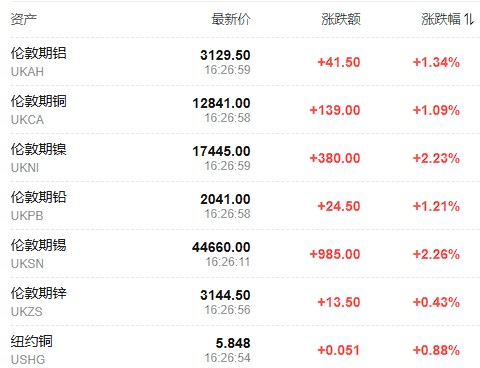
The LMEX index, which tracks six major base metals traded in London, is expected to record its fourth consecutive week of gains, marking the longest winning streak since August of last year.
Goldman Sachs raised its copper price forecast for the first half of the year to $12,750 per ton, although the bank expects prices to decline in the second half. Concerns over potential import tariffs in the US have prompted metal inflows into the US market, tightening supply conditions in other regions, which has been a significant driver of rising copper prices.
According to news from the Wind Trading Desk, the results of the US critical minerals Section 232 tariff investigation are expected to be announced this Saturday (January 10). On January 8, Citigroup's Kenny Hu research team believed that without tariffs, metals would flow out of the US to other regions, alleviating the current extremely tight market conditions and putting downward pressure on London spot prices In addition to the upcoming announcement of the "Section 232" tariff investigation results, which may trigger significant volatility in the precious metals market, large-scale commodity index rebalancing trades have also begun, putting unprecedented selling pressure on silver and other commodities.
The outlook for the mining sector is also under scrutiny. Rio Tinto has stated that it is in acquisition negotiations with Glencore, and if the deal is reached, it will create the world's largest mining company. This would become the largest transaction in mining history, as the industry is experiencing a wave of mergers and acquisitions, with producers seeking to expand their copper resource reserves.
Risk Warning and Disclaimer
The market carries risks, and investments should be made cautiously. This article does not constitute personal investment advice and does not take into account the specific investment objectives, financial situation, or needs of individual users. Users should consider whether any opinions, views, or conclusions in this article are suitable for their specific circumstances. Investment decisions made based on this are at the user's own risk
