


Copper prices have risen far beyond expectations! Goldman Sachs has raised its target price for the first half of the year, but still insists on a "post-U.S. tariff correction."

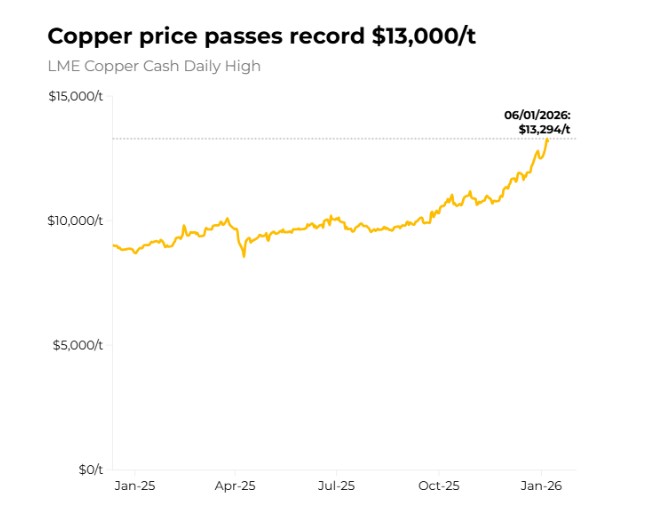
Due to factors such as "U.S. stockpiling" and the AI boom, copper prices surged 22% in one month to USD 13,387 per ton. Goldman Sachs raised its short-term forecast to USD 12,750 but warned that high copper prices are difficult to sustain, as the market overlooks the fact of a global copper surplus. The bank maintains its judgment that prices will fall back to USD 11,200 by the end of the year and points out that the clarification of U.S. "refined copper" tariffs will be a key catalyst for the price correction
The crazy rise in copper prices has forced Goldman Sachs to reassess its short-term forecasts, but the Wall Street giant still believes that once the U.S. tariffs are implemented, the gravitational pull of supply and demand fundamentals will come into play again.
According to news from the Wind Trading Desk, the latest research report released by Goldman Sachs' commodity research team led by analyst Eoin Dinsmore on January 8 shows that copper prices have experienced significant volatility over the past month, soaring from less than $11,000 per ton at the end of November to a peak of $13,387 on January 6, an increase of up to 22%. In light of this trend, Goldman Sachs acknowledges that prices have exceeded what it considers a fair fundamental level of around $11,400 per ton.
However, this "overheating" is not without reason. Goldman Sachs points out that a significant influx of investor funds and low inventories in markets outside the U.S. have added a notable "scarcity premium" to copper prices. More importantly, the market's expectation that the U.S. will impose tariffs on copper has led to a large influx of the metal into the U.S. market for stockpiling. Based on this, Goldman Sachs has decided to raise its LME copper price forecast for the first half of 2026 from the previous $11,525 per ton to $12,750 per ton.
However, investors should not be blinded by the current prosperity. Goldman Sachs clearly states that it does not believe prices above $13,000 can be sustained. The firm maintains its forecast of $11,200 per ton for the fourth quarter of 2026 and expects a price correction in the second quarter.
The Dual Drivers of "Overheating" Macroeconomic Narrative and AI Boom
Goldman Sachs analysis points out that three main themes are driving this round of copper price increases:
-
Tight Signals in the Spot Market: At the beginning of December, requests for metal withdrawals from LME warehouses surged, confirming supply tightness in markets outside the U.S.
-
Frenzy Around AI and Data Centers: Despite some fluctuations in mid-December, the construction boom around AI data centers continues to attract capital inflows into the copper market.
-
Macroeconomic Narrative of "Running it Hot": This is the final spark driving the rally. As market expectations for accelerated U.S. economic growth and loose monetary and fiscal policies rise, expectations for a rebound in cyclical demand have propelled a strong rebound in copper and broader risk assets at the start of the new year.
This macroeconomic narrative even obscures the underlying weakness in fundamentals. Goldman Sachs' equity strategy team points out that accelerated U.S. economic growth should drive cyclical sectors of the stock market up, and this sentiment has spilled over into the copper market.
The Moment Tariffs Are Implemented Marks the End of Stockpiling
Goldman Sachs' core view is: The current rise is built on the specific behavior of "U.S. stockpiling."
Analysts believe that the second quarter will be a critical turning point. By then, the U.S. decision on refined copper tariffs may be announced. Once this decision is clarified, it will mark the end of stockpiling behavior in the U.S., and market focus will shift back to global market oversupply According to CCTV News, on July 30 last year, U.S. President Trump signed a notice announcing that starting August 1, a 50% tariff would be imposed only on semi-finished products such as copper pipes, copper wires, and cables, but refined copper, including cathode copper and anode copper, which is mainstream in international trade, was exempted. However, the prospect of import tariffs on refined copper has not completely disappeared. The U.S. Department of Commerce has suggested delaying the imposition, starting with a 15% tariff in 2027, increasing to 30% in 2028. Trump has instructed the department to provide an update on the U.S. copper market by the end of June 2026.
It is noteworthy that Goldman Sachs has adjusted its expectations regarding tariffs. Given that the White House recently postponed the tariff increase on lumber products (due to concerns about affordability), Goldman Sachs believes the likelihood of delaying or not implementing the refined copper tariff is increasing.
-
Baseline scenario (45% probability): A 15% tariff announced in mid-2026, but postponed to 2027.
-
Delay scenario (40% probability): The tariff decision is directly postponed to 2027.
If it is the latter, meaning the tariff is postponed, this would be bearish for LME copper prices, as it implies no tariff threat, and the market will refocus on the ample global supply.
Global Surplus "Concerns"
Beneath the prosperous surface, the fundamentals of the global copper market are actually quite weak.
Data shows that the global copper market recorded a surplus of 600,000 tons (600kt) in 2025, the largest absolute surplus since 2009. For 2026, Goldman Sachs has raised its global surplus expectation from the previous 160,000 tons to 300,000 tons.
Additionally, due to the declining attractiveness of the U.S. import arbitrage window, Goldman Sachs has also lowered its 2026 U.S. stockpiling expectation from 7.5 million tons to 6 million tons.
Speculative Positions Reach Historic Highs, But This May Not Be the Peak
For the market, the most dangerous signal comes from the position structure.
Goldman Sachs warns that current speculative positions are at historical highs. This usually indicates that the market has entered a late stage. However, prices may still have support before the three pillars of "U.S. economic growth, AI spending, and U.S. stockpiling" collapse.
From historical data, although positions have reached record levels, the proportion of managed fund long positions in CME copper futures relative to total positions has not yet reached extremes. To push copper prices up to $14,000 per ton, this proportion needs to rise from 24% at the end of December to around 30%. While this is not Goldman Sachs' baseline forecast, it illustrates the potential peak form that speculative frenzy could reach The above wonderful content comes from Chasing Wind Trading Platform.
For more detailed interpretations, including real-time analysis and frontline research, please join the【 Chasing Wind Trading Platform ▪ Annual Membership】.
