


Trump's oil price target: $50

The Trump administration is advancing a long-term plan to dominate Venezuela's oil industry, believing that this move will drive oil prices down to $50 per barrel. Currently, the White House has confirmed the launch of global sales of Venezuelan oil and is actively negotiating with major oil companies such as Chevron to implement control and distribution of Venezuelan oil resources. As voter dissatisfaction with the cost of living intensifies and polling pressure increases ahead of the midterm elections, the urgency of this agenda has heightened
On January 7 local time, according to media reports citing informed sources, Trump and his advisors are planning to dominate the Venezuelan oil industry in the coming years. The president told aides that he believes his efforts can help bring oil prices down to his desired level of $50 per barrel.
Informed sources also revealed that the plan envisions a certain degree of control by the U.S. over the Venezuelan state oil company (PdVSA), including the acquisition and sale of most of the company's oil output. If the plan succeeds, it would effectively give the U.S. control over the management of most oil reserves in the Western Hemisphere and could potentially lower energy prices for American consumers.
According to CCTV News, on January 6 local time, U.S. President Trump announced that the Venezuelan interim government would transfer 30 to 50 million barrels of oil to the U.S. These oils will be sold at market prices, and the proceeds will be overseen by Trump to ensure that the funds are used to "benefit the people of Venezuela and the people of the United States."
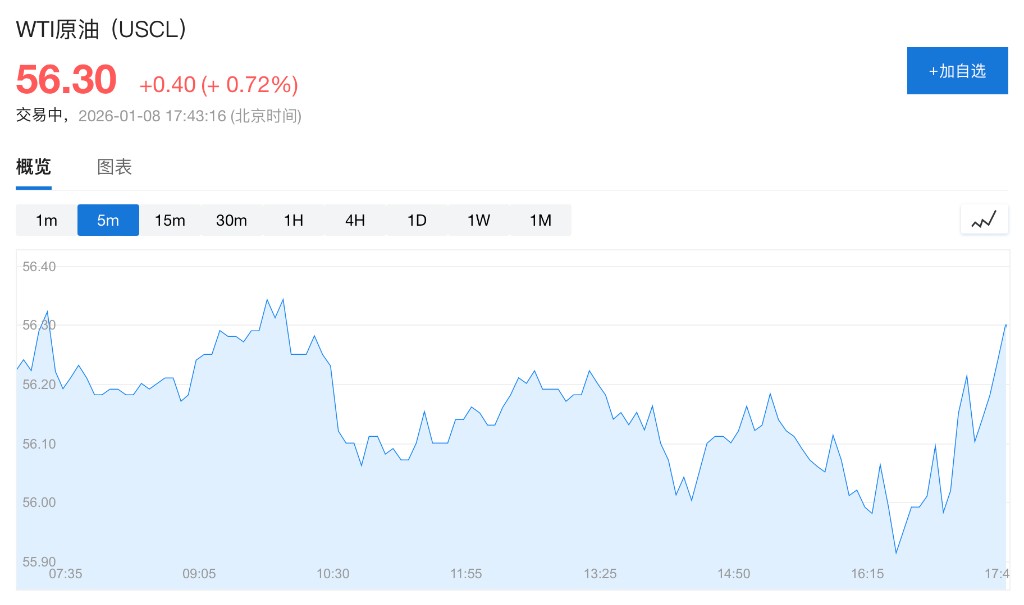
Currently, WTI crude oil prices are around $56 per barrel, hovering near the breakeven point of about $50 for many oil companies. If low oil prices persist, it could severely impact the U.S. shale oil industry.
White House Confirms Launch of Global Sales of Venezuelan Oil
The U.S. government is rapidly advancing its plan to control Venezuelan oil resources, and the White House has confirmed the launch of global sales of Venezuelan oil. On January 4, Beijing time, according to Xinhua News, the White House has requested major U.S. oil companies to make significant investments in Venezuela to repair the country's crude oil extraction infrastructure According to media reports citing informed sources, U.S. officials are considering selling Venezuelan oil to several distributors and international energy companies, including Mercuria, Vitol, and Trafigura.
According to Wall Street Insight, on Wednesday, January 7th, U.S. Eastern Time, White House Press Secretary Levitt stated at a briefing that the U.S. has begun to market Venezuelan oil globally, with the proceeds deposited into bank accounts controlled by the U.S. government, which will decide on the distribution. Energy Secretary Wright emphasized at a meeting that the U.S. will indefinitely control the sale of Venezuelan oil exports, stating, "We just want to control the flow of funds."
Levitt indicated that this batch of oil will "soon" begin to arrive in the U.S., but she refused to disclose the duration of U.S. control over Venezuelan oil. She said:
"Secretary of State Rubio and the entire team are seriously developing a long-term plan, rest assured there is a long-term plan here. This is the first step you will see."
The Trump administration's plan to control Venezuelan oil is facing the harsh reality of the country's severely deteriorated industrial foundation. The country's oil industry has declined due to long-term underinvestment and mismanagement, and to significantly increase production, U.S. oil companies would need to invest hundreds of billions of dollars. However, in the current environment of persistently low oil prices, these companies may have serious reservations about investing due to capital return considerations.
On January 7th, Beijing time, Xinhua News reported that President Trump hinted on the 6th that the U.S. government may use taxpayer money to compensate U.S. energy companies for the costs required to renovate oil infrastructure in Venezuela.
The Trump Administration Actively Consults with Oil Companies
Venezuelan state oil company PDVSA stated in a statement that it is negotiating with the U.S. government regarding crude oil sales, with the negotiation framework similar to its arrangement with Chevron.
As the U.S. continues to intensify economic sanctions against Venezuela, Chevron is currently the only major U.S. oil company still operating oil field projects in Venezuela. According to CCTV News, at the end of the 20th century, Venezuela's oil industry reopened to foreign investment, with U.S. companies such as Chevron, ExxonMobil, and ConocoPhillips entering the market. After Hugo Chávez was elected president in 1999, he required that foreign companies developing Venezuelan oil field projects must cooperate with Venezuelan oil companies and that the projects must be controlled by the Venezuelan side. ExxonMobil and ConocoPhillips refused to comply and subsequently withdrew from the Venezuelan market. Chevron and some other foreign oil companies accepted the relevant policies and continued to operate in Venezuela Trump will meet with oil executives from companies such as Chevron and ExxonMobil at the White House on Friday. According to media reports citing informed sources, U.S. government officials have also been in contact with oil company executives, urging them to propose ways for both the U.S. and Venezuela to maximize profits from Venezuelan oil.
Production Increase Plans Have Not Received Industry Response
Analysts believe that this government action essentially extends its "full-scale production increase" policy slogan beyond U.S. borders. Trump has always viewed increasing production and lowering oil prices as key to boosting the economy, and has prioritized it on his agenda for a second term. As voters continue to complain about cost-of-living pressures and his poll numbers decline ahead of the midterm elections, the urgency to advance this agenda has significantly increased.
However, the oil industry's response to this plan may not be positive. Despite Trump repeatedly urging and implementing loose regulations aimed at stimulating drilling, the new supply from OPEC+ and concerns about economic slowdown triggered by tariffs have collectively suppressed oil prices throughout 2025. Oil and gas producers, who have long adhered to Wall Street's capital discipline, continue to maintain spending restraint.
Data shows that from December 2024 to November 2025, U.S. oil production is expected to increase slightly by just over 3%. Analysts believe this growth is primarily due to natural improvements in oilfield efficiency rather than the result of policy stimulus. Clay Seigle, a senior fellow at the Center for Strategic and International Studies, pointed out that investors are not concerned about energy dominance; they care about dividends from energy stocks
