


Warner Bros. Discovery rejects Paramount's trillion-dollar leveraged buyout: the offer is "still insufficient," and the Netflix proposal is "more certain."

On Wednesday, the Warner Bros. board stated in a letter to shareholders that despite billionaire Larry Ellison's commitment to personally guarantee $40.4 billion in equity financing to support Paramount's hostile takeover bid at $30 per share in cash, Warner Bros. believes that Paramount's proposal carries significant risks and uncertainties, questioning whether Paramount can complete the transaction
The board of Warner Bros. Discovery rejected Paramount's revised acquisition offer, expressing doubts about the feasibility of Paramount's $100 billion leveraged buyout.
On Wednesday, the Warner Bros. board stated in a letter to shareholders that compared to Netflix's proposal to acquire its film and streaming business for $27.75 per share in cash and stock, Paramount's proposal carries significant risks and uncertainties.
Despite billionaire Larry Ellison's personal guarantee of $40.4 billion in equity financing to support Paramount's hostile takeover bid at $30 per share in cash, Warner Bros. remains skeptical about Paramount's ability to complete the transaction and has chosen to reject the revised acquisition offer.
Pentwater Capital Management, Warner Bros.' seventh-largest shareholder, warned that the board would be "making a mistake" if it did not engage with Paramount and threatened to oppose all board members in the next election and vote against the Netflix merger.
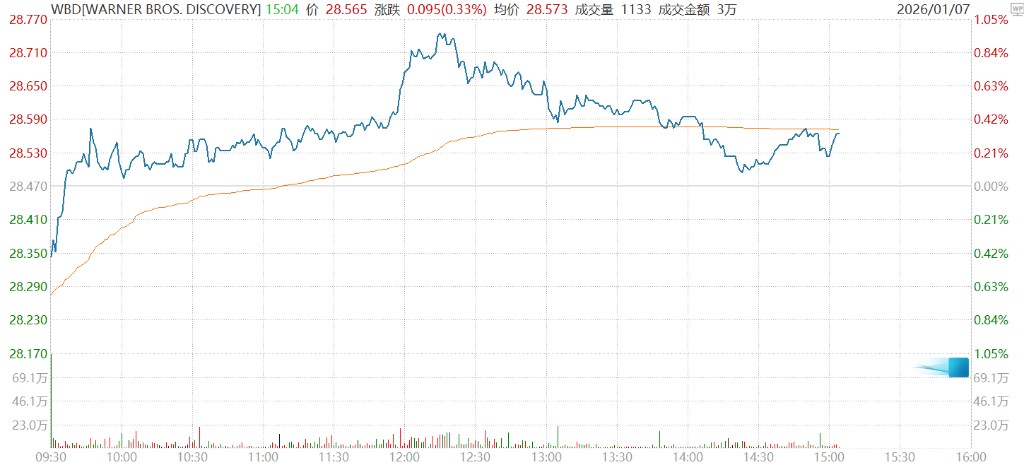
Warner Bros. shares rose 0.33% to $28.55 on Wednesday, still below Paramount's offer.
Financing Structure Raises Concerns About Transaction Risks
Paramount's financing arrangements remain a key issue.
The Warner Bros. board reiterated concerns about the requirement for over $50 billion in borrowing. According to Warner Bros. in the letter, Paramount, with a market value of approximately $14 billion, is attempting an acquisition that requires $94.65 billion in debt and equity financing, nearly seven times its total market value.
Warner Bros. stated:
Such massive debt financing and other terms of Paramount's offer exacerbate the risk of transaction failure, especially compared to the certainty of merging with Netflix. Changes in the performance or financial condition of the target company or acquirer, as well as changes in the industry or financing environment, could jeopardize these financing arrangements.
The cost of terminating the Netflix agreement is also significant.
The board noted in the letter that if it shifts to a Paramount deal, Warner Bros. would need to pay $4.7 billion in termination fees, including a $2.8 billion breakup fee to Netflix, $1.5 billion in costs related to failed debt exchanges, and approximately $350 million in additional borrowing costs.
This means that the $5.8 billion termination fee guarantee offered by Paramount effectively leaves only $1.1 billion. Lightshed Partners analyst Richard Greenfield pointed out that Warner Bros.' rejection is not just about price:
Why would the Warner Bros. board terminate the agreement with a strong balance sheet and cash-rich Netflix, incur termination fees and debt-related costs, and accept Paramount's high-leverage offer, hoping that financing will ultimately materialize to complete the transaction?
Additionally, the Warner Bros. board pointed out that Paramount's proposal continues to impose restrictions on the company's operational capabilities before the transaction is completed, such as limiting the signing of technology infrastructure contracts valued over $30 million annually The board warned in a letter that these restrictions could "harm" Warner Bros. business in the 12 to 18 months prior to the completion of the transaction, providing an excuse for Paramount to abandon the deal during this period.
Shareholders and Analysts Call for Higher Offers
Warner Bros. board chairman Samuel DiPiazza stated in the media on Wednesday that the board recognizes Ellison's personal support for the Paramount deal as a "significant change," but "there are other issues" that need to be addressed, and "ultimately he did not raise the price."
He stated:
Paramount had opportunities to raise the price in the seventh and eighth proposals, but they did not do so, and they must come up with a compelling and superior proposal.
Multiple shareholders and analysts expect Paramount to raise its offer. Bloomberg Industry Research analyst Geetha Ranganathan wrote in a report:
Warner Bros. Discovery's rejection of Paramount's revised offer of $30 per share indicates that this merger drama is far from over. We believe Paramount needs to raise its offer to at least $32 per share to bring Warner back to the negotiating table.
Pentwater Capital Management, Warner Bros.' seventh-largest shareholder, stated in a letter to DiPiazza and the board on Wednesday that the board's failure to communicate regarding Paramount's revised acquisition proposal was "a mistake."
The company's CEO Matthew Halbower stated that Paramount's cash offer of $30 per share is "economically superior" to Netflix's offer and added:
Paramount is likely to unilaterally choose to improve its proposal.
If Paramount does indeed improve its proposal, Halbower stated that the board needs to communicate fairly with Paramount. If the board fails to do so, Halbower warned that:
Pentwater will not vote to support any directors in the next board election and will also vote against the merger with Netflix.
The Battle for Industry Restructuring Continues
This increasingly fierce contest concerns one of Hollywood's most legendary studios.
Controlled by Oracle Corporation chairman Ellison and his son David, Paramount has been trying for months to win over Warner Bros., competing with the world's most valuable entertainment companies to acquire the producers of film franchises like Batman and Harry Potter, as well as the crown jewel of television business, HBO.
Warner Bros. announced on December 5 of last year that it had reached an agreement with Netflix to sell its film and streaming business to the latter and planned to spin off its cable network to shareholders before the transaction's completion. Paramount's offer targets the entire Warner Bros., including cable assets.
For both Netflix and Paramount, acquiring Warner Bros. would reshape the entertainment industry landscape, providing the new owner with a coveted content library and opportunities to expand streaming business.
Previously mentioned by Wall Street Watch, Paramount launched a direct acquisition offer to shareholders on December 8, offering $30 in cash per share. Shareholders must decide whether to accept Paramount's acquisition offer by January 21 On Wednesday, Netflix stated that it has submitted regulatory applications and is in communication with antitrust agencies, including the U.S. Department of Justice and the European Commission. Netflix said in a statement:
Netflix remains committed to closely collaborating with Warner Bros. Discovery, regulators, and all stakeholders to ensure the successful completion of the transaction.
The Warner Bros. board emphasized in a letter that, under the existing agreement, the value derived by investors from the cable television spin-off and Netflix shares will exceed that of the Paramount deal. The letter stated:
The merger agreement negotiated by Netflix maximizes value while minimizing risk, and we unanimously believe that the Netflix merger is in the best interest
