


Storage chip prices are out of control! Wall Street adjusts expectations again: DRAM may soar 88% in 2026, NAND up 74%

Citigroup, in its latest outlook, has shown a more aggressive bullish stance than Nomura Securities. Analysts believe that driven by the proliferation of AI Agents and a surge in demand for AI CPU memory, the prices of storage chips will experience an uncontrollable rise in 2026. The average selling price (ASP) of DRAM in 2026 is expected to be revised sharply from an original increase of 53% to 88%, while the expected increase for NAND has been raised from 44% to 74%
Citigroup warns that the world will face a "severe supply shortage" of memory chips in 2026.
According to information from the Wind Trading Desk, Citigroup has presented a more aggressive bullish stance in its latest outlook compared to Nomura Securities. Analysts believe that driven by the proliferation of AI Agents and a surge in demand for AI CPU memory, memory chip prices will experience uncontrollable increases in 2026. Analysts have raised their expectations for the average selling price (ASP) of DRAM in 2026 from an original 53% increase to 88%, and the expected increase for NAND from 44% to 74%.
Pricing Power Completely Shifts to Sellers
The Citigroup research team clearly stated in its latest report that a "severe supply shortage" is expected in the commodity memory market in 2026. This shortage is not a temporary supply chain disruption but is driven by structural data growth. Citigroup has significantly raised its year-on-year growth expectation for the average selling price (ASP) of DRAM (Dynamic Random Access Memory) in 2026 from +53% to +88%.
Even more shocking is the data for server DRAM.
Citigroup expects that driven by the dual demand for AI training and inference, the ASP of server DRAM will skyrocket by 144% year-on-year in 2026 (previously forecasted at +91%). For mainstream products like the 64GB DDR5 RDIMM, Citigroup predicts its price will reach $620 in the first quarter of 2026, a quarter-on-quarter increase of 38%, far exceeding the previous forecast of $518.
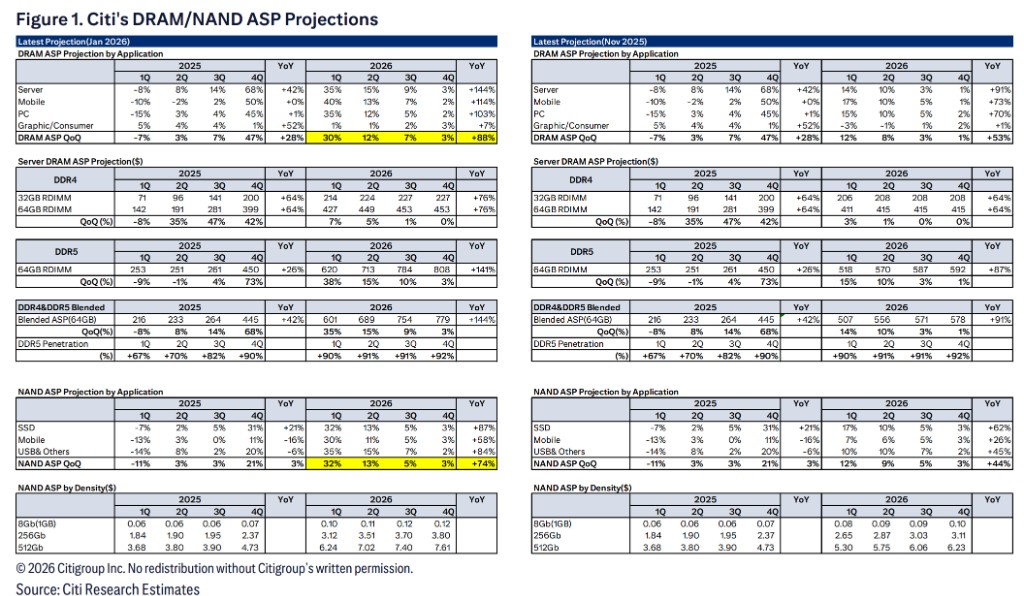
In the NAND (flash memory) sector, Citigroup is equally aggressive, raising its ASP growth expectation for 2026 from +44% to +74%. Among these, the ASP of enterprise-grade SSDs is expected to increase by 87% year-on-year. In the analysts' view, the market will enter an extremely intense seller's market, with pricing power completely in the hands of memory giants like Samsung.
Based on the above aggressive price forecasts, Citigroup has significantly revised its earnings outlook for Samsung Electronics. Citigroup expects that benefiting from an extremely favorable pricing environment, Samsung Electronics' operating profit (OP) will soar to 155 trillion won in 2026, a year-on-year increase of 253%.
This figure is far higher than Citigroup's previous forecast of 115 trillion won. Citigroup believes that as DRAM and NAND prices soar, Samsung's profitability will demonstrate strong resilience. Therefore, Citigroup has raised Samsung Electronics' target price from 170,000 won to 200,000 won.
Nomura's "Super Cycle" vs. Citigroup's "Extreme Shortage"
Previously, Nomura proposed the concept of a "Triple Super Cycle" (DRAM, NAND, HBM) in its report, predicting that the global memory market size will grow by 98% to $445 billion in 2026 However, there is a huge divergence between the two institutions in the specific judgment of price increases.
Nomura predicts a 46% increase in DRAM prices and a 65% increase in NAND prices by 2026. Although this is already a considerable increase, Citigroup's forecast for DRAM price increase (88%) is almost double that of Nomura.
The core of the divergence lies in the different depths of understanding of demand.
Nomura emphasizes the "dual resonance" of AI servers and general servers, as well as the ramp-up of HBM4 capacity; while Citigroup further emphasizes the incremental data generation brought by "AI Agents," believing that this will lead to an explosive growth in data volume, resulting in a steeper price increase for general server memory than expected.
Cleanroom Shortage Becomes a Long-term Bottleneck
Why are prices so out of control? In addition to the explosive demand, the physical limitations on the supply side are another key factor.
Nomura Securities pointed out in its report that the supply expansion of the global storage industry is severely constrained by the lack of availability of "cleanrooms."
Nomura emphasizes that even if manufacturers decide to expand production now, substantial expansion on the supply side will be very limited until mid-2027 due to the shortage of cleanrooms. In addition, technological migration (such as the transition to 1C nanometer processes) will actually lead to a 10% to 15% reduction in wafer capacity, with lower initial yields. This means that, in the face of the AI data explosion anticipated by Citigroup, the supply side has almost no capacity for a quick response. This mismatch between supply and demand is the fundamental logic behind Citigroup's bold prediction of a doubling of DRAM prices
