


Will GLP-1 spillover and AI empowerment make biomedicine the "alternative" for tech stocks in 2026?

Citigroup stated that the indications for GLP-1 are expanding from weight loss to cardiovascular and neurological systems, and will welcome the expansion of Medicare payments and the launch of Eli Lilly's oral drug orforglipron; AI is fully realizing cost and efficiency benefits in research and development, production, and clinical stages; coupled with the reshaping of distribution channels by the DTP (direct-to-patient) model, the overall profitability quality and innovation conversion efficiency of the industry are significantly improving
Due to attractive valuations, a recovery in business development (BD) and IPO activities, as well as a concentration of core catalyst points, the biopharmaceutical sector is demonstrating strong growth potential in 2026. Although the overall revenue and profit growth expectations for the industry are slightly below the market average, its low-risk attributes and strong pipeline option value make it an ideal alternative for investors to balance their technology stock allocations.
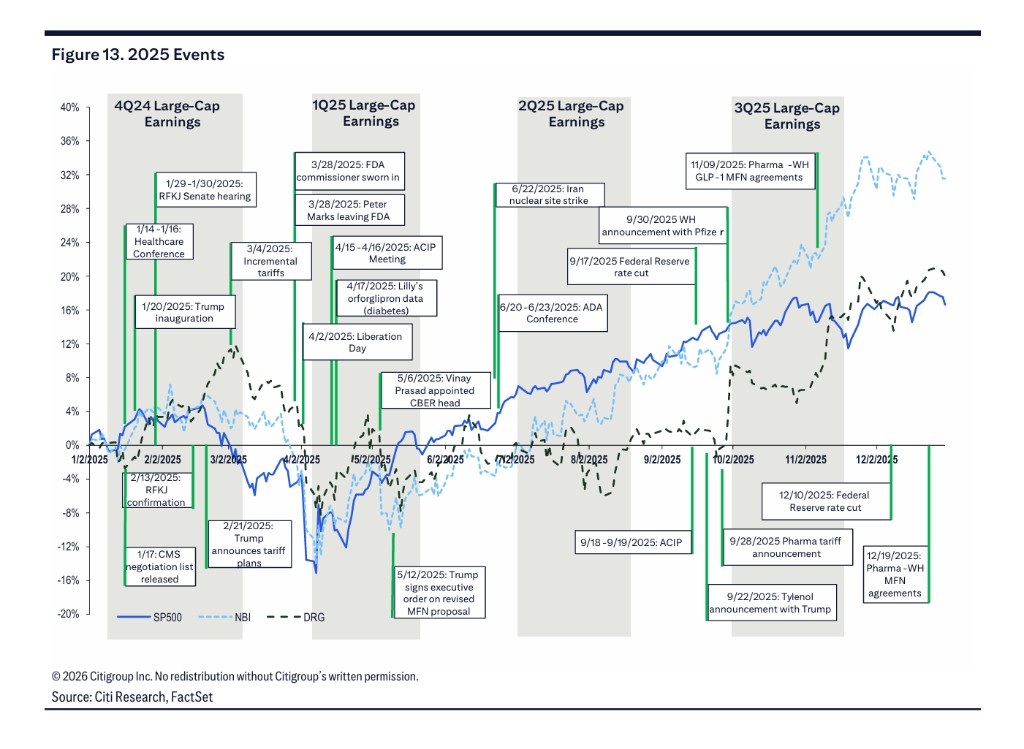
According to news from the Chasing Wind Trading Desk, Citigroup analyst Jarwei Fang's team released a research report on the 6th, stating that the U.S. biopharmaceutical sector performed well in 2025, successfully breaking a two-year slump. The Nasdaq Biotechnology Index (NBI) rose by 32%, and the S&P Pharmaceuticals Index (DRG) increased by 20%, both outperforming the S&P 500 Index's 17% gain. As policy uncertainties gradually dissipate in the second half of 2025, market sentiment has shifted from defensive to offensive.
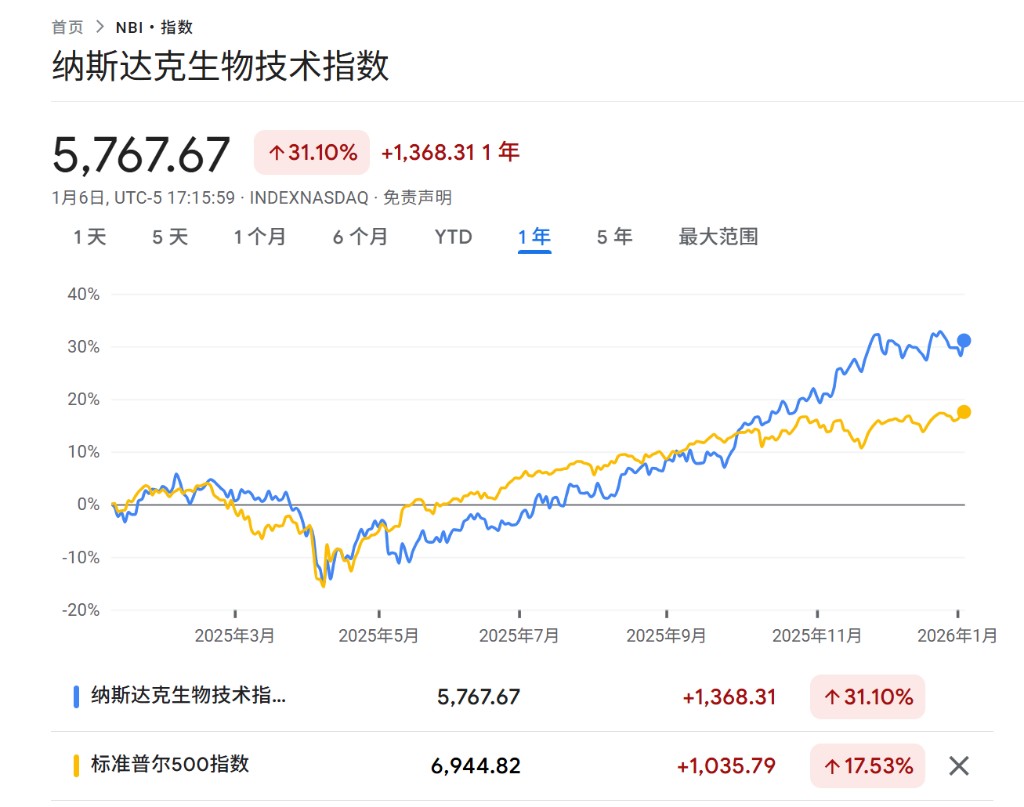
Currently, the forecasted price-to-earnings ratio of large-cap pharmaceutical stocks remains below that of the S&P 500 Index, indicating room for valuation recovery. Citigroup expects that the Federal Reserve may further cut interest rates in 2026, providing macroeconomic benefits for the biopharmaceutical sector. In particular, high-growth leading companies such as Eli Lilly, Gilead, and Vertex are expected to continue outperforming the market due to their strong commercialization execution.
The growth logic of the biopharmaceutical industry is undergoing profound changes. The market penetration of GLP-1 drugs is expanding from diabetes and obesity into cardiovascular and neurological fields; the application of artificial intelligence in drug development and clinical trial design has entered a harvest period; coupled with the reshaping of distribution channels by the Direct-to-Patient (DTP) model, the overall profitability quality and innovation conversion efficiency of the industry are significantly improving.
Farewell to Policy Shadows, Welcome Back to Fundamentals
For the biopharmaceutical industry, 2025 is a year of "ice and fire." In the first half of the year, constrained by the Inflation Reduction Act (IRA) drug price negotiations, Most Favored Nation (MFN) pricing threats, and tariff concerns, a large amount of capital flowed into the technology sector, putting pressure on pharmaceutical stocks. However, the turning point came in September, when Pfizer took the lead in signing a pricing agreement with the Trump administration, followed by several pharmaceutical companies including Amgen, Gilead, and Merck, effectively eliminating the greatest policy uncertainty troubling the industry.
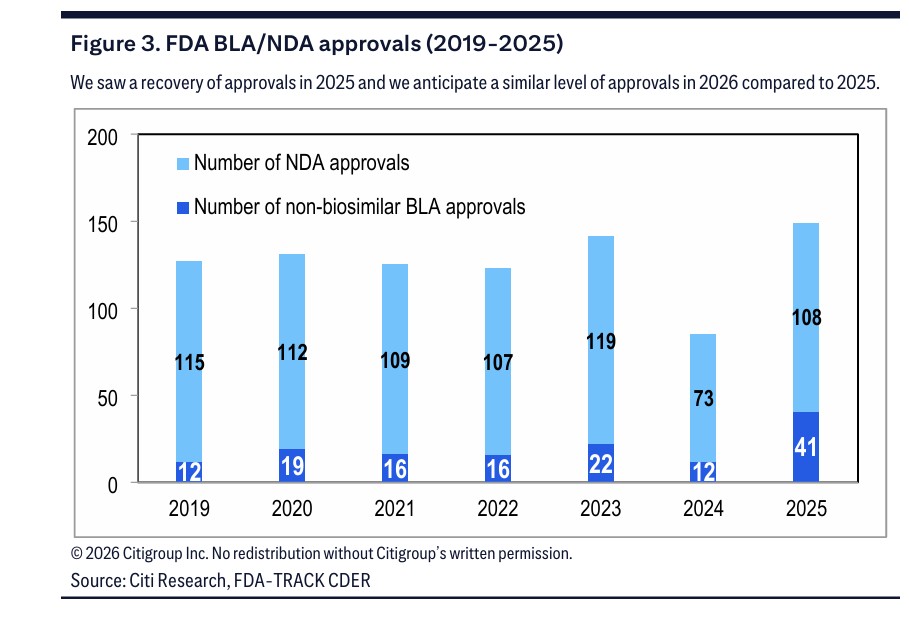
Entering 2026, Citigroup believes that the regulatory environment will become more lenient. Although the price reductions for the first ten drugs under the IRA took effect on January 1, and price negotiations for Novo Nordisk's Ozempic and other drugs are set to begin in 2027, the market has fully digested these expectations. More importantly, the significant rebound in FDA approval efficiency—strong rebound in the number of new drug approvals in 2025—has paved the way for the market entry of innovative drugs. Against this backdrop, Citigroup is optimistic about biotechnology as an "alternative trade" for tech stocks. Currently, the price-to-earnings ratio (PE) of large pharmaceutical companies remains at a discount relative to the S&P 500 index, and as interest rates decline, the financing costs for small and mid-cap biotech companies are decreasing, opening up the valuation recovery space for the entire sector.
GLP-1 Market: From "Weight Loss" to "Universal" Spillover
If 2025 is the year GLP-1 drugs establish their status as "miracle weight loss drugs," then 2026 will be the year of rapid expansion of their application boundaries. Citigroup's report emphasizes that the market for GLP-1 receptor agonists is undergoing profound changes in two dimensions:
First is the broad spillover of indications. In addition to consolidating their dominance in diabetes and obesity, GLP-1 is rapidly penetrating the fields of cardiovascular diseases, kidney diseases, and even neuropsychiatric and neurodegenerative diseases. Although Novo Nordisk's oral semaglutide did not meet its primary endpoint in Alzheimer's disease (AD) trials, positive signals from biomarker data indicate that this mechanism still holds potential in neurological diseases.
Second is the significant breakthrough on the payment side. It is expected that as early as April 2026, Medicare Part D will officially expand coverage for GLP-1 drugs. This means that over 20 million new beneficiaries will gain eligibility for insurance payments, and although this comes with price discounts, the logic of exchanging volume for price will significantly boost the sales peaks of giants like Eli Lilly and Novo Nordisk.
The most anticipated catalyst is the potential approval and launch of Eli Lilly's oral GLP-1 drug orforglipron (expected in the second quarter of 2026). As a once-daily oral medication, orforglipron is expected to break the adherence bottleneck of injectables and challenge Novo Nordisk's similar products with its advantage of no dietary restrictions. Citigroup predicts that the drug's sales in its first year on the market could reach $1.8 billion, even exceeding Wall Street consensus expectations.
AI Empowerment: From Concept Validation to Real Returns
In the field of biopharmaceuticals, artificial intelligence (AI) is no longer just a gimmick to attract investors; it is transforming into tangible efficiency and returns. By 2025, AI applications in the industry have shifted from early "trial" phases to generating quantifiable benefits.
Citigroup's report lists several examples demonstrating the value of AI: Bristol Myers Squibb has used AI to shorten clinical trial times by nearly three years and save approximately $250 million in supply chain costs; Novartis has optimized biopharmaceutical production processes through AI, saving $10 million to $15 million per factory annually; Novo Nordisk's generative AI platform "NovoScribe" has reduced the time required to write clinical research reports by about 90% Looking ahead to 2026, AI will further penetrate the core aspects of drug development. Eli Lilly's collaboration with NVIDIA to establish an "AI factory" has invested over $1 billion, signaling that the industry is moving towards an "autonomous laboratory" era. This system, capable of independently designing and conducting experiments, is expected to significantly accelerate the speed of new drug discovery.
2026 Trading Strategy: Embrace Growth and Catalysts
Citigroup's recommendations for large-cap stocks remain focused on growth-oriented companies. In terms of individual stocks, Eli Lilly is viewed as a top choice, primarily driven by the continued penetration of GLP-1 and the launch of orforglipron; Vertex is favored due to the consolidation of its cystic fibrosis pipeline and breakthroughs in its kidney projects; Gilead is expected to achieve growth through the comprehensive rollout of its HIV drug Yeztugo and its oncology pipeline.
In the small and mid-cap biotech sector, Citigroup is particularly focused on companies with significant de-risking events, including Apogee (52-week data for APG777 in atopic dermatitis), Arcellx (regulatory submission for anito-cel), and NewAmsterdam (Phase 3 data for obicetrapib in the cardiovascular field)
