


Ignore short-term fluctuations? Morgan Stanley is bullish on gold prices: aiming for $4,800 this year, with safe-haven demand and interest rate cuts remaining the main themes

Morgan Stanley significantly raised its gold price forecast, expecting it to surge to a historic high of $4,800 per ounce by 2026, driven by multiple factors including the Federal Reserve's easing cycle, geopolitical risks, and central banks' continued gold purchases. As a core safe-haven asset, gold's allocation value has significantly increased against the backdrop of heightened global macroeconomic uncertainty and a weakening dollar, with a bullish consensus in the market having fully formed
Under the multiple drivers of the Federal Reserve's shift to an accommodative monetary policy, escalating global geopolitical risks, and central banks' continued gold purchases, Morgan Stanley has significantly raised its gold price expectations, forecasting that this traditional safe-haven asset will continue to set historical highs by 2026, aiming for the milestone of $4,800 per ounce.
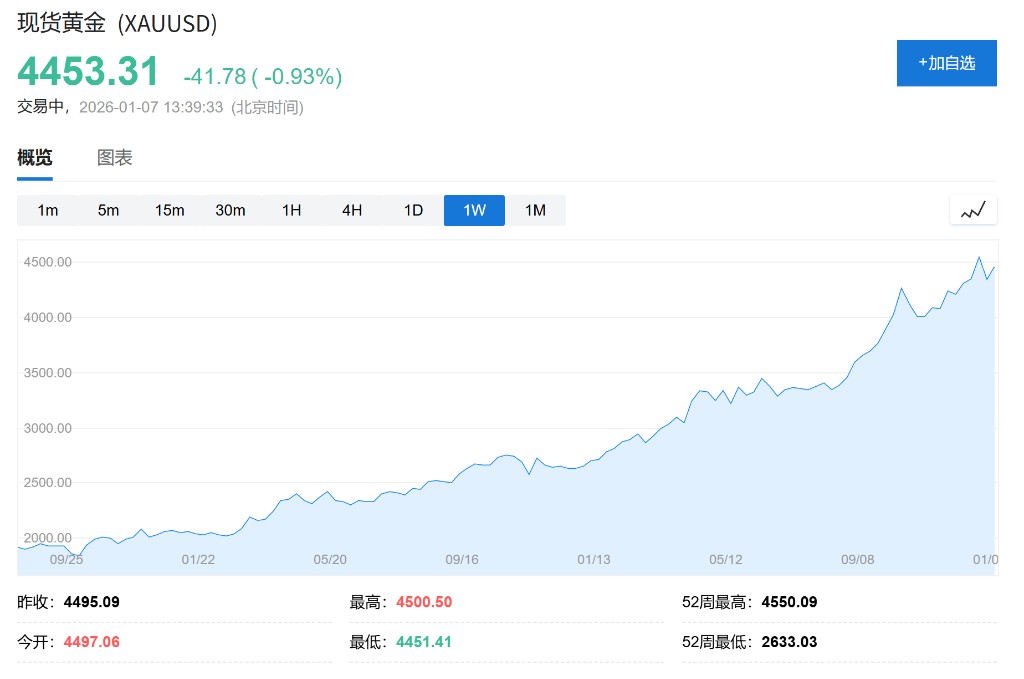
In a research report released on January 5, Morgan Stanley pointed out that gold prices are strongly supported by macroeconomic and policy shifts. These factors include the anticipated easing cycle from the Federal Reserve, changes in the Fed leadership, and ongoing purchases by central banks and investment funds. Previously, spot gold had recorded a historic increase in 2025, ending the year up 64%, marking the strongest annual performance since 1979.
However, on January 7, the precious metals market faced a sharp decline, with spot gold briefly falling below the $4,450 per ounce mark. According to Wall Street News, the Bloomberg Commodity Index (BCOM) is set to initiate its annual weight rebalancing from January 8 to 14, and the market is facing liquidity pressure from passive funds' "technical selling," posing a short-term bearish reversal risk for gold.
In the long term, geopolitical uncertainties have further fueled market demand for safe-haven assets. According to CCTV News, on January 3 at noon local time (January 4 at midnight Beijing time), U.S. President Trump and Defense Secretary Esper held a press conference at Mar-a-Lago in Florida regarding U.S. military action against Venezuela, aiming to control and extradite Venezuelan President Maduro.
As the situation in Venezuela escalates, including news of U.S. military intervention and the arrest of the country's leader, it has not only increased volatility in the energy and financial markets but also caused gold prices to surge again this week. Analysts believe that such sudden events effectively reactivate safe-haven buying in a market environment where investors are already in defensive positions For investors, this expectation means that in an environment of declining real interest rates and a weakening dollar, the opportunity cost of gold as a non-yielding asset decreases, significantly enhancing its allocation value. Morgan Stanley specifically pointed out that the recent share of gold in global central bank reserves has surpassed U.S. Treasury bonds for the first time since 1996, and this structural change is seen as a "strong signal" of investors' confidence in gold's long-term value.
Bullish Consensus and Institutional Layout
The bullish sentiment towards gold among major Wall Street investment banks has formed a broad consensus. Morgan Stanley has set its gold price target for the fourth quarter of 2026 at $4,800, a significant increase from its previous forecast of $4,400 set in October 2025. The bank previously noted that investors not only view gold as a hedge against inflation but also as a barometer for observing central bank policies and geopolitical risks.
JP Morgan also holds an optimistic view, with a more aggressive forecast, expecting gold prices to reach $5,000 by the fourth quarter of 2026, and even looking towards $6,000 in the long term. Natasha Kaneva, global head of commodity strategy at JP Morgan, emphasized in a report on December 18 that the trend driving the revaluation of gold prices has not yet exhausted, and although the rise will not be linear, the diversified allocation demand from central banks and investors will continue to push up gold prices amid ongoing trade uncertainties and geopolitical risks.
ING analysts also pointed out in a report on January 6 that central bank gold purchases and expectations for further rate cuts by the Federal Reserve form a solid foundation for rising gold prices. Alexander Zumpfe, a precious metals trader at Heraeus Metals Germany, stated that the situation in Venezuela, combined with existing geopolitical, energy supply, and monetary policy concerns, further solidifies safe-haven demand.
Weak Dollar and Capital Inflows
The weak performance of the dollar is a key macro factor supporting the rise in gold prices. The dollar is expected to decline by about 9% in 2025, marking its worst annual performance since 2017. Morgan Stanley analyst Amy Gower pointed out that the weakening dollar, strong ETF buying, and ongoing central bank purchases together constitute the momentum for further increases in gold prices.
Capital flow data confirms this trend. Recently, physically-backed exchange-traded funds (ETFs) have recorded record inflows, indicating strong interest from both institutional and retail investors. Morgan Stanley noted that even non-professional buyers have joined the "gold rush," driven by expectations of a weakening dollar and a broader trend of assets shifting away from the dollar-denominated system.
Silver and Base Metals Strengthening Together
Although gold is Morgan Stanley's preferred commodity, the bank also emphasizes the strong performance of other metal markets. Silver surged 147% in 2025, marking the strongest annual increase on record. Analysts believe that 2025 marks the peak of structural supply deficits for silver, and new regulations on export licenses in China have increased upside risks. ING noted that supported by industrial demand from solar panels and battery technologies, as well as ongoing investment inflows, the outlook for silver in 2026 remains constructive In the base metals sector, Morgan Stanley is optimistic about aluminum and copper, both of which face supply constraints amid rising demand. Three-month copper on the London Metal Exchange (LME) reached a historic high of $13,387.50 per ton this week, primarily driven by U.S. import demand and ongoing disruptions at the mine level. Additionally, nickel prices have also risen to their highest level since October 2024, mainly supported by risks of supply disruptions from Indonesia
