


For the first time since 2008! Deutsche Bank's PB returns to above 1, having dropped to a low of 0.19 in 2020

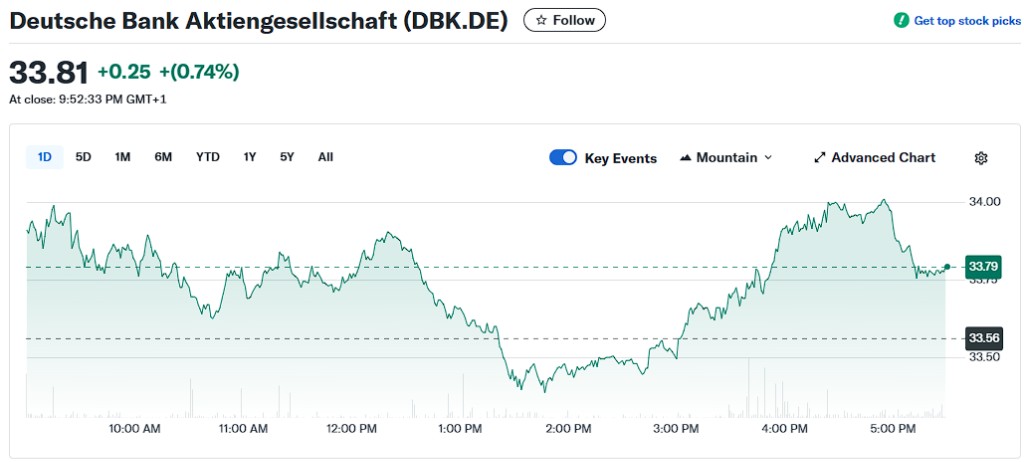
On January 5th, during early trading, Deutsche Bank AG's stock price rose to €33.95, surpassing the bank's recently reported book value per share of €33.66. This marks the first time since the onset of the 2008 global financial crisis that it has exceeded book value. The recovery is attributed to strategic adjustments such as exiting loss-making businesses and focusing on core areas. However, some strategists believe this is merely a return from "insignificant profits" to "average levels."
Deutsche Bank's stock price has surpassed its book value for the first time since the onset of the global financial crisis in 2008, marking a key milestone in the transformation of Germany's largest bank after years of legal setbacks, asset write-downs, and restructuring.
In early trading on January 5, Deutsche Bank's stock price climbed to €33.95, exceeding the bank's recently reported book value per share of €33.66. Although the closing price eventually fell back to €33.81, this still represents an important watershed.
The Price-to-Book ratio is a key indicator of bank valuation, reflecting investors' confidence in the bank's asset quality, return rates, and growth prospects. Since early 2008, when concerns about the health of the banking sector arose, Deutsche Bank's stock price has long traded at a discount below its book value.
This breakthrough has injected confidence into CEO Christian Sewing, who has vowed to turn the bank into the "champion of European banking." The recovery process has been fraught with twists and turns, as the bank's stock price fell to a historic low of less than €5 in March 2020, with a Price-to-Book ratio of only 0.19 times.
It is noteworthy that, despite significant progress, the market has not completely alleviated its concerns. Some strategists indicate that this merely reflects the bank's return from "insignificant profits" to "average profit levels," and its target of achieving a 13% return rate by 2028 still lags behind the target levels of up to 22% set by its European peers.
Restructuring Takes Effect and Profit Rebounds
Deutsche Bank's recovery is attributed to the effectiveness of a series of strategic adjustments. The bank reported last October that its profits for the first nine months of last year reached the highest level since 2007. Prior to this, the bank successfully improved its balance sheet by exiting non-core businesses and focusing on areas where it has a competitive advantage.
Analysts point out that the German government's debt-financed investment plan is expected to benefit Deutsche Bank's investment banking division, enhancing its role as an advisor for sovereign bond issuance and corporate restructuring. Additionally, the rising demand for corporate credit will also boost the profitability of its lending business.
In 2020, investors were concerned that the economic recession triggered by the COVID-19 pandemic could undermine Sewing's restructuring plans, compounded by the European Central Bank's negative interest rate policy, hefty restructuring costs, and obstacles to layoffs, which severely impacted the bank's profitability.
However, as European bank stocks have experienced a broad rebound over the past three years, investor confidence has slowly returned.
Deutsche Bank has not only resolved long-standing legal disputes, including improper sales of mortgage-backed securities, but has also decisively exited loss-making businesses such as equity trading, refocusing on fixed income trading and corporate banking.
Investors Remain Cautious
At the same time, despite significant progress, the market has not completely alleviated its concerns. According to reports, Andreas Thomae, a strategist at Deka, one of Deutsche Bank's top 20 shareholders, stated that the recent rise in stock prices merely reflects the bank's return from "insignificant profits" to "average profit levels."
Thomae pointed out that due to the presence of a capital-consuming investment banking division, Deutsche Bank "will never be able to achieve profit levels like BBVA or Santander."
Although analysts are confident that the bank will achieve its target of a 10% return on tangible equity (ROTE) when reporting its 2025 performance, its goal of reaching a 13% return by 2028 still lags behind the target levels of up to 22% set by its European peers.
In terms of long-term returns, despite the recent rebound in stock prices, Deutsche Bank's annualized total return over the past decade still lags behind the Stoxx 600 bank index and is lower than competitors such as UniCredit and BNP Paribas. Its performance has also been overshadowed by domestic competitor Commerzbank, whose price-to-book ratio has rebounded from 0.13 in March 2020 to over 1.4 by 2025, driven by potential acquisition offers.
On a specific business level, Deutsche Bank still faces integration challenges. The integration issues with Postbank once weighed down its retail business, although profitability has improved through branch closures and layoffs. Its asset management division DWS, while attracting significant inflows into low-margin passive products (such as ETFs), still faces pressure in the alternative investment sector
