


On the last day of 2025, the Federal Reserve "unleashes record liquidity."

On the last trading day of 2025, the Federal Reserve's Standing Repo Facility (SRF) provided $74.6 billion in loans to financial institutions, far exceeding the previous high of $50.35 billion. Market analysis suggests that this is mainly due to banks' routine seasonal operations for year-end balance sheet management and regulatory settlements. Despite the large-scale injection of liquidity, risk assets such as Bitcoin reacted tepidly
The usage scale of the Federal Reserve's Standing Repo Facility reached a historic high on the last trading day of 2025. On Wednesday, the New York Fed provided $74.6 billion in loans to eligible financial institutions through the Standing Repo Facility (SRF), far exceeding the previous record high of $50.35 billion set on October 31. These loans were secured by $31.5 billion in U.S. Treasury securities and $43.1 billion in mortgage-backed securities.
Despite the record borrowing scale, market participants and analysts generally believe that this is more of a routine operation for financial institutions to cope with year-end regulatory and settlement requirements, rather than a crisis signal indicating structural pressure in the market.
TD Securities U.S. interest rate strategist Jan Nevruzi stated that if the Federal Reserve does not become an active buyer of U.S. short-term government bonds again, the pressure could be much greater than it is now. Meanwhile, the Fed's overnight reverse repo tool also absorbed $106 billion in funds, the highest level since early August.
The cryptocurrency market is actively discussing this liquidity injection, but Bitcoin's price movement remains flat, continuing to fluctuate within a narrow range of $85,000 to $90,000, with both trading volume and volatility at low levels.
Year-End Balance Sheet Pressure Increases Borrowing Demand
Financial institutions typically tighten funding deployment at quarter-end and year-end to preserve cash and manage balance sheets, and this seasonal pattern raises the short-term borrowing costs in the repo market. Data from the New York Fed shows that the repo rate, measured by the Secured Overnight Financing Rate (SOFR), has recently climbed, reaching a two-week high of 3.77% on Monday before falling back to 3.71% on Tuesday.
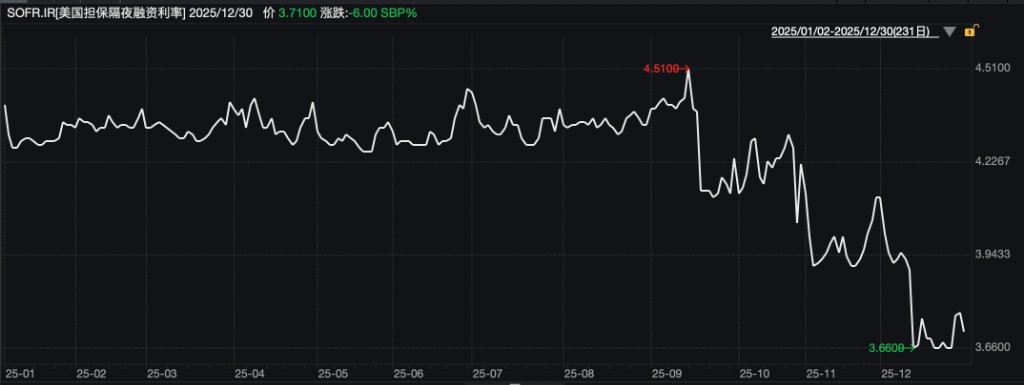
The surge in SRF usage on Wednesday is directly related to market interest rate trends. Scott Skyrm, Executive Vice President of Curvature Securities, pointed out that the general collateral repo rate was about 3.9% on Wednesday morning, higher than the SRF's rate of 3.75%, which prompted banks to choose to borrow from the Fed at a lower cost rather than turning to the open market.
Nevertheless, the $74.6 billion borrowing scale remains relatively small compared to the daily trading volume of over $1.3 trillion in the tri-party general collateral market. Market participants expect that as normal trading conditions resume in the coming days, the borrowing surge on Wednesday will dissipate.
Federal Reserve Encourages Use of Liquidity Tools
The SRF is part of the tools the Federal Reserve uses to manage short-term interest rates to achieve monetary policy goals, effectively replacing the discretionary repo operations previously used by the central bank.
The Federal Reserve has been actively signaling to encourage eligible financial institutions to use the SRF when there is a liquidity need. Earlier this month, at a policy meeting, the Fed raised the total volume limit for SRF operations. Roberto Perli, responsible for monetary policy implementation at the New York Fed, stated in November:
"If it makes economic sense, there is no reason not to participate on a large scale."
The minutes from the Federal Open Market Committee meeting held on December 9-10 local time show that there was an active discussion between market participants and the central bank on how to set up the SRF to operate according to policymakers' intentions. Meanwhile, the Federal Reserve halted the reduction of its balance sheet size earlier this month and began to expand it again to ensure that the market has enough cash to maintain relatively stable money market interest rates.
Skyrm stated that the SRF is functioning and alleviating the typical year-end tensions. He said:
"Given the relatively mild financing environment before the year-end, the financing market seems safer, panic has decreased, and confidence in the SRF's effectiveness has increased."
Cryptocurrency Market Reaction is Tepid
Despite cryptocurrency commentators discussing the Federal Reserve's liquidity injection, the market reaction has been relatively muted so far. Historically, global liquidity expansion has often coincided with strong performance in risk assets, including cryptocurrencies, but Bitcoin continues to trade within a narrow range.

This disconnect may reflect the complexity of the current cycle, where ample liquidity collides with restrictive policy rates, regulatory uncertainty, and a continued cautious sentiment after a tumultuous year. The latest minutes from the Federal Open Market Committee indicate that most participants believe further rate cuts are only appropriate if inflation continues to decline as expected, with the market pushing back the next rate cut expectation to at least March 2026.
