


Blue Arrow Aerospace's IPO has been accepted, aiming to become the "first stock of commercial rockets"!

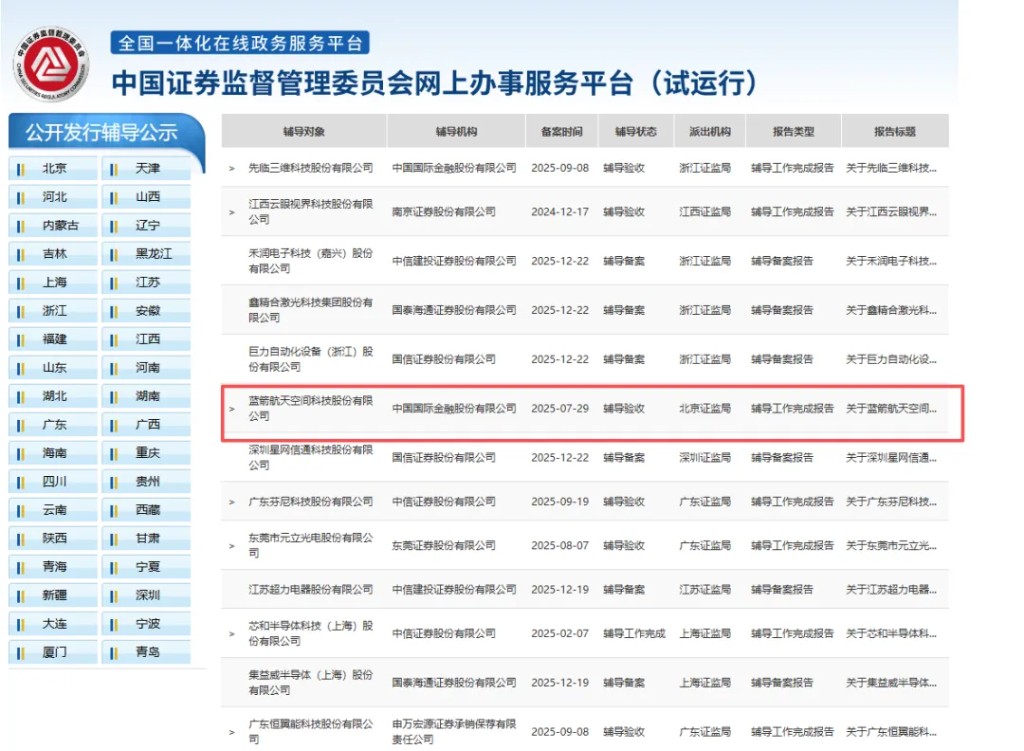
Previously, the company's IPO counseling work has been officially completed, with CICC as the counseling institution. On December 3rd, Blue Arrow Aerospace's Zhuque-3 reusable launch vehicle successfully launched into orbit. Although the first-stage recovery did not complete successfully in the final phase, this flight validated the feasibility of the liquid oxygen-methane recovery technology route and is seen as a key leap for China's commercial space industry on the path of "recovery and reuse." Analysts believe that this launch adds important technical validation background to Blue Arrow Aerospace's IPO process
The pace of China's commercial aerospace sector competing in the capital market is accelerating. Following the milestone first flight and recovery verification of the Zhuque-3 rocket, Blue Arrow Aerospace Technology Co., Ltd. has officially launched its bid for the Sci-Tech Innovation Board, aiming to claim the title of "the first stock of commercial rockets."
As of December 31, the latest information on the Shanghai Stock Exchange's official website shows that Blue Arrow Aerospace's IPO review status has changed to "accepted." Previously, the China Securities Regulatory Commission's online service platform disclosed that the company's IPO guidance work has been officially completed, with the guiding institution being China International Capital Corporation (CICC). CICC clearly stated that, after guidance, Blue Arrow Aerospace possesses the characteristics and attributes necessary to become a listed company.
Just before the IPO acceptance, according to Xinhua News Agency, on December 3, Blue Arrow Aerospace's Zhuque-3 reusable rocket was successfully launched into orbit. Although the first-stage recovery was not successfully completed in the final phase, this still marks the first attempt at first-stage recovery for a launch vehicle in China. This flight verified the feasibility of the liquid oxygen-methane recovery technology route and is seen as a key leap for China's commercial aerospace in the path of "recovery and reuse."
Analysts believe that this launch adds important technical verification background to Blue Arrow Aerospace's IPO process. For investors, whether the company can achieve commercial operation of reusable rockets and how it can achieve profitability in the fierce competition of commercial aerospace will become the focus of attention. According to Dong Kai, the deputy chief designer of the Zhuque-3, the company plans to achieve successful recovery and complete the technical closed loop by 2026, with a goal of launching ten rockets and shortening the reuse cycle to seven days to promote commercialization.
Technical Background: First Flight Verification and "Recovery" Challenges
Blue Arrow Aerospace's confidence in sprinting for the Sci-Tech Innovation Board largely stems from its engineering progress in the field of reusable rockets.
According to Dong Kai, the deputy chief designer of Blue Arrow Aerospace's Zhuque-3, the Zhuque-3, which had its first flight on December 3, is referred to as the "youth version." Although it is about 10 meters shorter than the complete version, its core configuration is comparable to SpaceX's Falcon 9, utilizing a liquid oxygen-methane and stainless steel technology route.
In this mission, the second stage successfully entered the designated orbit, while the first stage unfortunately failed in the final phase. Dong Kai revealed that although the orbit was achieved, in engineering evaluation, the success or failure of recovery is a distinction of "0 and 1," with not landing at the landing site being "0." However, the flight data is extremely valuable.
According to a relevant person in charge at Blue Arrow Aerospace, the rocket experienced the most challenging "supersonic re-entry aerodynamic gliding phase," verifying the composite control strategy of the cold gas reaction control system and grid fins Dong Kai pointed out that although the recovery was not perfect, the first stage of the rocket operated normally for 90% of the time, just one step away from success. This flight validated the actual effects of "re-entry ignition" and "aerodynamic deceleration phase," laying a solid foundation for subsequent model iterations.
The company stated that there is no intermediate state in engineering, but this attempt has significantly solidified China's practical foundation in the technology route of liquid oxygen-methane reusable launch vehicles.
Business Logic: Benchmarking Falcon 9 and Cost Control
In terms of business model, Landspace has a clear strategic roadmap. Dong Kai analyzed that commercial space must solve the "impossible triangle" of "large capacity, high frequency, and low cost," and reusable rockets are the only path.
This is also the reason why Landspace chose the liquid oxygen-methane + stainless steel route: Stainless steel does not require an external insulation layer, is more heat-resistant, and facilitates quick maintenance; liquid oxygen-methane avoids the carbon buildup issues of kerosene engines, significantly shortening the reuse cycle.
The market often refers to Zhuque-3 as the "domestic Falcon 9." In this regard, Landspace views it as a compliment and recognizes Falcon 9 as the benchmark for the world's only stable operating heavy reusable rocket.
Dong Kai emphasized that manufacturing capacity can only expand the base, while recovery technology is the multiplier. In engineering, time cost is the most scarce, and the core value of reuse technology lies in "spending twice the money to save half the time," thereby significantly enhancing launch capacity.
Regarding the profit model, Dong Kai believes its core logic lies in providing valuable launch services—cheaper, faster, and more stable. He likened the company's role to that of a "road builder," with the primary task of solidifying infrastructure, and the subsequent economic effects will follow.
Future Outlook: Achieving Technical Closure by 2026
In response to investors' concerns about the timeline for commercialization, Landspace has developed a clear plan.
According to Dong Kai, the company plans to achieve the successful recovery of Zhuque-3 by mid-2026. Once the technical validation is completed, the produced rockets will be quickly put into iteration, aiming to evolve into a "complete form" around 2026 and shorten the reuse cycle to about 7 days.
In addition, the company is prepared for capacity expansion, planning a launch target of ten rockets in 2026 and corresponding layouts for hundreds of engines. It is reported that Landspace's 200-ton full-flow staged combustion cycle liquid oxygen-methane engine has completed the whole machine test, which is a technological reserve for future larger-scale fully reusable rockets.
Although facing external competitive pressure, Landspace emphasizes that it will not distort the technology route for the sake of competing for the title of "first." The company stated that it will continue to promote the commercialization of high-frequency launch services through joint innovation in technology and management within the framework of safety regulation, and is confident in significantly catching up with international benchmarks in the next two to three years
