


Using history as a reference, has gold "overheated"?

In 2025, London spot gold recorded the highest annual increase in nearly 46 years, despite a slowdown in central bank gold purchases, with speculative funds driving gold prices higher. Looking ahead to 2026, the foundation of the gold bull market remains solid, and central bank gold purchases will become a supporting force for gold prices. 76% of central banks plan to increase their gold holdings over the next five years, highlighting the value of gold allocation in the market. Historically, this round of the gold bull market has not experienced excessive gains, and the long-term upward trend in gold prices is expected to continue, with related non-ferrous metals and strategic metals also likely to rise
Summary
In 2025, London spot gold recorded the highest annual increase in nearly 46 years. Despite a slowdown in central bank gold purchases during the year, speculative funds surged in, driving gold prices higher. Short-term corrections are mainly driven by sentiment and technical factors, while the core supporting logic of global stagflation, chaotic order, and the monetization of the U.S. deficit remains unchanged. Looking ahead to 2026, the foundation of the gold bull market remains solid, the upward trend is unaltered, and it is expected to spill over into related nonferrous metals and strategic metals.
Regarding central bank gold purchases, against the backdrop of global political multipolarity and the fading credibility of the U.S. dollar, the proportion of global central bank gold reserves has increased by 7 percentage points to 22% compared to three years ago, but it is still below the 29% at the end of the Cold War and the 58% at the end of the great stagflation in 1980. There remains a potential demand for 3,300 tons of gold purchases in the future. 76% of surveyed central banks plan to continue increasing their gold holdings over the next five years, and central bank gold purchases will become an important support for gold prices, constraining the space for corrections.
On the market funding side, gold, as a low-correlation and low-drawdown hedging tool, has highlighted its allocation value in an environment where the correlation between stocks and bonds is rising and traditional hedges are failing. Both risk parity and mean-variance strategy combinations have clear gold allocation needs, and a large number of non-institutional investors and traditional stock-bond portfolios have yet to enter the gold market, indicating a broad allocation space.
At the same time, the continuation of the Federal Reserve's interest rate cut cycle and the hedging demand in the later stages of the AI bubble will further drive market funds to increase their gold holdings. From a historical perspective, this round of the gold bull market has not been overbought. Starting from the monetization of the deficit in 2008 and the turning point of U.S. dollar credit in 2022, gold prices have risen 5.7 times and 2.4 times, respectively, far below the 24-fold increase in the 1970s. The scale of U.S. debt continues to expand, with the debt-to-GDP ratio expected to reach 118.5% by 2035, supporting long-term gold price increases. The bull market may only end when AI technology significantly improves productivity and the U.S. fiscal situation. At the same time, the spillover effects of the gold bull market are worth noting. Silver and copper, as core raw materials in the AI industry chain, have room for catch-up. Under global geopolitical competition, some strategic metals' "gold-like" properties will also emerge, likely following gold into an upward channel.
Looking ahead to 2026, as the market's pricing logic regarding "AI unknowns" remains unchanged, the lack of order continues to be a favorable environment for gold. When the AI bubble and gold form a "dumbbell," gold has realized its value as insurance for AI holdings during its shining moments. Silver, as a narrative asset that has both "gold-like" properties and is related to AI electricity, possesses higher elasticity in certain phases. However, once the AI narrative becomes clear, gold's shining moments may come to an end, and the "two-way benefiting" narrative of silver may also return to rationality.
Main Text
As of 2025, London spot gold has cumulatively risen by 71%, marking the highest annual increase since 1979. This year, we have witnessed a slowdown in central bank and sovereign gold purchase rates, yet we have seen speculative funds flooding into the market. In previous reports, we pointed out that short-term corrections in gold are mainly due to sentiment and technical factors, and the backdrop of global stagflation, chaotic order, and the monetization of the U.S. deficit has not changed, keeping the overall direction of gold unchanged Looking back at the "correction period" in the gold bull market since 2022, it is evident that the pace is slowing and the amplitude is narrowing, reflecting a gradual formation of new market perceptions.
Looking ahead to 2026, we are most concerned with several questions: First, from a funding perspective, is the process of central banks and markets increasing gold purchases nearing completion? Second, based on historical references, has this round of the gold bull market already become overbought? Third, can gold further drive other non-ferrous metals (silver, copper, strategic rare metals, etc.) into a prolonged bull market together?
Central Bank Gold Purchases: Slowing Pace, Not an End
Against the backdrop of global political multipolarity, the decline of U.S. geopolitical influence, and the rising debt vigilance in developed economies such as the U.S. and Europe, central banks of economies that were once on the fringes of the dollar-dominated old international order have gradually increased their gold reserves over the past three years. This is mainly reflected in major geopolitical countries (China, Russia, India, etc.), traditional neutral countries (Singapore, Saudi Arabia, Qatar, etc.), and countries on the frontlines of the Russia-Ukraine conflict (Poland, Hungary, etc.).
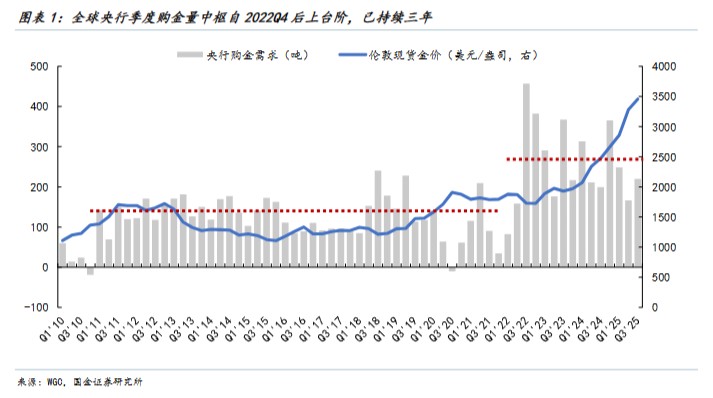
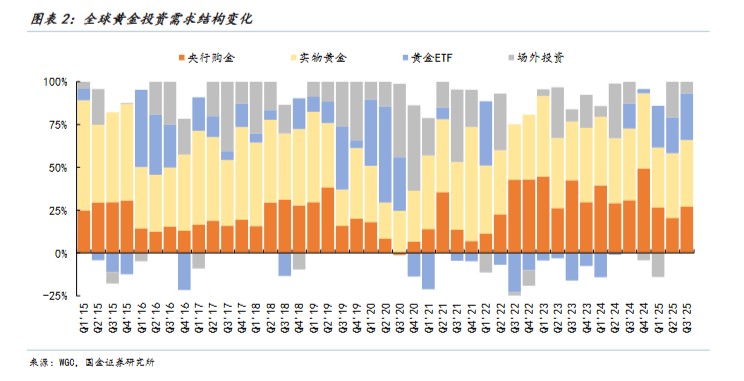
According to statistics from the World Gold Council, in the more than ten years prior to the third quarter of 2022, the average quarterly gold purchases by global central banks were around 100-200 tons, which rose to 200-400 tons after the third quarter of 2022. The share of "central bank gold purchases" in gold investment demand increased from 15% in the first quarter of 2022 to a peak of 54% in the fourth quarter of 2024.
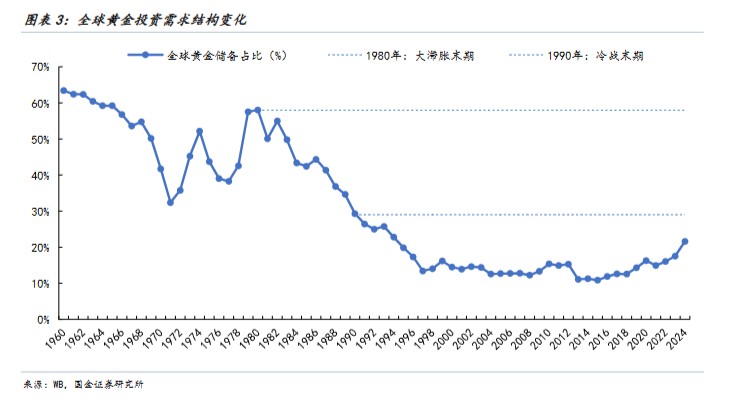
Even after three consecutive years of significant increases, global central banks still have a relatively low allocation to gold. According to World Bank data, in 2024, the proportion of gold reserves in global central bank reserves is about 22%, an increase of 7 percentage points from three years ago, but still falls short compared to historical turning points in significant geopolitical landscapes. This figure was 29% at the end of the Cold War in 1990 and 58% at the end of the stagflation period in 1980. If the proportion of gold reserves held by central banks were to return to the 1990 level, there would be an additional 7% increase space, corresponding to a gold purchase demand of about 3,400 tons.
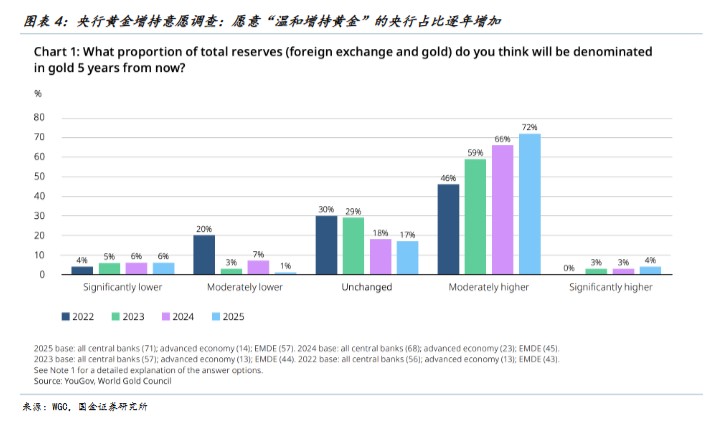
The 2025 survey results from the World Gold Council regarding central bank gold reserves show that 76% of the surveyed central banks indicated that the proportion of gold reserves will continue to "moderately increase" over the next five years (46% in 2022, 62% in 2023, and 69% in 2024). The performance of gold during crises, portfolio diversification, and the demand for inflation hedging are their core reasons for increasing gold holdings.
We believe that under the depreciation trade of diminishing dollar credit, gold, as a scarce currency asset backed by non-sovereign credit, is unlikely to see an end to its value reassessment, and gold prices have already "lost their anchor." In this process, the demand for gold purchases by central banks has not weakened; although the short-term gold purchase volume may not match the market's funding frenzy, it will become an important foundational force for gold prices. When gold prices undergo technical corrections, the expectations of central banks and sovereign funds for gold purchases will constrain the correction space and sustainability.
Market Funds: The Demand for Portfolio Optimization and Hedging AI Narratives Remains
For investment institutions, the long-term value of gold lies in its low drawdown and low correlation with traditional equity and bond assets, making it an indispensable hedging tool in major asset allocation portfolios. For example, risk parity strategies pursue low volatility and low correlation of underlying assets, and allocating gold can balance the high-risk contribution from stocks, achieving a more robust "all-weather" operation for the portfolio. The long-term allocation ratio of gold in a simple risk parity strategy portfolio is typically between 8%-10% or even higher.
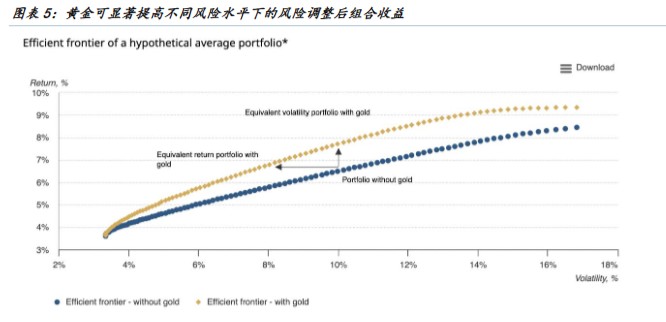
Furthermore, the core of the Markowitz mean-variance strategy portfolio is to maximize risk-adjusted returns, and gold naturally serves as an efficient "optimizer" for the efficient frontier. Due to its low correlation with assets such as stocks and bonds, adding gold to the portfolio can shift the efficient frontier upward to the left, enhancing returns at the same level of risk or reducing risk at the same level of return. The gold allocation ratio in a mean-variance strategy portfolio depends on the overall risk level of the portfolio, generally requiring more than 5% allocation to gold.
Although the aforementioned major asset allocation portfolios already have a certain exposure to gold, there are still some non-institutional investors and traditional equity-bond strategy portfolios that have not ventured into gold. This is because, for a considerable period in the past, equity-bond hedging was effective, and bonds were sufficient to diversify the volatility risk of U.S. stocks. Over the 40 years prior to 2022, the global economy experienced a declining interest rate environment and a dividend era characterized by cooperation among superpowers, especially after 2008 when major central banks in the U.S., Europe, and Japan maintained extremely loose monetary policies for many years. However, since 2022, factors such as the global pandemic, Western populist politics, and the interest rate and inflation environment have caused significant changes in the global financial market.
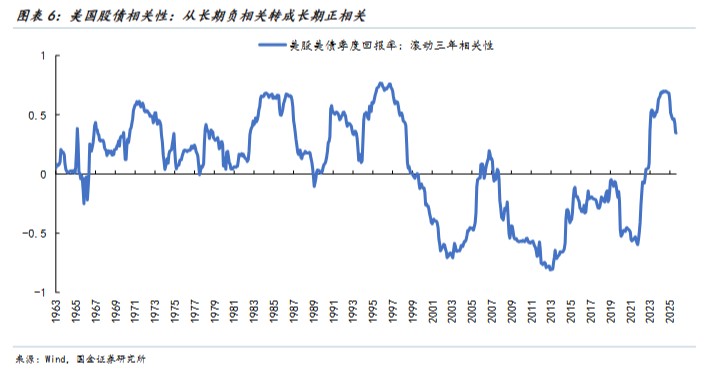
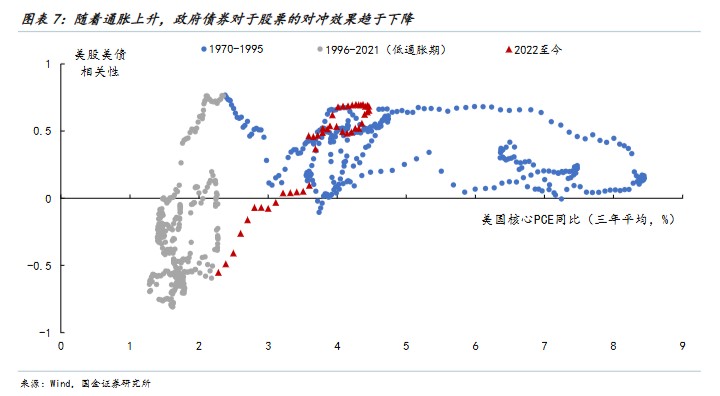
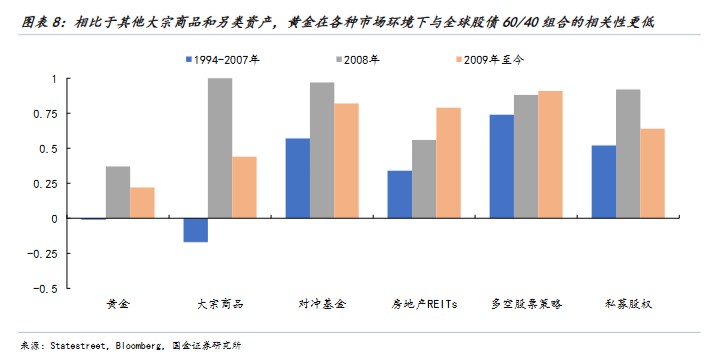
The persistent high inflation environment will largely undermine the value of government bonds as a tool for portfolio diversification. Historical experience over the past 50 years shows that when the U.S. core inflation level is below 2.5%, the correlation between U.S. stocks and bonds is generally negative (i.e., simultaneously allocating stocks and bonds can effectively diversify risk), but when core inflation exceeds 2.5%, this equity-bond hedging approaches failure This year, the positive correlation between U.S. stocks and bonds remains near a nearly 27-year high, highlighting the necessity of alternative assets as a diversification tool. Given that gold has historically had a low correlation with many traditional asset classes, strategically allocating to gold can help improve the risk-return profile of various portfolios across different market cycles. Moreover, after experiencing the triple whammy of the "Liberation Day Tariff" impact on dollar assets in April this year, the demand for traditional portfolios to hedge existing stock exposure has become even more urgent.
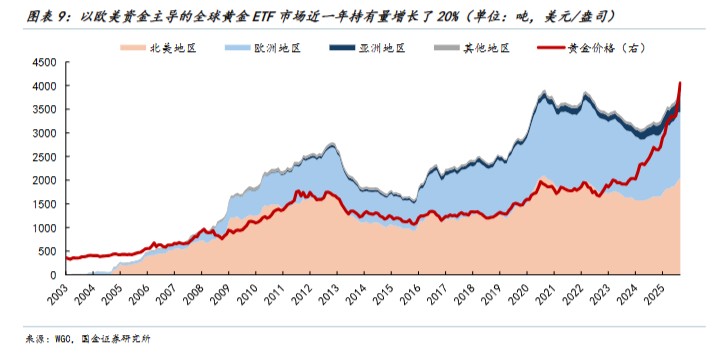
Following the risk parity approach to balanced risk allocation, Wall Street and major U.S. banks are adopting a "60/20/20" asset allocation mix of stocks, bonds, and gold instead of the traditional "60/40" mix, allocating 60% of funds to stocks for growth, 20% to bonds, and 20% to gold, in order to maximize protection against inflation, currency weakness, and market volatility. Over the past year, global gold ETF holdings have increased by 20%, and strong investment demand may not only be pricing in expectations for Federal Reserve rate cuts but also signals a transformation in traditional asset allocation strategies.
For trading funds, the demand for increased gold holdings still exists. On one hand, the Federal Reserve's rate-cutting cycle is not yet over, with the market pricing in 2-3 rate cuts next year, and expectations for lower real interest rates may drive market funds to buy into gold ETFs. On the other hand, the "long AI + long gold" barbell strategy is a bet on both ends of the next phase of the U.S. economy, as the "hedging" property of gold is expected to strengthen when the AI bubble reaches its later stages.
Learning from History, Has Gold "Overheated"?
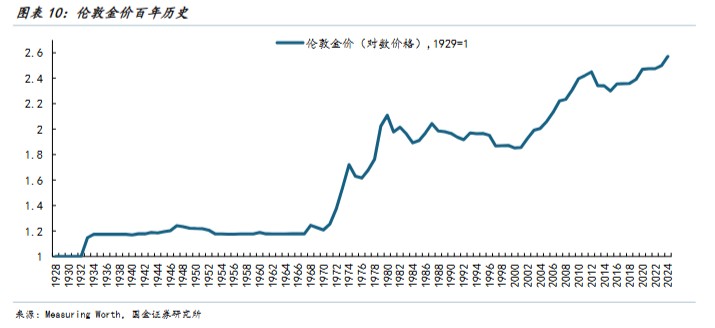
Looking back at the history of gold prices, the most relevant periods are World War II and the 1970s. After the stock market crash in 1929, the U.S. fell into the Great Depression, and public runs on gold led to the banking system nearing collapse. Under the gold standard, the issuance of dollars had to be linked to gold reserves, which limited the government's ability to solve problems through currency issuance, resulting in mass bank failures and widespread unemployment. Therefore, after the Roosevelt New Deal in 1933, it was announced that all banks in the country must stop gold trading and that gold would be nationalized After the outbreak of World War II, the Federal Reserve initially conducted some open market purchases aimed at stabilizing the short-term financing market and preventing market chaos amid the uncertainties of the early war period. After the United States officially entered the war, the fiscal deficit rate in the U.S. once soared to 27%, and the Federal Reserve stabilized the market interest rates through unlimited purchases of Treasury bills. As a result of this measure, from August 1939 to August 1948, the total amount of base money in the United States increased by 149%. Meanwhile, the price of gold in U.S. dollars rose by 123% during the same period.
During the Bretton Woods system, the price of gold was fixed at $35 per ounce. However, after World War II, the U.S. economy soared, and international trade was settled in U.S. dollars. With continuous economic expansion, the supply of dollars increased, leading to a rapid escalation of inflation in the U.S. The continuous deficit in the balance of payments forced the U.S. to rely on currency issuance to make up for it, further exacerbating inflation and putting the credibility of the dollar at risk of collapse.
Starting in the 1970s, a global rush to redeem gold began, and U.S. gold reserves decreased. The U.S. was concerned about its ability to continue supporting the dollar's convertibility into gold. The Bretton Woods system collapsed, and the price of gold shifted from a fixed price to a floating price. From 1973 to 1980, the price of gold skyrocketed from $35 to $850, a 24-fold increase. It wasn't until the Volcker era of aggressive interest rate hikes in 1980 that gold truly peaked. In the following 20 years, U.S. inflation gradually eased, the rise of internet technology improved the fiscal deficit rate, and by the early 21st century, a fiscal surplus was achieved, leading to another round of a major bear market for gold.
In the first decade of the 21st century, gold entered a new bull market, rising from $260 to a peak of $1,920, a 7.4-fold increase, catalyzed by a series of events including the "911" incident, inflation following rapid U.S. economic growth, the global financial crisis, and the European debt crisis. As the European debt crisis was contained and the U.S. economy gradually recovered, gold entered a 5-year bear market after 2011.
In the 17 years since the outbreak of the financial crisis, the average annual federal fiscal deficit rate in the U.S. has reached 6.3%. Even excluding the pandemic years of 2020 and 2021, the average deficit rate is still as high as 5.4%, far exceeding the average level of 1.7% from the 1950s to before the financial crisis. The economic growth model driven by fiscal overspending is the core reason for the continuous depreciation of the dollar relative to gold. The technical default of the U.S. on $300 billion of Russian foreign reserves after the Russia-Ukraine crisis marks a new phase of declining dollar credibility and influence, represented by the Chinese central bank, which has been reducing its holdings of U.S. Treasuries while significantly accumulating gold.
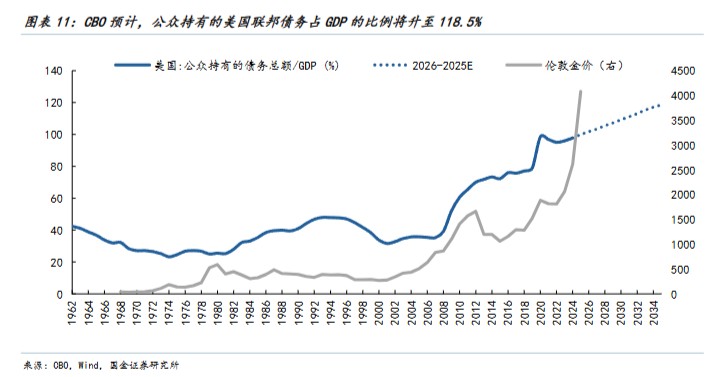
If we take the start of U.S. deficit monetization in 2008 as a baseline, the price of gold has increased by 5.7 times to date; if we take the technical default on Russian foreign exchange reserves in 2022 as a baseline, the price of gold has increased by 2.4 times to date. Compared to the 24-fold increase in gold prices in the 1970s, this round of the gold bull market has not shown significant signs of overheating The opposite of gold is the credit of the US dollar. In the long term, the upward trend of gold prices is positively correlated with the scale of US debt. According to the US Congressional Budget Office (CBO) forecast, by 2035, the total amount of publicly held US federal debt as a percentage of US GDP will rise from 97.8% in 2025 to 118.5%, exceeding the peak after World War II. In this context, there is still room for imagination in the gold bull market. Unless during this process, AI technology can bring a comprehensive improvement in productivity across industries from an organizational and structural level, leading the US out of stagflation and improving economic and fiscal efficiency, this would signal the end of the gold bull market.
Potential Spillover Effects of the Gold Bull Market: Focus on Silver, Copper, and Other Strategic Metals
If AI continues to inflate bubbles in the future, and gold stands as the opposite of AI, then the gold bull market may still have "spillover effects." This is reflected in two aspects: first, AI-related metals (silver, copper) may rise further; second, other strategic assets with "gold-like" properties may also need to catch up.
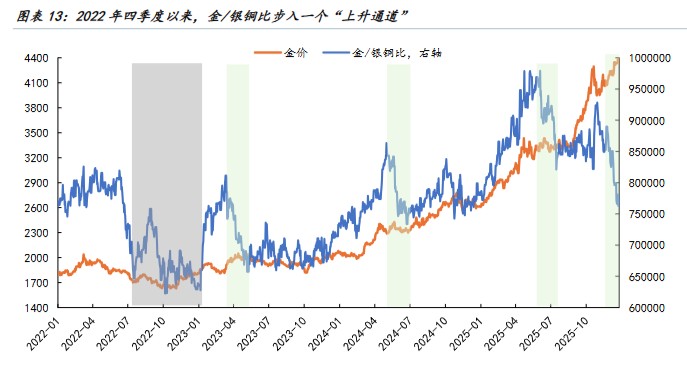
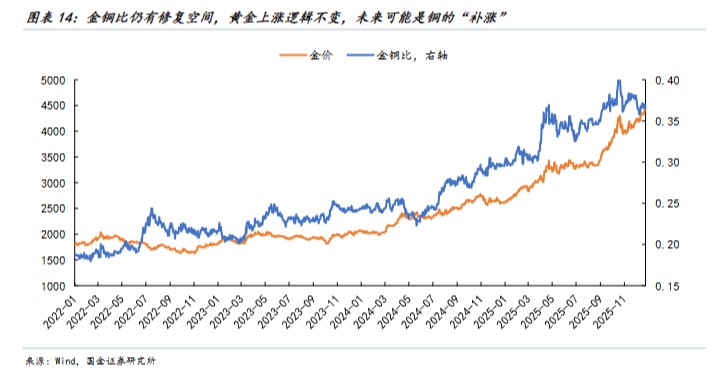
The market has commonly used the gold-silver ratio, gold-copper ratio, and gold-oil ratio as reference indicators to observe whether gold is overbought or oversold. Unlike silver and copper, the fundamental supply and demand for crude oil is currently weak, making the gold-oil ratio temporarily ineffective. However, silver, due to its good thermal and electrical conductivity, is used in chip packaging and internal circuit connections, while copper is the main transmission medium for wires and cables. Therefore, both silver and copper are essential in the chip manufacturing and computing power center construction phases of the AI wave, endowing them with "AI attributes."
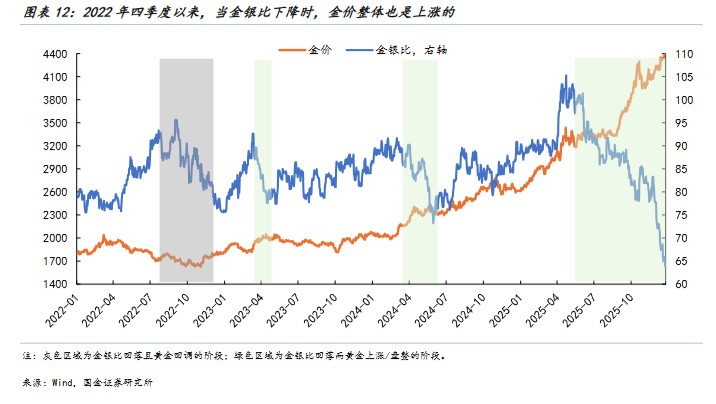
Gold stands opposite to AI and serves as the "insurance" of the AI narrative; thus, the gold-silver ratio of 6 and the gold-copper ratio should, to some extent, reflect a "mean reversion" relationship. Since silver itself also possesses certain "gold-like" properties, the logic behind silver's current rise is the clearest and most elastic.
In the past two years, whenever the "gold-silver ratio" or "gold/silver-copper ratio 7" has risen to a peak, gold has tended to "rest" at high levels rather than simply correcting, followed by a "catch-up" in silver and the silver-copper ratio (for example, from March to May 2023, from April to June 2024, and from August to October 2025). This indicates that the pure financial attributes of gold are strengthening, reflecting a deepening consensus in the market regarding chaotic order. Particularly, the "gold/silver-copper ratio" has shown characteristics of fluctuating within an upward channel. Considering the gold-silver ratio, gold-copper ratio, and gold/silver-copper ratio, copper may also have room for catch-up in the future.
In addition to silver and copper, attention can also be paid to the complementary effects between gold and other strategic metals. The current global geopolitical changes and great power competition have reduced mutual trust among countries regarding critical minerals, leading to a race to find strategic assets with "gold-like properties."
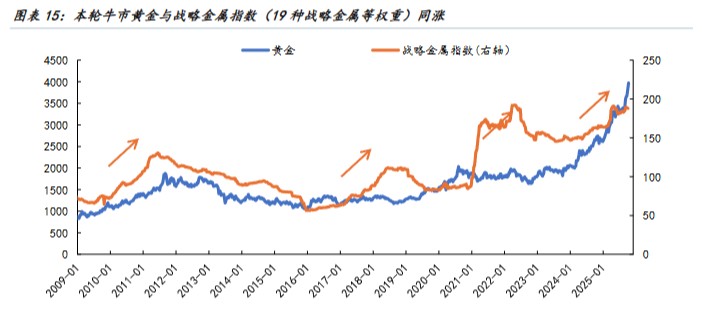
The backup for currency is buying gold, and the backup for production is mining and stockpiling minerals. Gold and strategically important minerals are complementary under the chaotic backdrop of global order. When a country's rare minerals are viewed as powerful bargaining chips for negotiation and balance, the eventual outcome may be a gradual formation of a mean-reverting price relationship between gold and strategic metals, achieving synchronized growth.
We construct a "Strategic Metal Index" based on equal weights of 19 rare strategic metals in the London strategic metal market. The previous three rounds of global strategic metal bull markets (①2009-2011, ②2016-2018, ③the first half of 2021) were triggered by tight supply combined with expanding private sector demand, showing some dislocation with the gold bull market, but this round may resonate with demand from both the private and public sectors. Starting in 2024, the strategic metal bull market has shown a clear "catch-up" momentum with the gold bull market, and this trend currently shows no signs of a turning point.

Looking ahead to 2026, when the market's pricing logic regarding "AI unknowns" has not yet changed, the lack of order remains a favorable environment for gold. When the AI bubble and gold form a "dumbbell," gold has already realized its value as insurance for AI holdings during its peak moments. Silver, as a narrative asset that possesses both "gold-like" properties and is related to AI electricity, has higher elasticity in certain phases. Once the AI narrative becomes clear, gold's peak moments may come to an end, and at that time, the silver narrative that benefits from both ends will also return to rationality.
Risk Warning and Disclaimer
The market has risks, and investment should be cautious. This article does not constitute personal investment advice and does not take into account individual users' specific investment goals, financial conditions, or needs. Users should consider whether any opinions, views, or conclusions in this article align with their specific circumstances. Investing based on this is at one's own risk
