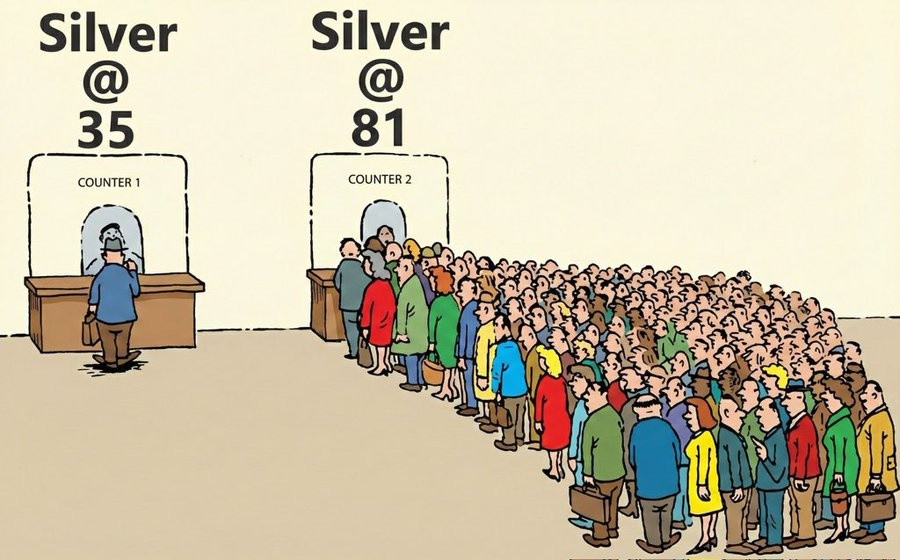
Silver at 35 is "deserted," while silver at 81 is "bustling."

The price of silver is expected to rise from $28 per ounce in 2025 to $82, an increase of 185%. Supply shortages and increased industrial demand are driving the price up. There is strong demand for silver from industries such as solar panels and electric vehicles. The Federal Reserve's interest rate cuts, government deficits, inflation, and geopolitical tensions make silver more attractive. It is predicted that prices may continue to rise in 2026, while UBS warns that prices are too high, and Citibank expects a drop to $42
In 2025, the price of silver experienced an extraordinary rise, climbing from about $28 per ounce at the beginning of the year to over $82 per ounce by the end of December, marking an increase of approximately 185% year-to-date.
This is arguably one of the most striking investment stories of the year, with silver's performance far exceeding that of traditional assets.
The silver market has faced a supply shortage for five consecutive years, meaning that global silver consumption has outstripped production.
The cumulative gap over these five years totals approximately 800 million ounces, roughly equivalent to a full year's output from global mines.
Over the past decade, mineral production has actually been declining, peaking in 2016, indicating that there are real structural constraints on supply rather than temporary factors.
At the same time, industrial demand has been exploding.
Solar panels consume over 20% of the world's silver supply, and the deployment of global renewable energy is accelerating.
Silver is also crucial for electric vehicles, electronics, artificial intelligence infrastructure, and 5G technology. Industrial silver production is expected to exceed 700 million ounces for the first time by 2025.
This is significant because it indicates real consumption; businesses need silver to produce products that people actually buy and use, so this is not just investors betting on price increases.
The macroeconomic environment has shifted in favor of silver.
When the Federal Reserve lowers interest rates, non-interest-bearing assets like silver become more attractive to investors as the opportunity cost decreases.
Additionally, concerns about government deficits, inflation, and geopolitical tensions are prompting people to turn to hard assets that they believe can retain value during uncertain times.
Geopolitical risks have further exacerbated this trend, with concerns about trade wars prompting manufacturers to stockpile silver before potential tariffs take effect, creating sudden buying pressure.
Most forecasters expect silver prices to remain high in 2026, with the potential for further increases.
Some aggressive analysts predict that gold prices could reach $95-100 per ounce within the next 12-24 months.
UBS warns that current silver prices seem too high, while Citibank expects silver prices to retreat to around $42 per ounce.
Looking ahead to 2027-2030, the bullish case becomes even more compelling.
The issues of supply shortages and accelerating demand for green energy will not resolve themselves quickly.
In realistic scenarios, long-term forecast prices are around $77-88 per ounce by 2030; more optimistic forecasts suggest prices could exceed $200 per ounce.
Some forecasters warn that if industrial demand weakens or higher prices prompt mining companies to produce more silver, the current price levels may be difficult to sustain.
However, investors should carefully consider their entry points and position sizes, especially in situations where retail investors are flooding in and market sentiment is extremely optimistic, as these conditions often signal an impending correction.