Is AI now at "1998" compared to the internet bubble?

Guotai Junan Securities compares the current AI wave to the late stage of the internet bubble in early 1998, believing that we are currently at the tail end of the "1→N" phase: high revenue growth but slowing margins, with valuation premiums only one-third of the extreme levels seen that year. A moderate correction is expected in mid-2026, followed by a more bubble-like "N→N+" acceleration phase. However, unlike in 1998, this round of tech stocks has stronger profit support
If history is a mirror, the AI wave is reflecting the shadow of 1998. The annual strategy report released by the team led by Wang Xueheng from Guosen Securities on the 27th believes that the current stage of AI industry development is highly analogous to the early 1998 period of the internet bubble in terms of time dimension, specifically the later stage of the "1→N" phase.
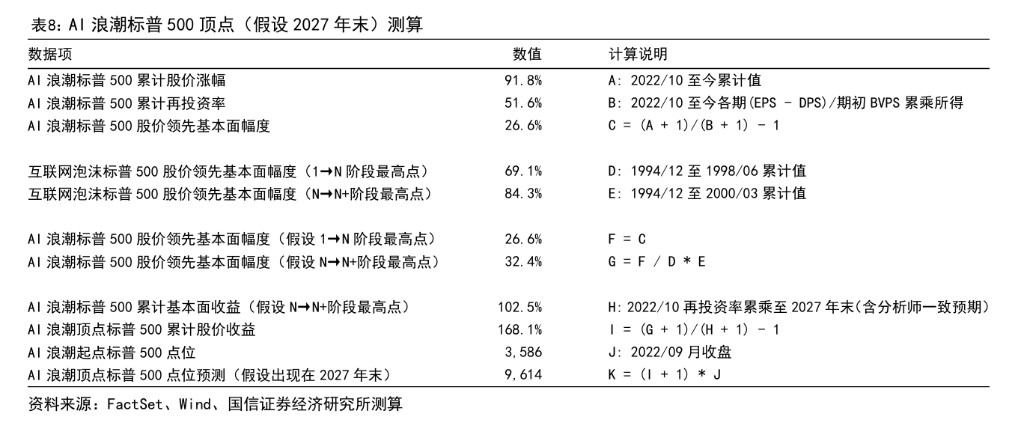
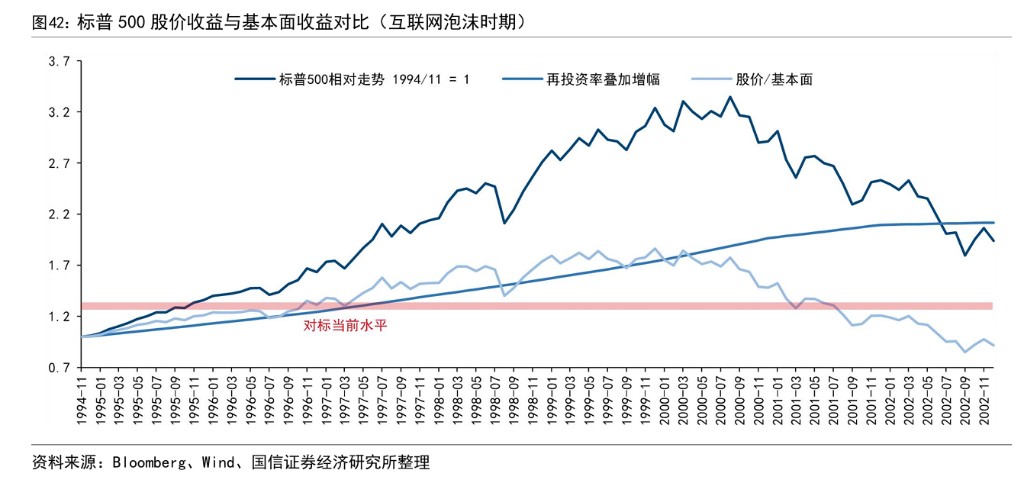
Compared to the internet bubble period, the current AI wave has only reached about one-third of the limits seen at that time in terms of spatial development. Data shows that since October 2022, the S&P 500 index has outperformed its fundamentals by approximately 27 percentage points, far below the peak level of 85 percentage points during the internet bubble. The degree of style differentiation between Nasdaq and the S&P 500 is also only about one-third of what it was then. This means that despite recent market concerns about high valuations, the valuation pressure of the AI market has not yet reached extreme levels from a historical perspective.
The direct impact of this judgment on investors is to recalibrate expectations for the next two years. The report predicts that the "1→N" phase of the AI wave will come to an end around mid-2026, at which point the market may experience a mild correction, with the S&P 500 potentially retreating to around 6700 points. However, this does not signify the end of the market but rather the prelude to the "N→N+" phase. In the second half of 2026, as the bubble concentrates, the market, especially tech stocks, is expected to accelerate, potentially pushing the S&P 500 to challenge the high of 9600 points by the end of 2027.
Therefore, the first half of 2026 will become a critical window for investors to adjust their portfolio structure and optimize the cost of AI positions. Unlike the weak fundamentals during the internet bubble, the current AI wave shows stronger profit support from Nasdaq, which not only continues to outperform the S&P 500 but also has the potential for a widening gap in future upward trends.
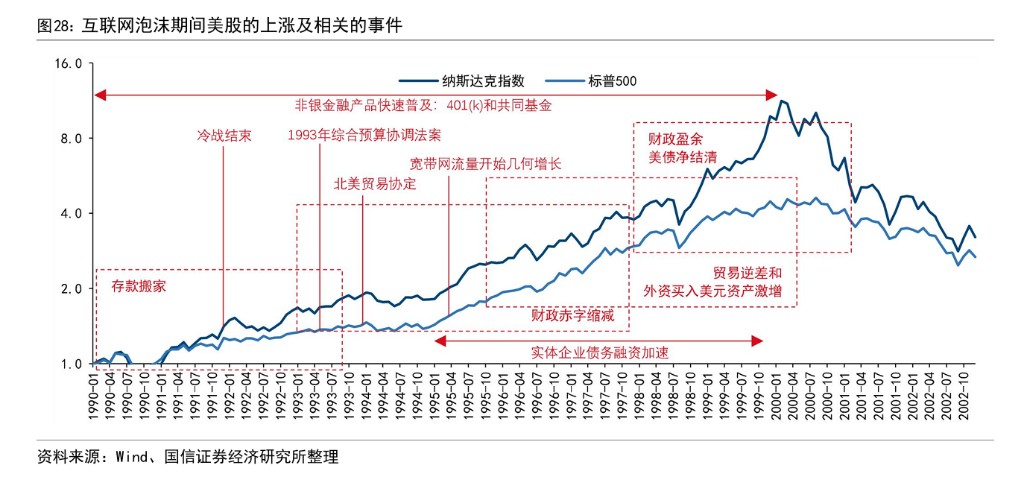
The Essence of the Internet Bubble: A Feast of Capital Accumulation
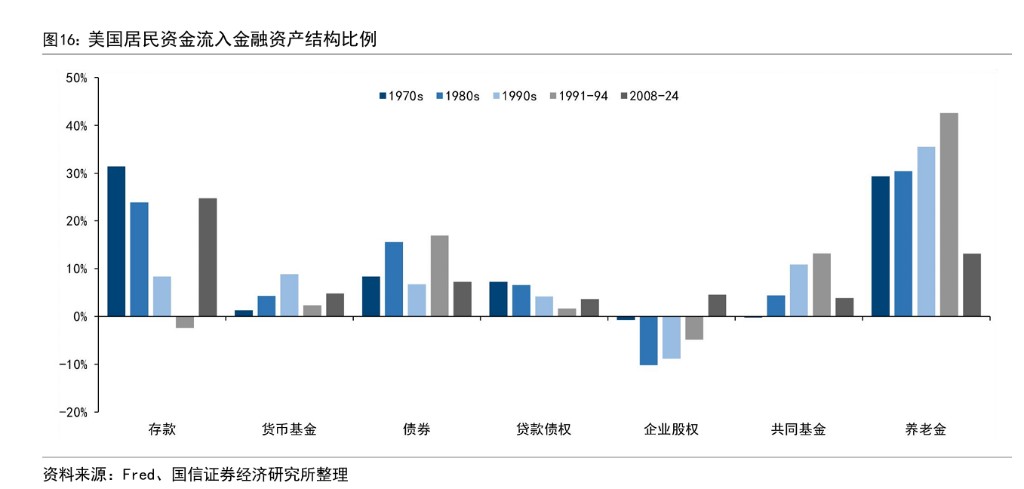
The research report states that looking back at history, the internet bubble was not merely an industrial frenzy but a product of the imbalance between capital and asset supply and demand under a special historical context. At that time, the United States was in a "peace dividend" period following the end of the Cold War, with fiscal surpluses leading to a significant reduction in U.S. Treasury supply, resulting in a severe "asset shortage." Meanwhile, the relocation of deposits and pension system reforms (401k) spurred a boom in non-bank finance, combined with massive foreign capital inflows brought about by trade liberalization, flooding the equity market with vast amounts of capital.
This extreme abundance of capital coincided with the rise of internet industry narratives. The market severely underestimated the supply capacity of fiber optic technology due to cognitive biases, mistakenly believing that network resources would be in long-term shortage, thereby supporting aggressive capital expenditure plans This expectation of "overestimating demand and underestimating supply" has transformed financing funds into industrial profits, attracting more capital into the market and forming a self-reinforcing positive feedback loop. Ultimately, this bubble was not burst by high debt leverage but was pierced by the concentrated selling pressure of equity assets in the primary market in early 2000, as well as the reality of excess supply in the fundamentals.
Time Anchor: AI is in the late stage of "1→N"
Bringing the focus back to the present, by comparing key indicators, the research report believes that the timeline of the AI wave has reached a position similar to that of 1998. From the perspective of revenue growth in the industrial chain, the internet bubble went through four stages: the preparation period, "0→1", "1→N", and "N→N+". NVIDIA, as the upstream representative of this round of the AI wave, shows a revenue growth trend in its data center business that closely aligns with that of Cisco back in the day. If we extrapolate from Cisco's historical trajectory, the current AI wave is in the "1→N" stage, where revenue growth is marginally declining but still remains high.
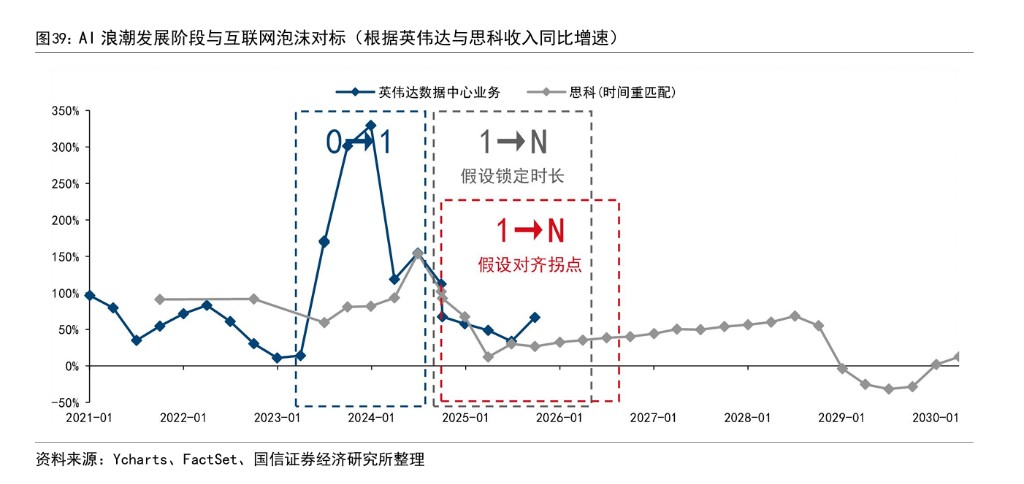
Another comparison comes from CoreWeave, which focuses on AI cloud computing, and the former America Online (AOL). The revenue growth comparison between the two also indicates that the current AI industry is in the application expansion phase. Overall, this stage is expected to last until mid-2026. Referring to the market performance of 1998, the "1→N" stage typically ends with a mild market correction before entering the most frenzied and severely bubbled "N→N+" stage.
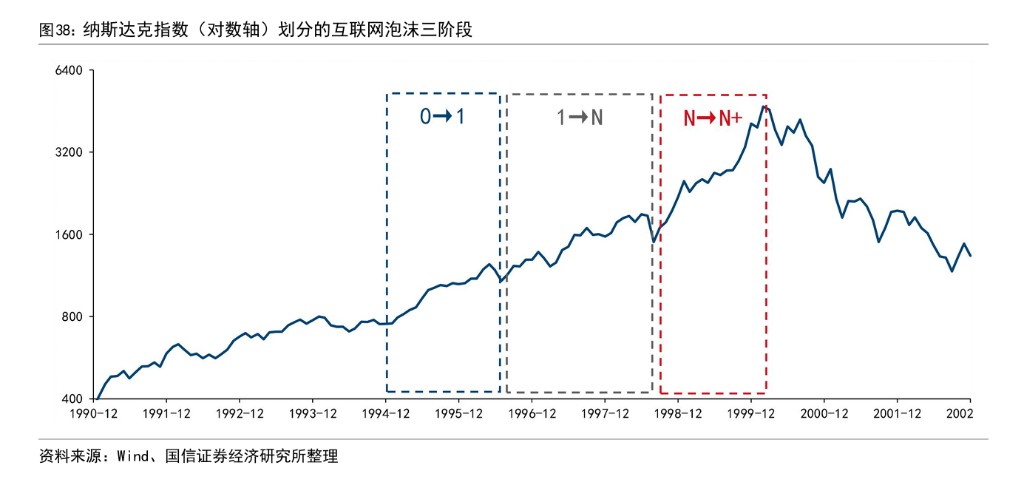
Spatial Estimation: Valuation pressure is only one-third of the bubble peak
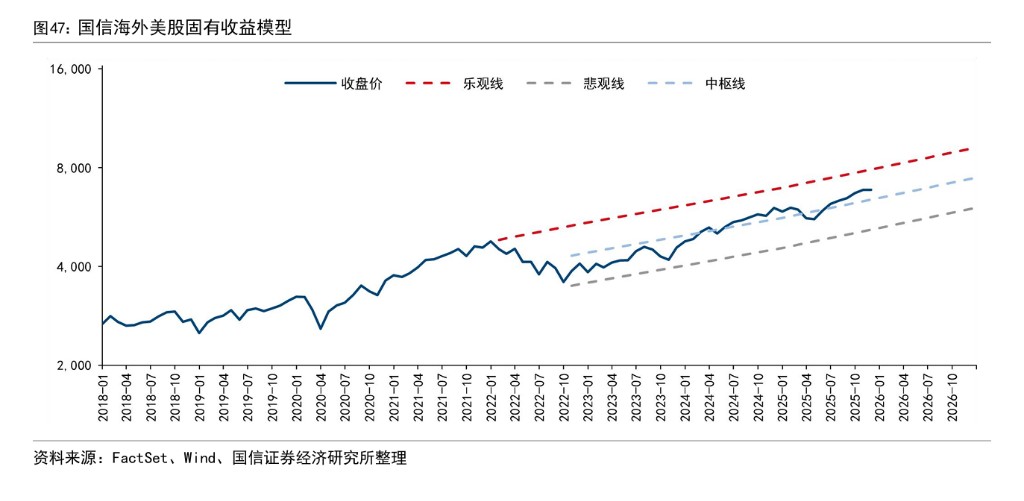
Although AI concept stocks have surged remarkably, their level of bubbleization is far from that of the internet era. The report uses the "inherent earnings model" for comparison and finds that the current S&P 500 index stock price has outperformed the fundamentals (cumulative reinvestment rate) by about 27%, while during the late stage of the "1→N" phase of the internet bubble, this figure had already reached 69%, peaking at 84% during the bubble's peak. In other words, the current market's valuation premium is only about one-third of the extreme level of the internet bubble.
The differentiation in styles also confirms this point. Since October 2022, the Nasdaq index has outperformed the S&P 500 by about 6 percentage points on an annualized basis. In contrast, during the internet bubble, this excess return was as high as 18 percentage points. This difference mainly stems from the improvement in fundamental support: in this round of the AI wave, the profitability of Nasdaq component stocks is significantly stronger than that of the overall S&P 500, providing more solid fundamental support for stock prices rather than purely emotional speculation.
Outlook for 2026: Adjusted Accelerated Sprint
Based on the above comparison, the future market path is gradually becoming clear. The report believes that in the first half of 2026, as the "1→N" phase comes to an end, the S&P 500 may face an adjustment similar to that in mid-1998. Calculations indicate that the index may retract to around 6700 points, exhibiting a sideways fluctuation. This will be a good opportunity for investors to reassess their holdings and prepare for the next phase.
After crossing this adjustment period, the market is expected to enter the "N→N+" phase, ushering in an accelerated rise similar to that from 1999 to early 2000. Under the baseline assumption, the neutral point for the S&P 500 is expected to reach 7500 points by the end of 2026. If market sentiment further evolves, the index may even challenge 9600 points by the end of 2027. During this process, the Nasdaq index is expected to maintain excess returns over the S&P 500, potentially reaching around 23500 points by mid-2026, and further widening its lead thereafter. Of course, this path still faces multiple uncertainties from factors such as Federal Reserve monetary policy, macroeconomic expectations, and the pace of AI technology evolution.