


The competition in energy storage has actually begun, and the intensity in the future may far exceed that of photovoltaics?

The energy storage industry may face intense competition similar to that of the photovoltaic industry. Although the energy storage supply chain is relatively long and has certain resilience, industry insiders are concerned that competition has already begun to intensify and may be more rapid and severe than that of photovoltaics in the future
Energy storage, will it repeat the internal competition of photovoltaics?
Regarding this question, Gan Tanhao has thought deeply and holds an optimistic attitude. The main reasons are as follows:
- The energy storage industry chain is very long, extending from spodumene, lithium carbonate, positive and negative electrode materials, battery cells, PACK, all the way to energy storage power stations, with a downstream segment also being diverted by power batteries, which is much longer than the rigid photovoltaic manufacturing industry. The longer the industry chain, the more buffering links there are, thus making it more resilient;
- The focus of the energy storage industry is not on the upstream, but on the midstream battery cells. With CATL as the leading vertically integrated giant, its market share is far greater than that of the leading silicon material companies, giving it significant power over the upstream and downstream. If CATL does not want to engage in competition, energy storage cannot become competitive;
- The end exports of lithium batteries are different from photovoltaics, with a large portion of products being highly market-oriented electric vehicles, while the end form of photovoltaics is components, with prices directly controlled by the bidding mechanisms of the five major and six minor players;
- The global division of labor and cooperation in the energy storage industry is also much broader and deeper than that of photovoltaics. Market participants include not only Chinese companies but also companies from Europe, America, and Japan, making it not so easy to push them out of the competition;
- Lastly, energy storage systems, especially large-scale storage, test overall solutions, which are not as homogeneous as photovoltaic components.
Of course, there are many more reasons, but I won't list them all here. However, it has been proven that Gan Tanhao is somewhat overly optimistic about the energy storage industry. After all, this industry is still too young compared to photovoltaics and has not gone through a proper cycle.
During the 2025 China Photovoltaic Industry Annual Conference, I communicated intensively with mid-to-senior executives from several energy storage companies on-site, and the answers I received were: the internal competition in energy storage has actually already begun and is intensifying. Many energy storage practitioners believe that the internal competition in the energy storage industry may be even faster, stronger, and harder to conclude than that of photovoltaics!
Every instance of internal competition has an incentive
Whether in photovoltaics or energy storage, whenever there is a major explosion in overseas markets, Chinese companies will massively expand production. There is often a time lag from supply shortages to capacity release. These often lay the groundwork for the hidden dangers of overcapacity.
If it weren't for the European energy crisis triggered by the Russia-Ukraine conflict, the past three years of massive expansion in photovoltaics and household storage would probably not have been so intense; similarly, if it weren't for the emergence of new demands like AIDC leading to power shortages, the overseas large-scale storage explosion would not have occurred so rapidly.
These are external factors that can only be seen as the fuse. In various regions, in order to seek new momentum for GDP development, "internal competition" in attracting investment + government industrial guidance funds personally engaging in production capacity have been important drivers of overcapacity, disorderly competition, and even internal competition in many emerging industries.
It is a good thing for companies to expand reproduction and make more money. Competition itself is not scary; free competition is precisely the essence of the market. Sometimes, it is often difficult to clearly define the boundary between normal market competition and vicious internal competition. Because of this,
There are always those who, in the name of the so-called market, sing against this round of anti-internal competition and push back.
Currently, our country is solidly promoting the preparation of the "14th Five-Year Plan," a period that is crucial for laying a solid foundation for the basic realization of socialist modernization and making comprehensive efforts, holding an important position in bridging the past and the future If deep reforms cannot be advanced with a systematic approach, breaking down institutional barriers and fundamentally solving prominent issues in development, it will only lead to treating symptoms rather than the root causes.
To put it bluntly, if the fundamental problems are not addressed, whether it is photovoltaic, energy storage, semiconductors, GPUs, or lithography machines, even if we manage to develop them and industrialize them, they can still end up being as cheap as "cabbage."
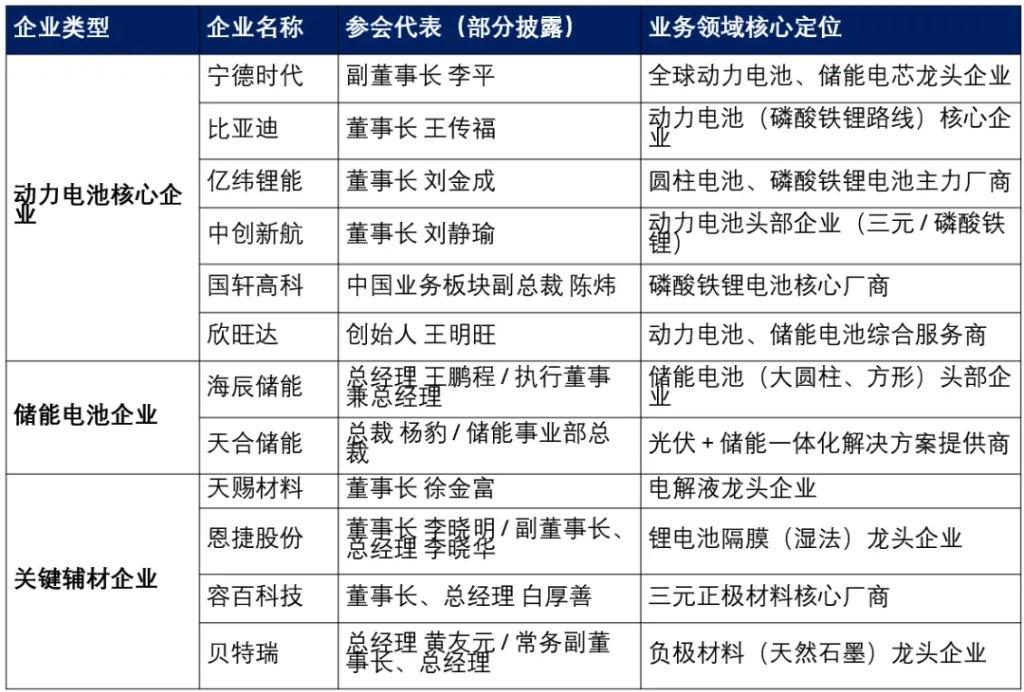
List of companies attending the seminar
On November 28, 2025, the Ministry of Industry and Information Technology held a seminar on the lithium battery industry, focusing on core issues in the energy storage industry such as "disorderly competition at low prices," "blind expansion," and "product quality and safety bottom line." So, how can energy storage systematically avoid repeating the inward competition seen in photovoltaics?
Prices have collapsed, who is stirring the pot?
The most intuitive feeling of inward competition in energy storage comes from two simultaneous facts: the overseas market is experiencing explosive growth, lithium carbonate prices are rising, but while the shipment volume of energy storage products has surged, prices have not risen in tandem. This has led to the gross margins in the energy storage industry not rising as sharply as the overseas explosive orders, but rather continuing to decline.
A research report from BloombergNEF indicates that by 2025, the average price of global stationary energy storage battery packs will drop to about $70/kWh, a year-on-year decrease of about 45%; if looking at the entire turnkey system, the average price will be about $117/kWh, a year-on-year decrease of about 31%.
This is not a gentle cost reduction, but rather the entire energy storage industry chain and companies are exchanging price for volume and volume for cash flow. How similar is this situation to the photovoltaic industry in the second half of 2023 and throughout 2024? At that time, all photovoltaic companies were also exchanging price for volume, lowering prices to increase sales, which later resulted in increased volume but also falling prices. The final outcome is that prices cannot be maintained now and in 2026, and volume begins to decline due to oversupply.
Guan Tan Hao believes that in the domestic market, the bidding mechanism that favors the lowest price and emphasizes price alone has completely "standardized" competition in the energy storage industry: when price becomes the most important or even the only criterion for evaluation, it quickly leads the industry into the logic of "the lowest price is the competitiveness." In April 2025, the winning bid price for energy storage systems (equipment) had already reached a limit low price of 0.405 yuan/Wh, and it is approaching 0.4 yuan/Wh in multiple projects.
This is very similar to the bidding for centralized photovoltaic modules.
I remember that as early as August 29, 2024, the China Photovoltaic Industry Association initiated a proposal at the "Photovoltaic Power Station Construction Bidding Price Mechanism Seminar" to unite upstream and downstream companies to further optimize the bidding mechanism for photovoltaic power station construction, such as adopting a two-step opening method, using a reasonable average price as the target price, and incorporating product and technology innovation, product quality reliability, intellectual property, and independent controllability into the scoring system. However, which central state-owned enterprises have adopted this proposal now? Has it been solidified in the form of systems or regulations? If photovoltaic energy hasn't succeeded, or if it's been difficult and slow to promote, can the energy storage industry succeed?
Additionally, the punishment for bidders who bid below cost is indeed too lenient. Recently, the results of the first batch of centralized procurement for photovoltaic modules by the Three Gorges Group for 2026 were announced, and some leading companies did not bid according to industry self-discipline requirements. Of course, while most leading companies can bid at self-discipline prices, there are quite a few companies that secretly adopt "buy ten, get one free" contracts. Who has been punished or disciplined for this?
In the energy storage industry, there are countless cases of bidding below cost.
China General Nuclear Power Group's 202 annual 10.5GW energy storage system centralized procurement: for the grid-type (6GWh), the bidding range was 0.458–0.518 RMB/Wh, with 37 out of 47 bidders quoting below 0.5 RMB/Wh; the final candidate's equivalent unit price was in the range of 0.463–0.481 RMB/Wh.
CATL became the first candidate in a 300MW/1200MWh project in October 2025 with a quote of approximately 0.499 RMB/Wh.
BYD's lowest quote in a 1GWh energy storage system procurement in September 2025 was approximately 0.444 RMB/Wh (range 0.444–0.496 RMB/Wh).
CRRC Zhuzhou's equivalent unit price in a 2GWh system centralized procurement in October 2025 was about 0.412 RMB/Wh.
No wonder many centralized system companies lament that the internal competition in the energy storage industry truly began when battery cell companies entered the fray. As a subsidiary of a state-owned enterprise, CRRC Zhuzhou has long won bids at low prices, but its scale is relatively limited. When CATL and BYD enter the market, the price system that was previously upheld by system integration companies like Sungrow Power Supply was quickly breached.
When "0.4–0.5 RMB/Wh" becomes the norm rather than an exception, a dangerous consensus will emerge in the energy storage industry: as long as the scale is large enough, the integrated industrial chain is long enough, and financing is cheap enough, leading companies like CATL and BYD can drive the prices of large storage systems down to a level where other competitors cannot survive.
This is precisely the first reason why "the speed may surpass that of photovoltaic": the price benchmark is rapidly unified by the bidding system, and the spread of price wars is much faster than the decentralized games of photovoltaic in the past.
When chips are hard to come by, leading companies take the lead in expanding production, and global capacity is clearly oversupplied
I remember a photovoltaic big shot once told a joke: when it comes to photovoltaic capacity oversupply, everyone will say that the oversupply is from others, and their own capacity is never oversupplied. This is both business and human nature, simply "greed."
From the demand side (installed capacity/shipment)—
CNESA disclosed that in the first half of 2025, China's new energy storage added 23.03GW / 56.12GWh of installed capacity, with approximately 35.8GW added from January to October 2025, and it is expected to reach about 42–45GW for the whole year Under the international institutional perspective, China's new energy storage capacity in 2025 has also been significantly revised upwards. The Financial Times cited BNEF, stating that China will add approximately 47.6GW/130.4GWh in 2025, while noting that rapidly declining prices are reshaping the global market.
On the shipment side, CNESA disclosed that in the first half of 2025, Chinese companies shipped 233.6GWh of global energy storage batteries (excluding base station/data center batteries).
From the supply side (manufacturing projects/capacity) perspective——
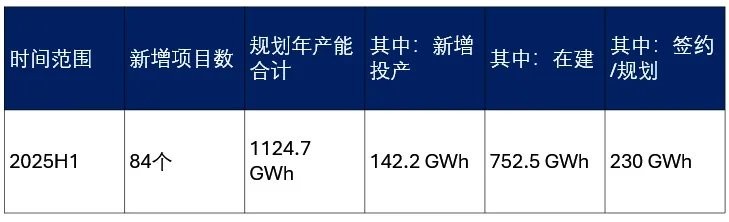
This data comes from the Economic Reference Daily's citation of the CESA industry database.
The Economic Reference Daily, under Xinhua News Agency, cited the CESA industry database, indicating that in just the first half of 2025, there were 84 new domestic lithium battery manufacturing projects, with a planned annual production capacity totaling 1124.7GWh; among them, 142.2GWh has been newly put into production, 752.5GWh is under construction, and 230GWh is signed/planned.
The same source also pointed out that as of June 30, 2025, the production capacity of the top 15 domestic lithium battery companies has exceeded 2100GWh, with domestic capacity accounting for over 70% of the global total.
On a global scale, the IEA emphasized in its 2025 commentary that global battery manufacturing capacity reached approximately 3TWh in 2024, while demand was about 1TWh, and multiple countries are accelerating the construction of local supply chains.
Therefore, the current "chip shortage" is more like a structural scarcity: what is tight is the large battery cells and complete package solutions that are recognized by top customers, validated, and can be delivered stably; what is not tight is the "paper capacity" that lacks customer orders, long-term warranty capabilities, and engineering validation records.
At the same time, various regions are competing to launch battery cell projects, treating short-term shortages as long-term certainties, which is pushing the industry towards a typical "time lag trap"—the time difference between capacity construction and demand realization will turn today's scarcity into oversupply and price collapse in the coming years.
When the capacity structure has already shown "overcapacity," price wars are almost an automatic result: as long as demand growth fluctuates slightly, capacity utilization will become a lifeline for every enterprise.
What is more troublesome is that energy storage differs from photovoltaics in one aspect: the demand for energy storage is not a single market. It is simultaneously influenced by electricity spot/ancillary service mechanisms, grid connection standards, project financing, owner credit, system safety events, and overseas policy cycles. Any tightening on one end will amplify the pressure on the supply side—and the pressure on the supply side will first be reflected in pricing.
Looking at it now, industry concentration is actually a double-edged sword: sometimes it is easier to manage an industry, but sometimes it can also lead to the collapse of an industry. The Carbon Number often says that whether an industry is good or whether there is a healthy ecosystem depends on the leader. If the leader is doing well, the entire industry will not be too competitive. If the leader is always trying to eliminate competitors, then this industry will definitely face life-and-death struggles The Carbon Rush originally leaned towards one judgment: the energy storage chain is longer, has stronger engineering attributes, and the concentration of midstream battery cells and system integration is significantly higher than that of photovoltaics, which should theoretically be more conducive to avoiding internal competition.
This judgment is not fanciful. Just looking at the export structure, CATL's share of China's energy storage battery exports for the first ten months of 2025 was disclosed to be about 58.4%.
High concentration means that two things are true at the same time:
First, the industry is more likely to form a "consensus mechanism." In photovoltaics, the upstream silicon material is concentrated, while the downstream components are dispersed, leading to a naturally torn profit chain; if energy storage is dominated by a few leading battery cells and system manufacturers, the probability of "sitting down to negotiate" is at least higher.
But the second point is more fatal: high concentration also means that the behavior of benchmark enterprises will be replicated across the entire industry.
When leading participants like CATL, BYD, and CRRC Zhuzhou put prices in the range of 0.4–0.5 yuan/Wh in public procurement, this is no longer ordinary order grabbing, but rather resetting the life-and-death line for the entire industry.
To the outside world, everyone only sees the continuously emerging costs; but for the entire energy storage supply chain, the pressure will be transmitted synchronously in several directions:
Warranty and quality assurance commitments are financialized: the lower the quote, the more reliant it is on stuffing future risks into the terms; once performance standards or safety incidents occur, the resulting disputes will be more complex than in photovoltaics.
Redundancies in materials and manufacturing are compressed: energy storage is not just about delivering photovoltaic panels at once; it is a system that must continuously operate under high temperatures, cycles, rates, and grid disturbances.
The Carbon Rush believes the worst part is that such projects have not set a good precedent: once central state-owned enterprises establish such low-price anchors with leading companies, all subsequent project tenders will gravitate towards this anchor point, which will inevitably further squeeze the survival space of non-leading manufacturers and innovative products.
Photovoltaics once saw a multitude of players competing; energy storage may ultimately evolve into a situation where a few leading companies take the lead, and other companies can only passively follow.
How to Leave Room as Overseas Capacity Fully Emerges?
The pain of photovoltaics at least has a buffer zone of "upstream advantages": the international dominance of silicon materials, silicon wafers, and other links allows China to have the ability to "stabilize price expectations through supply-side adjustments" at certain stages.
However, energy storage is different; overseas capacity is systematically emerging, and policy and safety factors are pushing energy storage into a more sensitive position.
First, the sensitivity of trade and industrial policies in the energy storage industry is actually higher than that of photovoltaic components.
In the United States, Reuters has reported: the tariff adjustment plan for lithium batteries from China will raise the tax rate to a higher level starting in January 2026, which will constrain the rapidly growing energy storage deployments in the U.S.
In Europe, the EU will launch support plans such as the "Battery Booster" in December 2025, clearly using funds and rules to accelerate the construction of local battery supply chains and strengthen the policy direction of prioritizing localization.
When overseas capacity and policy barriers appear simultaneously, the "export for cash flow" route for energy storage will encounter more complex resistance than photovoltaics: not only tariffs but also a whole set of rules regarding localization, compliance, financing, and supply chain traceability The second point is that the attributes of safety and critical infrastructure will be infinitely amplified.
Reuters reported in May 2025 that the West will place greater emphasis on energy storage devices and grid security issues. Inspections in the U.S. energy sector found that some inverters and related equipment manufactured in China contained undisclosed communication components, raising concerns about the risks of remote control of the grid. The Reuters report also mentioned that the scope of concern has extended to critical equipment, including batteries.
When large-scale energy storage overseas, especially those addressing computing power demands, becomes intertwined with geopolitical issues, it is often more challenging to explain matters through commercial logic than with photovoltaics. Unlike components, energy storage systems are closer to the grid, closer to dispatch, and closer to data and control systems.
Therefore, Gan Tan Hao believes that if energy storage rapidly devolves and externalizes, turning energy storage into a commodity and driving companies from Europe, the U.S., and Japan to bankruptcy, the resulting antagonism will be much greater and more dangerous than the current wave of bankruptcies among European photovoltaic companies.
On this point, we must think and act; we must not fish the pond dry. Otherwise, our industry will suffer backlash.
The energy singularity moment has arrived; how to systematically mend the fence?
However, we must correctly distinguish the essential difference between reasonable cost reduction and malicious competition in energy storage cost reduction.
Cost reduction itself is not a sin. On the contrary, reducing the cost per kilowatt-hour of energy storage alongside photovoltaics, promoting "solar storage parity" or even "solar storage superiority over fossil energy," is the most critical realistic path for energy transition.
Lazard's latest calculations show that the cost competitiveness of new energy combined with energy storage can compete head-on with traditional power sources in many scenarios.
The deployment speed in the U.S. market also illustrates the issue: by April 2025, the installed capacity of batteries on the power system side in the U.S. is nearing 30,000 MW, a significant leap from approximately 2,000 MW in 2020.
What truly needs to be governed is not the technological cost reduction but malicious competition—it typically has several clear characteristics:
- Pricing significantly below the verifiable cost range, relying on betting on continued declines in raw material prices or transferring risks through terms;
- Achieving apparent low prices through extended payment terms, disguised financialization, and weakening after-sales responsibilities;
- Sacrificing safety redundancy and lifespan consistency for short-term bidding wins;
- Destroying industry profit pools through pricing, leading to simultaneous blood loss in R&D and quality systems.
The Ministry of Industry and Information Technology has placed "strengthening industry standard management and promoting high-quality development" alongside "curbing low-price disorderly competition" in discussions, essentially drawing a bottom line and red line for the lithium battery storage industry.
Gan Tan Hao believes that the anti-involution in the lithium battery and energy storage industry cannot only target enterprises in governance but must establish mechanisms and systems. If the focus is solely on a few companies, the conclusions may be very swift but could also lead to failure.
The involution of energy storage itself is a typical mechanism collusion:
- At the local level: Capacity approval and investment impulse remain, with project implementation tied to finance and employment;
- Capital and finance: The financing threshold for capacity expansion is relatively low, making capital stories easier to tell;
- Owners and procurement: The pricing of the evaluation system standards does not emphasize the full lifecycle value in the scoring table;
- Leading enterprises: They simply undercut prices by leveraging advantages in scale, supply chain, and capital costs, maintaining capacity utilization by seizing market share during industry downturns;
- Expectations for going overseas: During the high growth phase of overseas demand, it is easy to form a collective illusion that as long as production expansion is grasped, money can be made in this round.
The Carbon Rush proposes five suggestions:
First, the governance combination for lithium batteries and energy storage should not focus on "price limits," but rather on removing the legitimate advantages of those who bid low. Transform the bidding process from "lowest price wins" to "lowest total lifecycle cost wins." The scoring system should forcibly introduce LCOS (Levelized Cost of Storage), availability, degradation curves, warranty fulfillment mechanisms, and historical operational data; set hard thresholds for consistency of key components, thermal runaway protection, and software and communication security. Price remains important, but it can no longer be a veto.
Second, there should be "hard constraints + soft warnings" on the supply side.
Hard constraints bind new capacity to energy consumption, land, environmental protection, safety standards, and project fulfillment rates; soft warnings establish more frequent disclosures and monitoring of capacity, inventory, and ongoing projects, allowing the market to see in advance "how far the supply gate is open."
Third, financial discipline must be incorporated into the anti-involution of lithium batteries and energy storage. The greatest concern is that some companies expand despite losses but can still access the cheapest capital.
Fourth, the potential friction caused by externalizing the involution of energy storage should be treated as an important variable for systematic management.
With the trend of rising tariffs in the United States and accelerated localization in Europe, Chinese energy storage companies need to shift from "selling equipment" to "compliance systems + local services + consortium ecosystems," while avoiding creating a "dumping impression" overseas through extreme low pricing.
Fifth, there must be full protection for innovation.
The Carbon Rush is genuinely concerned that technologies such as perovskite tandem cells, solid-state batteries, and long-duration energy storage may be prematurely pulled into a capacity competition by capital and local impulses before completing large-scale commercial validation. How can we ensure that those valuable innovators in our industry, while trying to break through through technological innovation, do not become "the next big cabbage"? This is also a question that requires systematic thinking.
Finally, a side note. Recently, there have been rumors that CATL is in talks to acquire a leading digital energy group. If this is true, I personally oppose it.
Whether this merger involves monopoly is one thing, but when an industry is too high, how to protect innovation and create a healthy and harmonious business ecosystem becomes a matter of common welfare for the entire industry. We imagine that when only one giant remains in a forest and all other species disappear, will that forest be well?
Risk warning and disclaimer
The market has risks, and investment requires caution. This article does not constitute personal investment advice and does not consider individual users' specific investment goals, financial situations, or needs. Users should consider whether any opinions, views, or conclusions in this article align with their specific circumstances. Investing based on this is at one's own risk
