


From photovoltaics, nuclear power to coal, "all lines take off," how long can the "AI power supply" theme in the US stock market last?

The power supply shortage brought about by artificial intelligence has driven the entire U.S. stock power sector to rise this year, but as valuations have reflected most of the optimistic expectations, investors will shift their focus to companies' actual execution capabilities next year. This year, the U.S. power sector has experienced a rare comprehensive rise, with significant increases from clean energy to coal, and from mature technologies to speculative projects, driven primarily by the power supply gap created by AI data centers. The annual increase of U.S. renewable energy ETFs reached 50%-60%, while the stock prices of nuclear power and natural gas equipment manufacturers doubled, and even fuel cell companies saw their stock prices soar threefold, with coal stocks also rising by about 50%. According to JP Morgan stock analyst Mark Strouse, 2025 is still in the early stages of the cycle, and investors only need to gain exposure to AI. However, by 2026, we need to see actual transaction announcements and order accumulation. Currently, most power stocks have reached historical high valuations, with some companies even surpassing tech giants. Once the supply shortage shifts from a favorable factor to a constraint, this "everyone wins" energy trade may be difficult to sustain. The comprehensive rise from nuclear power to coal covers a wide range in this round of power sector increases. Uranium miner Cameco has risen about 80% this year, nuclear power plant operator Constellation Energy has increased by about 60%, and even the speculative small modular reactor stock Oklo has more than doubled this year. The Trump administration's executive orders accelerating the application of nuclear energy have provided additional momentum for the sector. Equipment manufacturers have also performed strongly
The power supply shortage brought about by artificial intelligence has driven the entire U.S. stock power sector to rise this year, but as valuations have reflected most optimistic expectations, investors will shift their focus to companies' actual execution capabilities next year.
This year, the U.S. power sector has experienced a rare comprehensive rise, with significant increases from clean energy to coal, and from mature technologies to speculative projects, driven primarily by the power supply gap created by AI data centers.
The annual increase of U.S. renewable energy ETFs has reached 50%-60%, with nuclear power and natural gas equipment manufacturers seeing their stock prices double, and even fuel cell companies' stock prices soaring threefold, while coal stocks have also risen by about 50%. According to JP Morgan stock analyst Mark Strouse:
2025 is still early in the cycle, and investors only need to gain AI exposure. But by 2026, we need to see actual transaction announcements and order accumulation.
Currently, most power stocks have reached historical high valuations, with some companies even surpassing tech giants. Once the supply shortage shifts from a favorable factor to a constraint, this "everyone wins" energy trade may be difficult to sustain.
Comprehensive Rise from Nuclear Power to Coal
This round of power sector increases covers a wide range.
Uranium miner Cameco has risen about 80% this year, nuclear power plant operator Constellation Energy has increased by about 60%, and even speculative small modular reactor stocks like Oklo have more than doubled this year. The Trump administration's executive orders accelerating the application of nuclear energy have provided additional momentum for this sector.
Equipment manufacturers have also performed strongly. Natural gas turbine manufacturer GE Vernova's stock price has doubled, driven by long-standing backlogged orders that have increased demand for smaller power equipment that is more accessible but at a higher price.
Engineering machinery manufacturer Caterpillar and engine manufacturer Cummins, which produce small turbines, have risen about 60% and 50%, respectively. Fuel cell company Bloom Energy's stock price has even tripled.
Even the coal industry has seen a rise, with Peabody Energy increasing by about 50% this year. The U.S. Energy Information Administration estimates that due to rising electricity demand, U.S. coal consumption will increase by 9% this year compared to 2024.
"Catch-Up Trade" in Renewable Energy
The U.S. renewable energy sector started the year weakly, as the "Inflation Reduction Act" included subsidies for the industry on the reduction list.
However, this summer, as the reduction extent and eligibility rules for renewable energy tax credits became clearer, the sector began to recover. Subsequently, investors focused on the growth of AI electricity demand triggered a wave of "catch-up trading."
Invesco WilderHill Clean Energy ETF and Invesco Solar ETF have risen approximately 60% and 50%, respectively, so far this year.
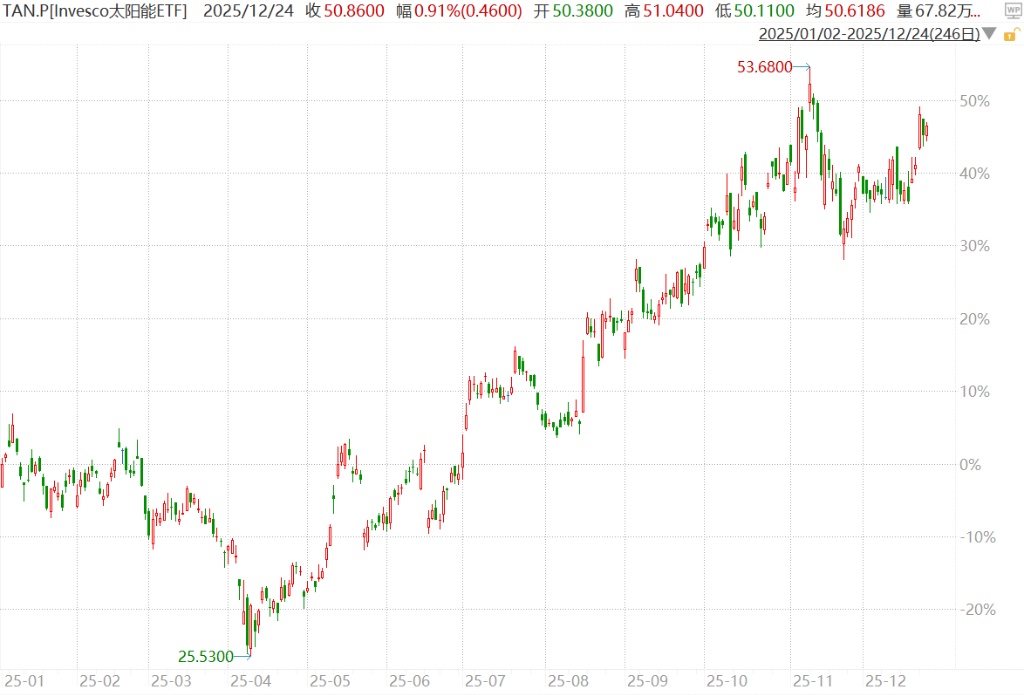
Geothermal energy company Ormat Technologies has increased by about 65%. The company stated that it is negotiating with data center clients to sign power purchase agreements at higher prices after the expiration of existing contracts.
Analysts believe that although some clean energy stocks have risen this year, the valuation multiples have not expanded, indicating that profit expectations have not increased.
The forward price-to-earnings ratio of renewable energy leader NextEra Energy is basically flat compared to the beginning of the year, remaining at about 20 times.
The valuation multiple of U.S. solar manufacturer First Solar has expanded to 12 times this year, but it is still cheap relative to its historical average.
Valuations Have Reached High Levels
The valuations in most power sub-sectors have reflected a large amount of optimistic expectations, which means that more positive news is needed to drive stock prices further up, while a small amount of bad news could lead to declines.
Companies whose valuations are most directly related to AI power demand have exceeded those of tech giants. Constellation Energy, GE Vernova, and Cameco all have forward price-to-earnings ratios exceeding 30 times.
Fuel cell manufacturer Bloom Energy has a forward price-to-earnings ratio of 90 times, making it one of the most expensive energy stocks.
The valuations of turbine manufacturers are also high, with Caterpillar and Cummins trading at prices 50% and 44% higher than their historical valuations, respectively.
The companies most likely to experience a pullback are those with zero or very little revenue.
This includes small modular reactor startups Oklo and NuScale Power, as well as Fermi, which plans to build a nuclear and natural gas combined power plant for data centers. The latter saw a significant drop this month after a potential tenant withdrew from a $150 million construction funding agreement.
Supply shortages have been beneficial for energy stocks this year, but could turn into a disadvantage in the future.
According to Wood Mackenzie research analyst Joseph Shangraw, engineering, procurement, and construction contractors are in short supply as they are taking on data center and gas power generation projects, drawing skilled labor away from solar projects. Such physical constraints may lead to a divergence between winners and losers in the industry
