


For the first time in 12 years! The S&P 500 closed at a record high on Christmas Eve, heating up the year-end "Christmas rally"

The S&P 500 Index reached a new high on Christmas Eve for the first time since 2013, successfully breaking through the key resistance level of 6911 points. Supported by a technical breakthrough and the dual boost of an economic "soft landing" and rising expectations for interest rate cuts in 2026, the U.S. stock market's year-end "Christmas rally" may be supported. However, current funds are mainly flowing into high-quality and high-dividend sectors, indicating that investor sentiment remains cautious
On the lightly traded Christmas Eve trading day, major U.S. stock indices closed at historic highs, with the S&P 500 Index reaching a new closing high on Christmas Eve for the first time since 2013.
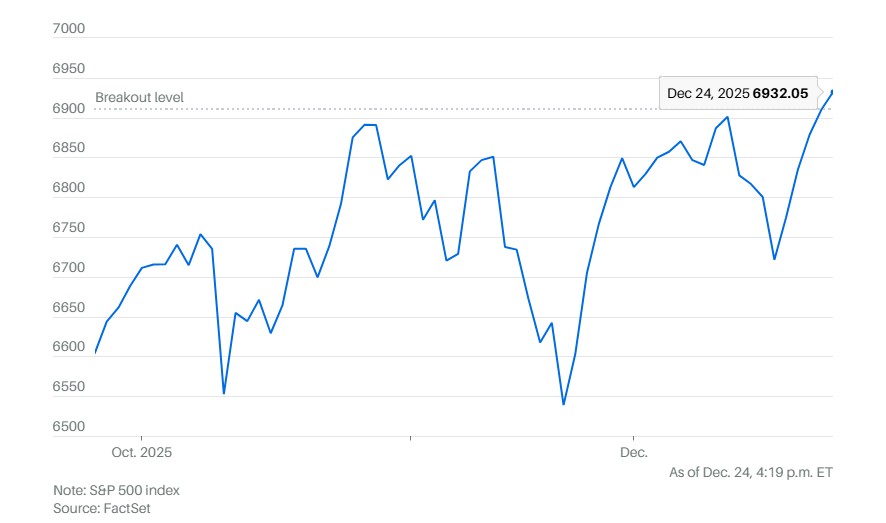
On December 24th, U.S. stocks closed early due to holiday factors. By the close, the S&P 500 Index rose 0.3%, closing at 6932.05 points; the Dow Jones Industrial Average performed even better, rising 0.6% to close at 48731.16 points, also setting a new closing high. The tech-heavy Nasdaq Composite Index edged up 0.2%. Meanwhile, the CBOE Volatility Index (VIX), which measures market fear, closed below 14 for the first time since December 2025, indicating overall low market volatility.
From a technical perspective, this rise is of key significance. According to Fairlead Strategies analyst Katie Stockton, although the S&P 500 Index had previously risen, it had not confirmed a breakout. Wednesday's closing price was well above the key resistance level of 6911 points, which is seen by technical analysts as a clear "breakout" signal. The confirmation of this signal may alleviate concerns about a market pullback before the end of the year.
Technical Breakout May Pave the Way for Year-End Rally
Although Wednesday's rise was modest, its technical significance may be more important than the magnitude of the increase itself. According to Fairlead Strategies' Katie Stockton, prior to this breakout, market technicians believed that the risk of a correction still existed, and investors needed to manage risks before the year-end.
Now, with the S&P 500 Index closing above the key level of 6911 points, a technical breakout has been established.
Analysts suggest that this development may attract more funds that rely on technical signals, especially trend followers and momentum traders, who may view this as a signal to continue adding positions, thereby boosting the year-end "Santa Claus rally." From a market psychology perspective, this also somewhat alleviates concerns about a sell-off at the end of 2025.
Has the "Santa Claus Rally" Begun? Wall Street is Optimistic About 2026
As the year-end approaches, investors are hopeful for the traditional "Santa Claus rally"—typically referring to the last five trading days of the year and the first two trading days of the new year. Although previous tariff storms had caused market turbulence, with U.S. stocks repeatedly hitting new highs, this panic has been replaced by "fear of missing out" (FOMO).
The macro fundamentals support this optimistic sentiment. The latest initial jobless claims in the U.S. have decreased, highlighting seasonal fluctuations in the data but also indicating that the labor market has not deteriorated, with layoffs remaining low. Traders currently maintain expectations that the Federal Reserve will implement two 25 basis point rate cuts next year (2026), which is one more than the median forecast of Federal Reserve officialsMagdalena Ocampo, an analyst at Principal Asset Management, pointed out: “As long as the unemployment rate does not spiral upwards, a resilient economy, cooling inflation, and a more accommodative policy environment will continue to support risk assets.”
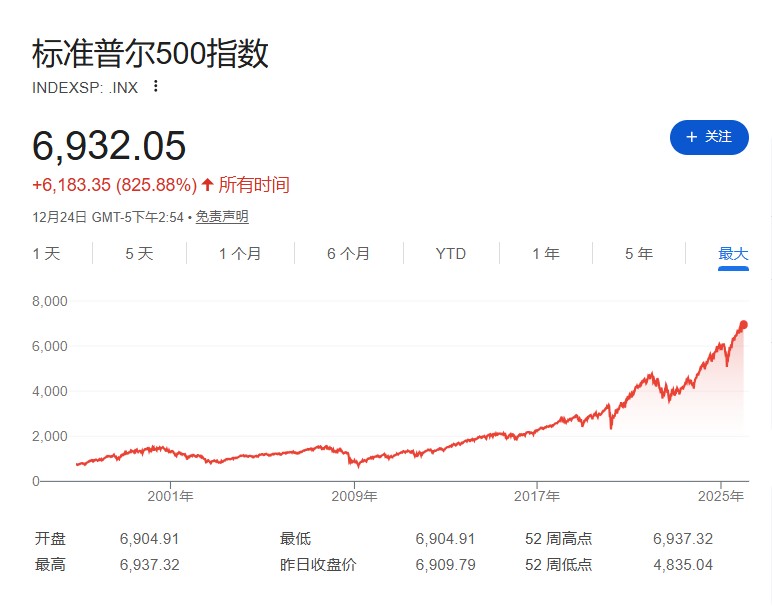
According to CFRA data, the S&P 500 index has risen nearly 18% this year, moving towards the goal of achieving double-digit gains for the third consecutive year (i.e., a "three-peat"). Predictions for the upcoming year 2026 from Wall Street strategists are also unusually concentrated and optimistic, with the year-end target price differences among major institutions being the smallest in nearly a decade, indicating strong market consensus.
According to Barron's, since the election day on November 2024, the U.S. stock market has risen by 19.8%. Although this increase is the smallest recorded for the same period following a presidential election since 2008, it is still significantly above the historical average. Data shows that since 1952, the average increase during this period has been 10.1%, and the current performance is nearly double that.
Despite ongoing concerns about overvaluation in tech stocks, analysis indicates that the performance of the "Magnificent Seven" is not entirely synchronized, with some individual stocks even underperforming the market this year, suggesting that not all tech stocks are in a bubble. The improvement in market breadth may provide a more solid foundation for future gains.
“The consensus among Wall Street investment strategists is that this positive momentum will continue,” noted Wall Street's prominent bull Ed Yardeni, who predicts that U.S. stock indices will reach 7,700 points.
Market sentiment is cautious, with investors favoring quality and dividend stocks
Despite major indices reaching new highs, the flow of funds within the market reveals a cautious side among investors. On that day, the Russell 2000 index, representing small-cap stocks, and the Nasdaq index, dominated by tech stocks, both lagged behind the Dow Jones and the S&P 500 index in terms of gains.
More granular market data shows that high-risk assets performed modestly. For example, the Invesco S&P 500 High Beta ETF, which tracks the most volatile stocks in the S&P 500 index, only rose by 0.2%. Meanwhile, investors showed a clear preference for “quality” and “dividend” stocks, with the Invesco S&P 500 Quality ETF and State Street SPDR Portfolio S&P 500 High Dividend ETF both rising by 0.5%.
Analysis suggests that this phenomenon may be related to light trading volumes on Christmas Eve and traders' reluctance to take on excessive risks before the long weekend. This indicates that even in a risk-averse market atmosphere, the stock market may still rise
