


Seven predictions unveil the turning point of the AI power supply revolution! Infineon Technologies white paper looks ahead to next-generation technology

Infineon Technologies expects that in the next decade, the load current of a single processor will reach 10,000 amperes, which is ten times the current level; the power rating of power racks will exceed 100 kilowatts; the power consumption of AI server racks will exceed 1 megawatt; and the power consumption demand of data centers will reach gigawatt-level scale
This AI-driven power revolution is reshaping the entire power supply system from chips to the grid.
Infineon’s latest white paper presents seven key predictions that outline the future landscape of AI-powered electricity: In the next decade, the load current of a single processor will reach 10,000 amperes, ten times the current level; the power rating of power supply racks will exceed 100 kilowatts; the power consumption of AI server racks will surpass 1 megawatt; and the power demand of data centers will reach gigawatt-scale...
Adam White, President of the Power and Sensor Systems Division of the company, pointed out that since the release of ChatGPT at the end of 2022, the exponential growth of AI technology has brought unprecedented power demand challenges, forcing the industry to continuously push the boundaries of innovation.
These predictions encompass comprehensive transformations from vertical power supply technologies to DC microgrids, which will have profound impacts on data center operators, equipment manufacturers, and investors. As AI workloads continue to grow, traditional 48V power supply architectures will be replaced by high-voltage DC systems, and the integration of renewable energy will also become key to meeting the enormous energy consumption demands.
Prediction 1: Vertical Power Supply Will Dominate Future Processor Architectures
Infineon predicts that vertical power supply will become a key technology for modern processors.
The white paper states that GPUs and TPUs adopt advanced process technologies (such as TSMC N4P) to break through the limitations of single processes through multi-chip integration. As chip sizes increase and supply voltages drop to around 0.4V, total current consumption is expected to rise to 10,000 amperes within a decade. Traditional horizontal power supply methods occupy significant space and incur substantial losses at such high currents, and electrical energy will be transmitted vertically to the back of the processor via the motherboard.
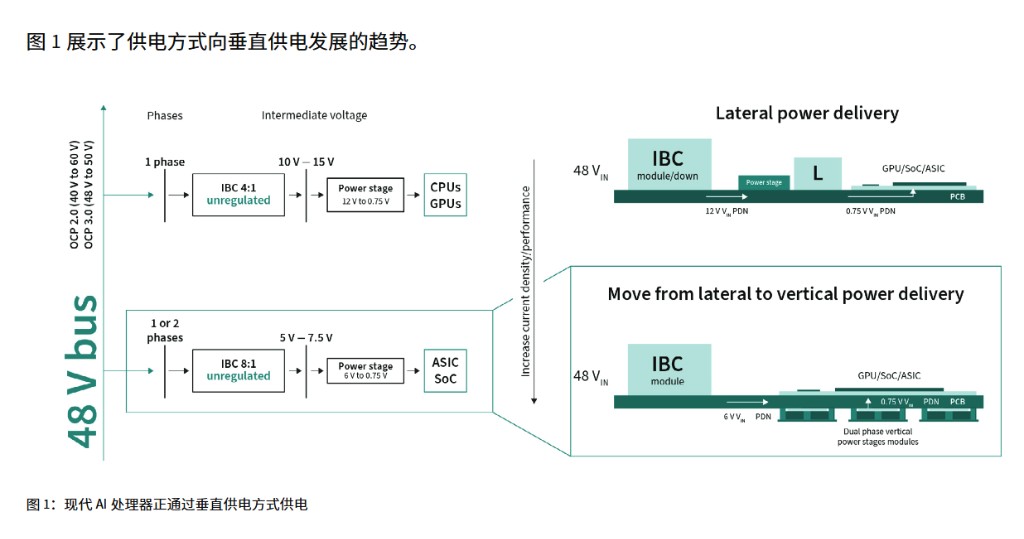
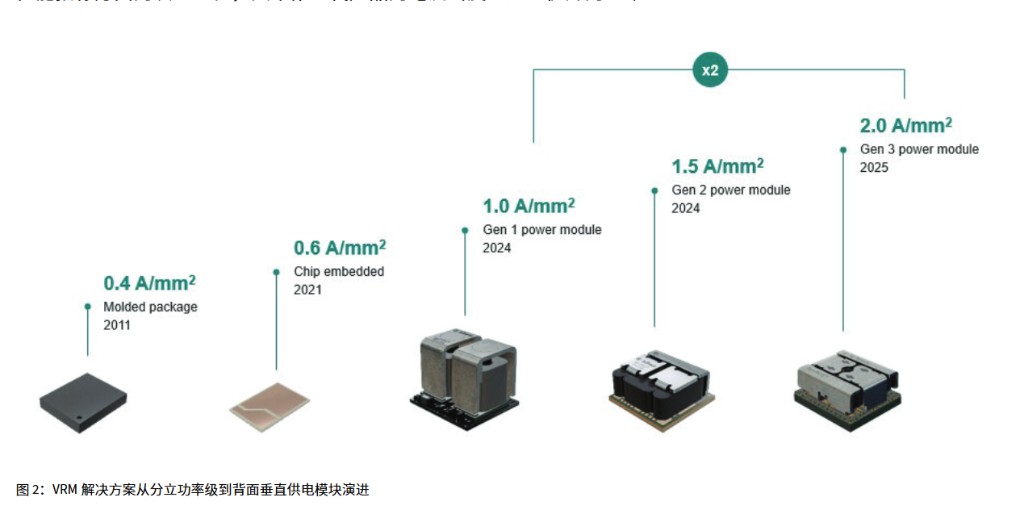
Infineon offers a complete product portfolio from discrete power levels to four-phase vertical power modules, with the third-generation product achieving a current density of 2A/mm². The company combines OptiMOS™ 7 series low-voltage silicon-based MOSFET technology with chip embedded packaging technology and patented 3D integration processes to achieve unprecedented power density in vertical power supply solutions.
Prediction 2: High-Voltage DC Power Supply Architecture Will Replace 48V Ecosystem
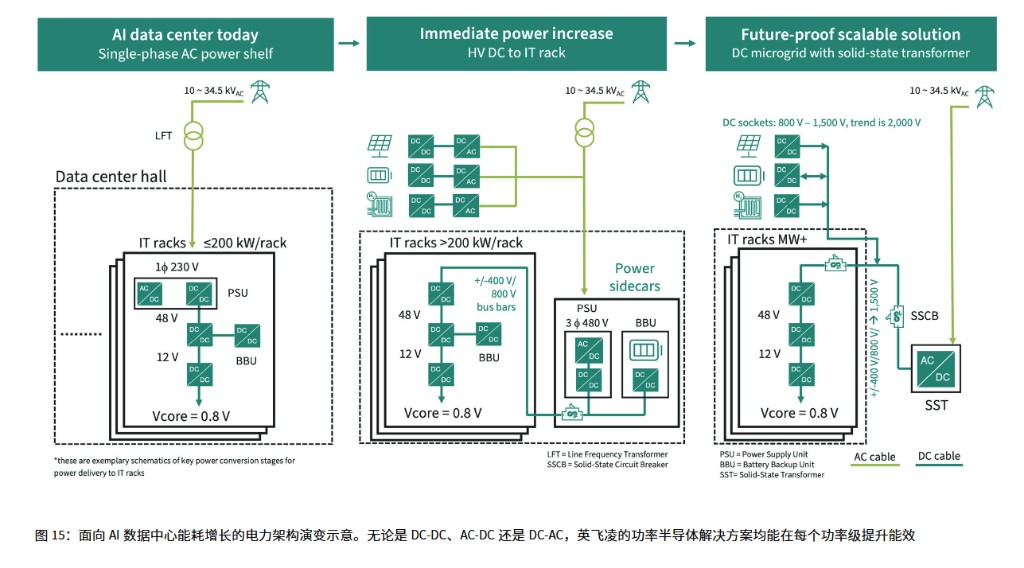
When the power of a single rack exceeds 1 megawatt, the system architecture must shift from the 48V ecosystem to 800V or ±400V high-voltage DC power supply. This transition is expected to occur when the power of a single rack reaches 200-250 kilowatt-hours, at which point the 48V busbar will need to carry 4100-5200A of current.
Future server motherboards will operate directly at 800V or ±400V voltage, requiring the introduction of new modules such as electronic fuses and hot-swappable features. Infineon’s solution based on the XDP™ XDP70x hot-swappable controller and CoolSiC™ JFET technology can achieve controlled pre-charging and quickly disconnect in case of anomalies
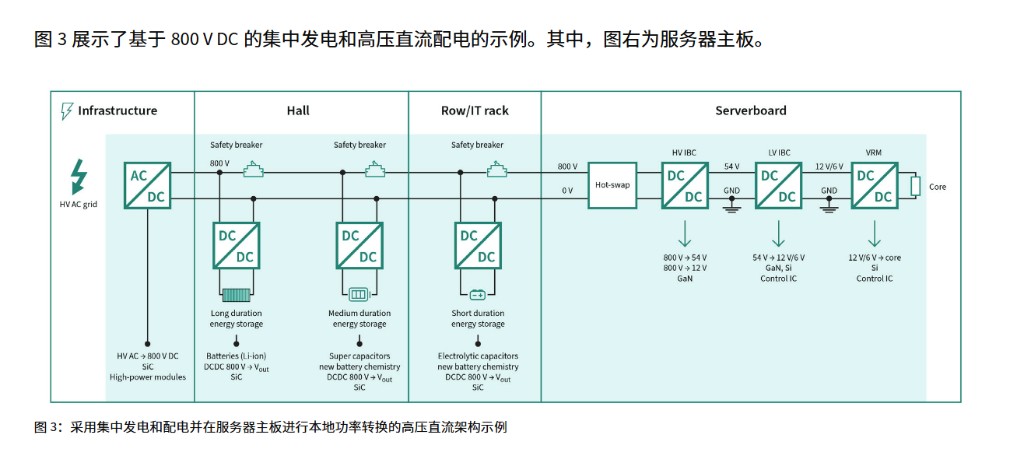
The company's developed 6 kW 800V→12V demonstration board has a power density exceeding 2300W/in³, with a peak efficiency of 97.4% and a full-load efficiency of 96.6%.
Prediction Three: AI Rack Power Consumption Enters the Megawatt Era
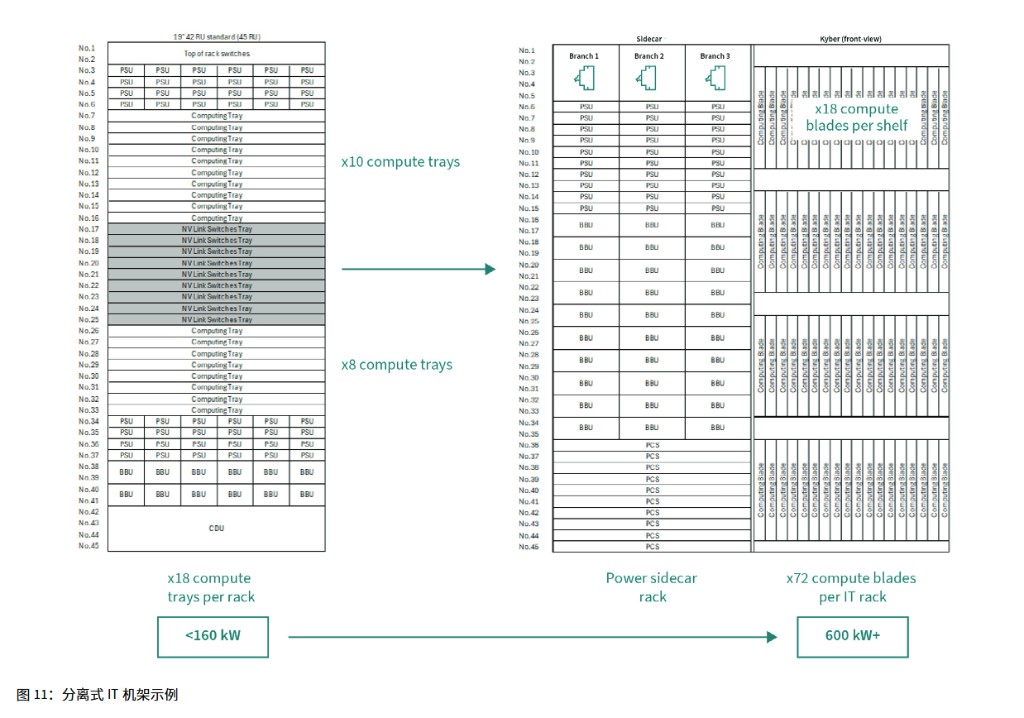
The white paper points out that training trillion-parameter AI models requires thousands of GPUs integrated to run synchronously within the same machine. Since the data transfer rate within an IT rack is much higher than between racks, the industry trend is to integrate more GPUs within a single IT rack. When a single rack integrates up to 72 blade servers, the total power of the IT rack will exceed 1 megawatt within ten years.
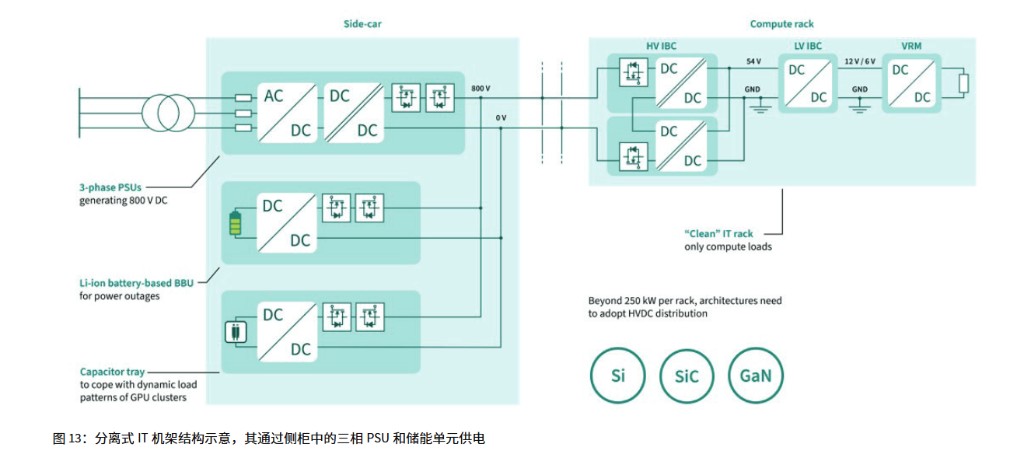
At such high power levels, the internal space of the rack becomes a major physical limitation. AI racks will focus more on IT loads and high-speed communication capabilities, while additional functions such as power modules and battery backup storage units will be moved to side cabinets or auxiliary racks.
Prediction Four: Power Levels of Power Racks Will Exceed 100 kW
When the power of IT racks approaches 100 kW, the 12 kW PSU based on single-phase AC input can be upgraded while maintaining a compact 1U size. Each power rack can accommodate 6 power modules (72 kW), with a maximum of 8 power racks configured per rack, laying the foundation for reaching 1 megawatt IT racks.
Infineon uses a multi-level architecture in the 12 kW PSU demonstration board, with the high-voltage section utilizing 400V CoolSiC™ MOSFETs and the secondary side using 80V CoolGaN™ HEMTs. When the power of a single IT rack is increased to 1 megawatt, data centers will shift from single-phase PSUs to three-phase PSUs, directly connecting to 400V AC or 480V AC three-phase power grids.
Prediction Five: The Power Demand of Next-Generation Data Centers Moves Toward Gigawatt Levels
The continuous increase in modern GPU power consumption and the dense deployment of AI computing nodes have led to new data centers requiring power in the hundreds of megawatts. In the coming years, dedicated "AI factories" will emerge, with power consumption within the same data center campus reaching gigawatt levels, or even exceeding several gigawatts. Several hyperscale data center operators have already announced related construction plans.
Infineon provides CoolSiC™ MOSFETs and CoolSiC™ JFET protection circuits covering various packages from 400V to 3.3kV, as well as ultra-fast switching GaN HEMTs from 80V to 650V, ensuring seamless and stable operation of gigawatt-level data centers
Prediction Six: Distribution Systems Will Shift to DC Microgrids
As power demand approaches the gigawatt level, entirely new distribution infrastructure must be established. DC microgrids are considered the most promising architectural solution to shape the future of AI data centers, with electricity generated directly from medium-voltage AC grids (10-35kV) and distributed in high-voltage DC form, eliminating traditional AC-DC power modules.
Solid-state transformer (SST) technology will play a key role, capable of directly receiving power from the 10kV-35kV medium-voltage AC grid and providing stable, adjustable high-voltage DC distribution. Each solid-state transformer is expected to output power ranging from 2 to 10 megawatts. Infineon offers a broad range of CoolSiC™ MOSFET and IGBT products for such applications (with a voltage range covering 750V-3300V).
Prediction Seven: Renewable Energy Becomes a Key Constraint for AI Development
According to the International Energy Agency, AI is one of the three major drivers of global electricity demand growth in the next decade. The proportion of electricity used by global data centers from renewable energy is approaching 50%. To support the next round of explosive growth in AI, electricity must be sourced sustainably.
Infineon predicts:
-
AI data centers must adopt renewable energy to eliminate dependence on fossil fuels, with approximately 8 square kilometers of solar fields needed to support the operation of a 1-gigawatt data center.
-
Nuclear power and small modular reactors will provide stable zero-carbon energy in the future.
-
Although non-renewable energy will still play a role, the global trend is focused on promoting the decarbonization of data centers
