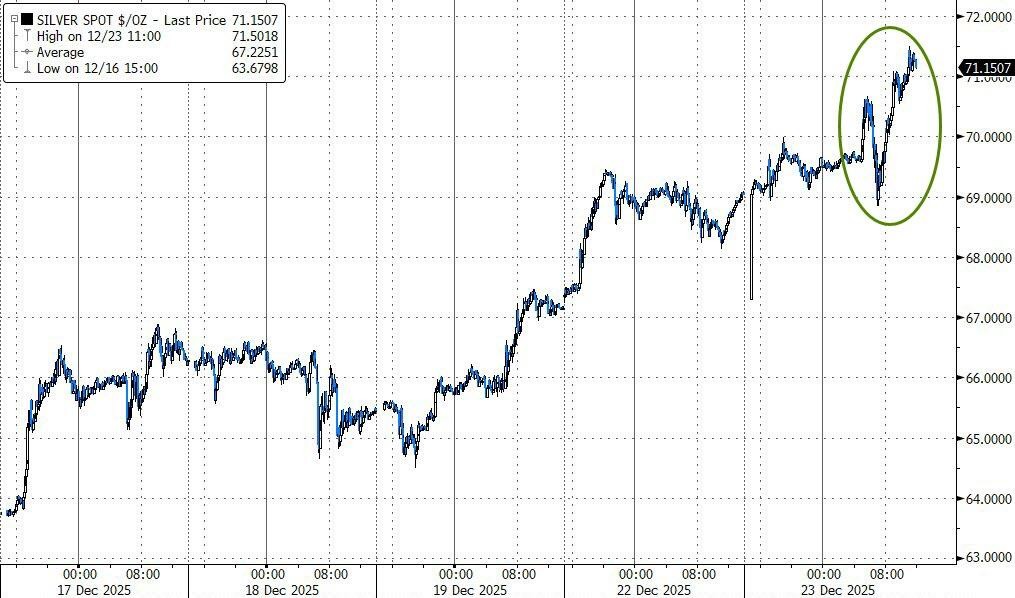
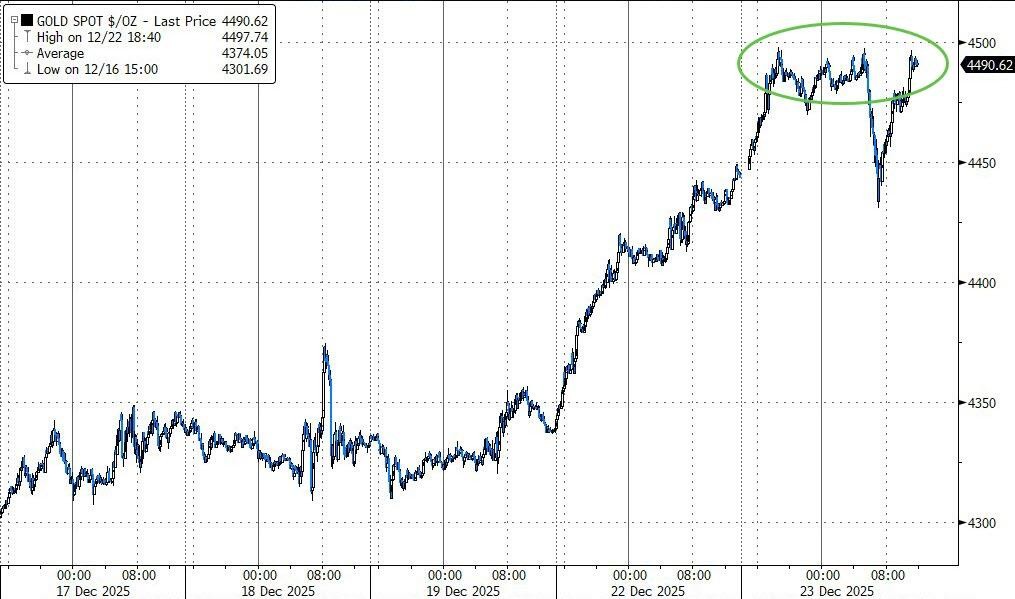
Gold and silver hit new historical highs, poised to achieve the largest annual increase since 1979, with two major drivers at work

On Tuesday, spot silver rose by 2.4% at one point, breaking through $70 per ounce for the first time, while spot gold approached the $4,500 mark. Driven by escalating geopolitical tensions and expectations of further interest rate cuts by the Federal Reserve, gold prices have increased by more than two-thirds this year, and silver prices have risen by about 140% year-to-date, showing an even more vigorous upward trend
As geopolitical tensions escalate and expectations for further interest rate cuts in the United States rise, both gold and silver prices have surged, reaching new historical highs.
On Tuesday morning in New York, spot silver rose by 2.4%, breaking the $70 per ounce mark for the first time.

Gold approached $4,500 per ounce, continuing to rise after recording its largest single-day gain in over a month. Platinum and palladium prices also increased simultaneously.

Traders are betting that the Federal Reserve, after having cut rates three times in a row, will cut rates again next year, which would benefit non-yielding precious metals.
Additionally, the rise in geopolitical tensions over the past week has further strengthened gold's appeal as a safe haven, especially in Venezuela. The United States has imposed a blockade on oil tankers from the country and has continued to increase pressure on President Nicolás Maduro's government.
Media reports indicate that Pepperstone Group strategist Ahmad Assiri stated that geopolitical friction has returned to the market narrative. He mentioned the seizure of oil tankers and noted that while these developments have not yet triggered widespread risk aversion, they undoubtedly increase the background demand for gold as an important hedge asset.
Total Holdings of Gold ETFs Rise Monthly
Since the beginning of this year, gold prices have risen by more than two-thirds, poised to achieve the best annual performance since 1979. Supporting factors for this rally include continued large purchases by central banks and ongoing inflows into exchange-traded funds (ETFs). According to the World Gold Council, total holdings of gold ETFs have risen every month this year except for May.
Analysts state that a series of aggressive measures taken by U.S. President Trump earlier this year aimed at reshaping the global trade system, along with his threats to the independence of the Federal Reserve, have fueled this bull market. Investors are also driven by what is known as "currency devaluation trades," where concerns about the growing scale of debt eroding long-term value lead to withdrawals from sovereign bonds and their denominated currencies.
Strong buying in ETFs is one of the main drivers pushing gold prices significantly higher. This year, the world's largest precious metals ETF—SPDR Gold Trust under State Street—has seen its holdings increase by more than one-fifth.
The chief economist of Muthoot Fincorp stated that the inflows into gold ETFs over the past few months have primarily come from retail investors rather than institutional investors. He pointed out that due to the lower stickiness of retail funds, price volatility will likely remain high.
Previously, when gold prices fell from a peak of $4,381 per ounce in October, the market briefly believed the rally was overheating. However, gold prices quickly rebounded, and there is currently a trend that could extend the gains into next year. Goldman Sachs is one of several banks that expect gold prices to continue rising in 2026, with a baseline scenario predicting $4,900 per ounce and believing that the upside risks are greater
Silver Shines Brighter than Gold
Silver has risen approximately 140% this year, outperforming gold. The recent surge has been boosted by speculative capital inflows, and following the historic short squeeze in October, the persistent supply mismatch in major trading centers has also driven up prices.
In India, driven by the Hindu festival Diwali, buyers have imported large quantities of silver. Meanwhile, the holdings of global silver ETFs continue to climb. This wave of demand has collided with the tight inventory in the London benchmark market, leading to a temporary supply squeeze.
Subsequently, silver inflows into London vaults have significantly increased, but most of the globally available silver remains concentrated in New York. Traders are awaiting the results of a U.S. Department of Commerce investigation assessing whether imports of critical minerals pose a national security threat, which could lead to tariffs or trade restrictions on silver.
At the same time, in China, silver inventories in warehouses associated with the Shanghai Futures Exchange fell to their lowest level since 2015 last month.
In addition to its financial asset properties, silver is deeply embedded in the global supply chain and is widely used in electronics, solar panels, and medical device coatings. According to the Silver Institute, global demand for silver has exceeded mine production for five consecutive years.
Analysts: $4,500 and $70 Levels Are Not Difficult to Break Through
From a technical perspective, the relative strength index for gold has entered the overbought territory, with readings exceeding 80 as of Tuesday. Silver is also approaching 80 and has maintained high levels for about two weeks. Generally, readings above 70 are considered overbought signals.
However, this has not deterred investors. Assiri from Pepperstone noted that there has not been a large-scale sell-off in the market; on the contrary, gold and silver continue to attract capital inflows during their upward movements.
He pointed out that this behavior indicates that the $4,500 and $70 levels are more like reference points in the trend rather than insurmountable ceilings, thus providing solid support for both metals at least for now and during the holiday period