Europe's November car sales increased for five consecutive months, Tesla sales fell by 11%, and BYD surged over 220%

Wallstreetcn
2025.12.23 13:17
portai
I'm PortAI, I can summarize articles.

Data shows that electric vehicles are the main driving force, with pure electric vehicles accounting for 21% of the market share in the European Union, 26% in the UK, and as high as 98% in Norway. The registration of electric vehicles has seen significant growth in major markets such as Germany, Italy, and Spain. Traditional fuel vehicles continue to decline, with the market share of gasoline and diesel vehicles dropping from 45.8% to 36.1%

The European new car market continues its recovery momentum driven by strong growth in electric vehicles, with November sales achieving year-on-year growth for the fifth consecutive month.

On December 23, according to data from the European Automobile Manufacturers Association (ACEA), the overall market, including the EU, the UK, and the European Free Trade Association, saw a 2.4% year-on-year increase in car sales in November, reaching 1.1 million units.

Electric vehicles have become the main driving force behind market growth, with the market share of pure electric vehicle registrations reaching 21% in the EU, 26% in the UK, and as high as 98% in Norway. Significant growth in electric vehicle registrations has also been observed in major markets such as Germany, Italy, and Spain.

In the pure electric vehicle (BEV) sector, the performances of the two giants, BYD and Tesla, have shown starkly different trajectories. BYD's registrations in November surged by 221.8% year-on-year, capturing a market share of 2%, while Tesla's registrations fell by 11.8%. Despite setting sales records in Norway, its market share dropped to 2.1%.

Despite the recent positive momentum, ACEA warns that overall sales are still far below pre-pandemic levels. Analysts believe that the European automotive industry is at a critical crossroads of transformation, facing not only high-cost competition from China and pressure from U.S. import tariffs but also challenges to its own profitability.

Electric Vehicles Lead Market Growth

Electric vehicles performed strongly in November, with significant growth in registrations across various electrified models.

According to ACEA data, pure electric vehicle registrations increased by 44.1% year-on-year, hybrid vehicles grew by 38.4%, and plug-in hybrid vehicles rose by 4.2%.

The three types of electrified vehicles together accounted for 65.6% of the EU market share, a significant increase from 56% in August 2024. This growth is primarily attributed to strong performances in major markets such as Germany, France, Spain, and Italy.

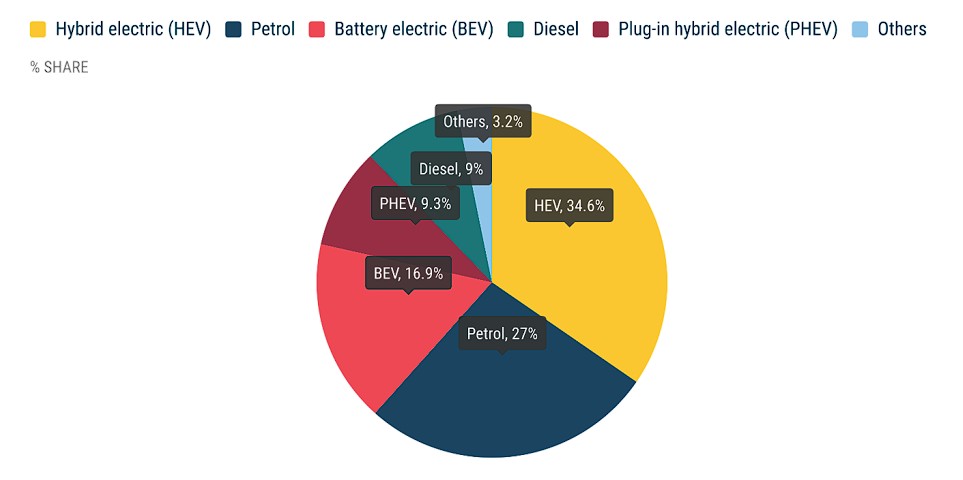
Data shows that from the beginning of 2025 to November, new registrations of pure electric vehicles reached 1.66 million, accounting for 16.9% of the market share. The growth in the four major markets of Germany, Belgium, the Netherlands, and France provided key support for the overall data.

In terms of powertrain choice, hybrid vehicles (HEV) continue to solidify their position as the preferred choice for European consumers.

In the first 11 months of 2025, hybrid vehicle registrations increased to 3.4 million, capturing 34.6% of the market share. Major markets such as Spain, France, Germany, and Italy all recorded strong growth.

Meanwhile, plug-in hybrid vehicles (PHEV) also maintained their growth momentum, with market share rising from 7.1% last year to 9.3% this year.

Diverging Performances of BYD and Tesla

Global electric vehicle manufacturing giants BYD and Tesla are showing different development trajectories in the European market.

Data shows that BYD's registrations in November skyrocketed by 221.8% year-on-year, indicating its rapid expansion momentum in the European market. In contrast, Tesla's registration volume in November decreased by 11.8%. Although it set a sales record in the Norwegian market, it still struggled to offset declines in other markets.

The market shares of the two companies in Europe are quite close, with Tesla at 2.1% and BYD at 2%. Analysts point out that this comparison highlights the changing competitive landscape of the European electric vehicle market, where Chinese brands are challenging the market positions of traditional electric vehicle leaders through price advantages and product innovation.

Traditional Fuel Vehicles Continue to Decline

As electric models become more popular, the market space for traditional internal combustion engine vehicles is further squeezed.

Data shows that the registration volume of gasoline vehicles decreased by 18.6% year-on-year, with market share dropping from 33.7% in the same period last year to 27%. All major markets experienced declines, with France seeing the largest drop at 32.1% and Germany down by 22.4%.

Diesel vehicles performed even weaker, with registrations falling by 24.4% and market share at only 9%. The combined market share of gasoline and diesel vehicles plummeted from 45.8% in the same period of 2024 to 36.1%.

Data for November alone shows that registrations of gasoline and diesel vehicles decreased by 21.9% and 23.2%, respectively, indicating that the trend of consumers transitioning to electric models is accelerating.

Market Recovery Still Requires Time

Despite achieving growth for five consecutive months, ACEA points out that the overall sales volume of the European automotive market is still far below pre-pandemic levels. In the first eleven months of 2025, new car registrations in the EU only increased by 1.4% year-on-year, indicating a relatively slow pace of market recovery.

The European automotive industry currently faces multiple challenges, including competitive pressure from China, potential import tariffs from the United States, and difficulties in meeting EU electrification regulations on a profitable basis.

The European Commission announced plans last week that may abandon the ban on the sale of fuel vehicles by 2035, which is seen as a significant retreat from the EU's green policies.

However, analysts believe that in the long term, electric vehicles remain the direction of development for the automotive industry, and the current growth trend suggests that the electrification transformation in Europe will continue to deepen