Tariff expectations and mine shutdowns "resonate," London copper breaks through $12,000 for the first time, setting a new historical high

LME copper has risen 37% this year, marking the largest annual increase since 2009. The surge is mainly attributed to two factors: first, expectations of tariffs under Trump have led traders to rush copper to the United States, resulting in a surge in imports and intensified global bidding; second, mines in various regions including the Americas, Africa, and Asia have halted production, with the world's largest mining company experiencing a 3% decline in output this year, leading to severe supply shortages. Citigroup predicts that under a bull market scenario, copper prices could rise to $15,000
Driven by expectations of supply disruptions and tariff threats, copper, regarded as a global economic barometer, has reached a historic high.
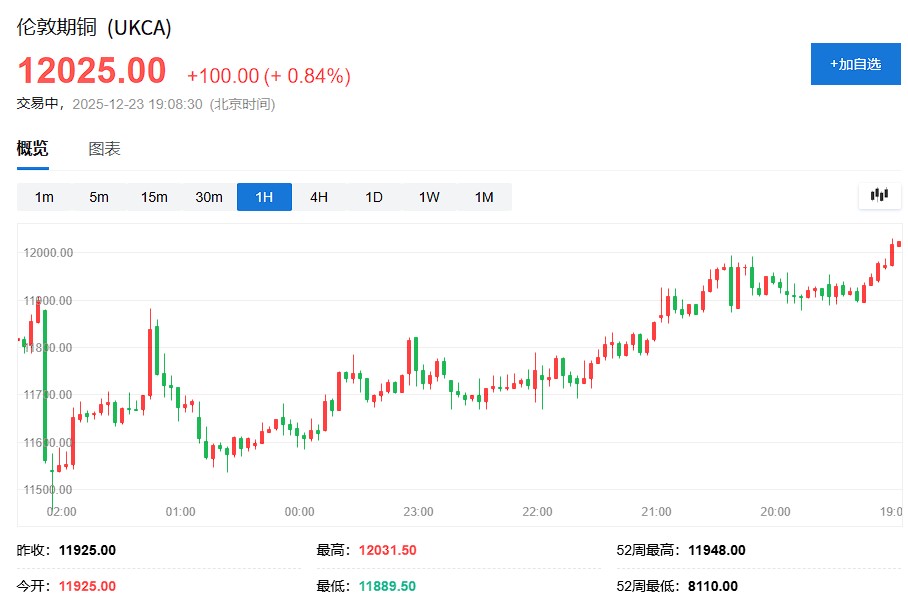
On Tuesday (December 23), influenced by the shutdown of multiple global mines and potential tariff policies from the Trump administration, London copper prices broke the USD 12,000 per ton mark for the first time in history. Since the beginning of the year, copper prices have risen by approximately 37%, and are expected to achieve the largest annual increase since 2009.

(LME Copper 1H Chart)
Market expectations of potential tariffs on metals by Trump have become the core factor driving prices higher. In order to get ahead of potential tariffs, traders are shipping large quantities of copper to the United States, leading to a surge in U.S. imports and forcing manufacturers in other regions into a fierce bidding war to maintain inventory.
At the same time, the supply side is also facing severe challenges, with mines in the Americas, Africa, and Asia experiencing shutdowns. The market warns that there will be a significant gap on the supply side, further fueling this round of price increases. As copper prices continue to rise, Citigroup predicts they could reach USD 15,000 in a bullish scenario.
Tariff Threats Trigger Global Competition
The impact of Trump's tariff agenda has led to severe trade distortions in the copper market.
As traders rush to ship more copper to the U.S. before potential tariffs are implemented, the market generally expects prices to continue rising. This "preemptive" behavior has caused U.S. imports to surge significantly throughout the year, disrupting the original market balance.
The dramatic shift in trade flows is so significant that copper prices can continue to rebound even when the fundamentals do not fully align. To maintain supply, manufacturers outside the U.S. are forced to participate in bidding, driving up global benchmark prices.
Mining Output Faces Shrinkage Risks
While trade is in chaos, the supply side has also issued serious warning signals. Due to operational disruptions at mines in several major global production areas, the market is on the brink of a supply deficit.
According to Deutsche Bank analysis, the output of the world's largest mining companies is expected to decline by 3% this year and may decline again by 2026. Analysts at the bank noted in their report:
"2025 will be a year of severe disruption, with several large mines facing significant operational challenges," adding that "overall, we believe the market is in a clear state of supply shortage."
For years, supply risks have loomed over the copper industry, and along with the surging demand expectations from rapidly growing sectors such as electric vehicles, renewable energy, and artificial intelligence, it has become a major basis for bullish forecasts from investment banks and investors.
It is worth noting that Wall Street has shown divergent predictions for copper price prospects.
Goldman Sachs analysts warned in mid-last month that the price surge is primarily driven by investor bets on future market tightness, rather than the current supply-demand situation, but the bank still lists copper as a preferred industrial metal and has raised its price forecast for next year to USD 11,400 per ton In contrast, Citigroup has provided a more aggressive forecast, believing that in a bull market scenario, with a weaker dollar and further interest rate cuts in the U.S. enhancing the attractiveness of copper, investors may more actively flood into the market, potentially driving copper prices up to $15,000