Trump's Capital Restructuring: A Trillion-Dollar Level Shift in Capital Flow

Wallstreetcn
2025.12.23 10:30
portai
I'm PortAI, I can summarize articles.

Trump reshapes the flow of funds in the United States with high-intensity policies: relaxing bank regulations to activate the treasury market, promoting the privatization of Freddie Mac and Federal National Mortgage Association, reversing clean energy subsidies and guiding capital back to fossil fuels, while opening private equity investment channels for 401(k) plans. This policy combination is leveraging the migration of trillions of dollars in capital, reshaping the asset allocation logic between Wall Street and ordinary households

In the first year of Trump's second presidential term, he and his advisory team are moving at an unprecedented speed and intensity to change the flow of funds in the U.S. economy, which has been established for decades.

Within hours of taking the oath of office, Trump signed 26 executive orders, about three times the number signed by his predecessor on their first day. The subsequent "Big Beautiful" bill and a series of regulatory adjustments quickly sent a clear signal to investors: the funding chain that originally flowed to renewable energy projects has been cut off, while incentives in pipeline projects, cryptocurrencies, and traditional finance are being reweighted.

This series of policy combinations directly affects the "pipeline" facilities of the U.S. financial system. From relaxing bank leverage limits that are crucial to the $30 trillion Treasury market, to promoting the privatization process of mortgage giants, and to granting legal status to stablecoins, these measures are reshaping the incentive structure of the market. The direct consequence is that market participants, including banks, energy developers, and cryptocurrency issuers, are experiencing a massive capital flow shift worth hundreds of billions to trillions of dollars.

White House spokesperson Kush Desai stated in a statement that President Trump is committed to restoring the United States as the world's most vibrant economy and is dedicated to cutting the "red tape" that stifles economic creativity. As these policies gradually take effect, the underlying logic of capital allocation is undergoing profound changes, from the trading floors of Wall Street to the 401(k) retirement accounts of ordinary Americans.

Bank Regulation Easing and Liquidity Release

To address the constraints on the operation of the Treasury market, federal banking regulators have taken action to relax key capital rules. According to regulatory plans, the so-called "Enhanced Supplementary Leverage Ratio" (eSLR) will be lowered from 5%, with this ratio for major lending institutions dropping to between 3.5% and 4.25%, and even lower requirements for their subsidiaries.

This change will take effect in early 2026 and aims to incentivize banks to invest more in Treasuries and other government-supported assets. It is estimated that this could free up as much as $219 billion in capital for subsidiaries of large banks such as JPMorgan Chase & Co. and Citigroup Inc. In response to the regulatory easing, the largest four banks in the U.S. nearly doubled their stock buybacks in the first full quarter after passing the Federal Reserve's annual stress tests, reaching $21 billion, and dividend payments also increased by about 10%.

However, this policy is not without controversy. Phillip Basil, the Director of Economic Growth and Financial Stability at the nonprofit organization Better Markets, warned that this "reversed policymaking" will make the banking system more fragile and exacerbate industry concentration.

The Privatization Game of Mortgage Giants

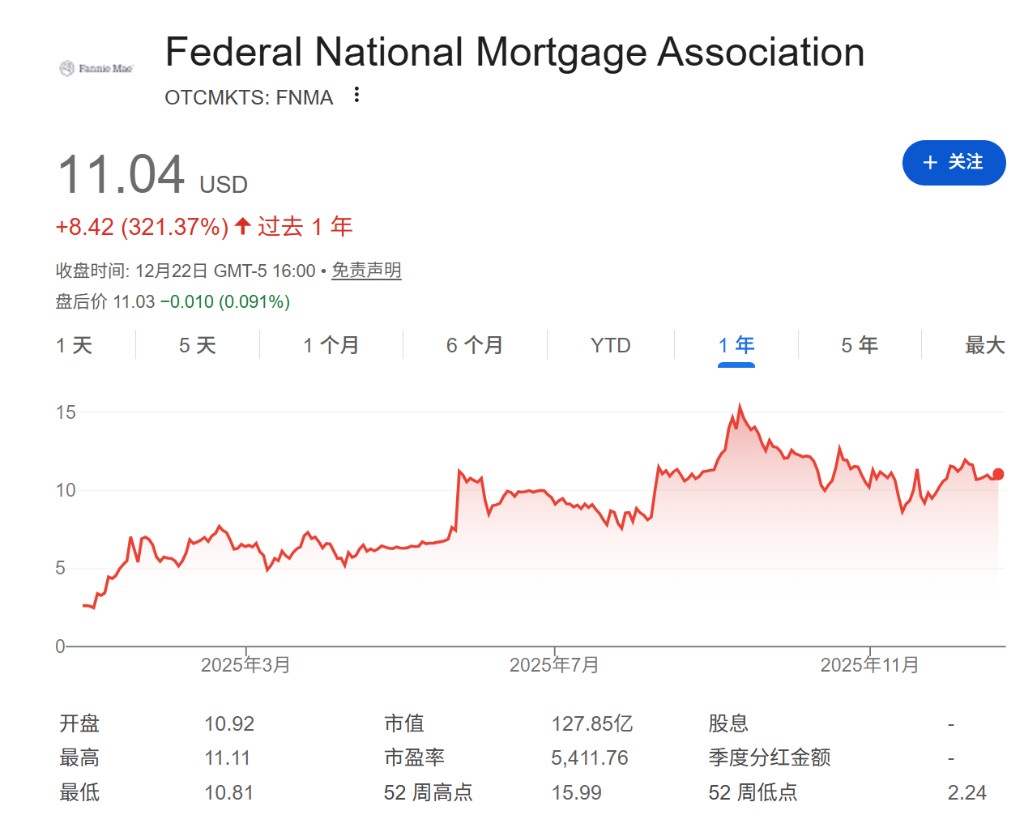
One of the most controversial and closely watched proposals during Trump's second term is the plan to end the government's takeover of the cornerstone of the mortgage market—Freddie Mac and Fannie Mae. This expectation has driven related stocks to surge, with Fannie Mae's stock price soaring from less than $2 before the election to over $15

Bill Ackman, a well-known hedge fund manager, is one of the most vocal figures in this debate. He claims that his company, Pershing Square, is the largest holder of common stock in these two companies and advocates for their relisting on the New York Stock Exchange. Currently, the Treasury holds up to $360 billion in preferred liquidation rights for the two companies, and how to handle this equity has become the core of the privatization discussion.

Despite the buoyant market sentiment, researchers at Stanford University point out that reforms may lead to increased costs for consumers. Even without ending the takeover, an initial public offering could moderately raise borrowing costs. Depending on the structure of different proposals, mortgage rates could rise by approximately 0.2 to 0.8 percentage points. For a $1 million 30-year fixed-rate loan, even if the rate rises from 6.2% to 7%, the interest cost over the loan term would increase by $200,000.

The Institutionalization Dividend of Crypto Assets

In stark contrast to the 2019 stance of calling cryptocurrencies "not even money," the Trump administration displayed an unprecedented embrace of digital assets during its second term. Its core initiative was the signing of the GENIUS Act in July, which provided a legal framework for stablecoins pegged to the dollar, quickly opening the door to the mainstreaming of stablecoins.

Citigroup expects the stablecoin market size to grow from approximately $310 billion currently to $4 trillion by 2030. Major Wall Street firms, including JPMorgan, are actively entering this field. Tether, as the world's largest stablecoin issuer, is seeking a valuation of $500 billion in the private market, which could see its chairman's wealth surpass that of Warren Buffett.

The new legislation requires stablecoin issuers to maintain reserves at a 1:1 ratio and explicitly allows U.S. Treasury securities with maturities of 93 days or less to be used as reserve assets. Treasury Secretary Yellen stated that this would boost demand for U.S. Treasury securities. However, this has also raised concerns among small banks, with economists from the American Bankers Association estimating that, in extreme cases, up to 10% of bank deposits could flow into stablecoins, thereby raising banks' funding costs.

The Reversal of Capital Flows in Energy Investment

In the energy sector, the reversal of capital flows is particularly severe. Under the "Big Beautiful" Act, the Trump administration ended tax credits for electric vehicles, wind, and solar projects, and canceled billions of dollars in clean energy grants awarded by the previous administration.

According to analysis by advocacy group E2, the policy shift since January has led to the cancellation or postponement of clean energy projects valued at nearly $29.3 billion. Project cancellations and corporate bankruptcies have followed: Pine Gate Renewables announced closures and laid off hundreds of employees, Fortescue Ltd. abandoned a $210 million battery factory plan, and South Korean solar manufacturer Hanwha Q Cells Co. also implemented large-scale furloughs and layoffs at its Georgia plant At the same time, the federal government's executive power is being refocused on supporting the development of fossil fuels and nuclear energy.

New Channels for Pension Fund Investment

The Trump administration is also trying to tap into the $13 trillion retirement savings market. Through a new executive order, the government is requiring relevant agencies to reassess guidance on investing alternative assets in retirement plans within six months.

This initiative is seen as a significant boon for the private equity industry, as traditional pension funds and endowment funds have nearly reached their allocation limits in the private market. Blackstone Inc. Chief Financial Officer Michael Chae stated that this will be a "real turning point" in the evolution of the market. If it can guide some 401(k) funds from traditional stocks and bonds into alternative assets, it will release hundreds of billions of dollars in new capital for the industry.

Despite warnings from Senator Elizabeth Warren and others that this will expose ordinary Americans to high-cost and high-risk investments, private equity firms insist that this is allowing ordinary investors to access financial products that were previously limited to seasoned investors