


Bank of America survey: Fund managers are almost "fully invested" going into the new year! Cash levels drop to 3.3%, a historical low

A Bank of America survey shows that fund managers' cash levels have dropped to a historic low of 3.3%, while stock positions continue to rise, indicating that investors are entering the new year with unprecedented optimism. However, the S&P 500 valuation has surpassed levels seen before the dot-com bubble burst, raising concerns about excessive AI capital expenditures and overly optimistic corporate earnings expectations. Analysts warn that high valuations put immense pressure on fundamentals, and a weakening U.S. labor market could bring recession risks back into focus, with uncertainty about the economic outlook in 2026 increasing
Investors are entering the new year with extreme optimism, although there are still concerns about potential challenges in 2026, the current enthusiasm for going long has taken the lead.
According to the latest fund manager survey by Bank of America, the cash level of fund managers has significantly dropped to 3.3% of assets under management, marking a historic low. Meanwhile, investor confidence in economic growth, stocks, and commodities is soaring, with the combined exposure to these two asset classes reaching the highest level since February 2022, which typically performs well during economic expansion.
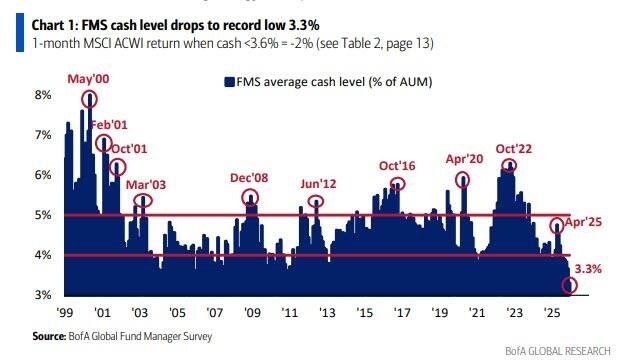
On December 23, Bloomberg market strategist Michael Msika stated that this nearly "fully invested" aggressive position reflects that the market's expectations for further rebounds have outweighed concerns about high valuations, massive capital expenditures in artificial intelligence (AI), and profit expectations. Although tech stocks remain the main driving force, investors have begun sector rotation over the past two months, and as more attractive investment opportunities arise, this rotation is broadening the market's upward breadth.
The article also pointed out that some strategists warn that behind this wave of optimism, the economic outlook is not without clouds. The stickiness of inflation, dynamic changes in the labor market, and the Federal Reserve's delicate balancing act remain structural risks that investors need to be wary of.
Extremely Optimistic Positioning
According to Bank of America's fund manager survey data, as the new year approaches, positioning appears quite crowded. Investors have significantly reduced cash holdings in favor of betting on risk assets. The cash ratio has dropped to a very low level of 3.3%, marking a retreat of market risk aversion and a significant rebound in risk appetite.
Typically, the start of a new year is accompanied by a seasonal increase in risk appetite. New risk budgets, resets of performance assessments, and inflows into pension funds usually provide tailwinds for the stock market.
While the outlook for the stock market in the first quarter and even April appears generally positive, historical data shows that January and February have traditionally not been particularly stellar months, with recent performances being mixed.
Fundamental Tests Under High Valuations
Driven by tech stocks, the long-term valuation metrics of the S&P 500 index have reached historic highs. This metric even surpasses previous peaks before significant pullbacks, such as before the summer of 2000 when the internet bubble burst and when the market began pricing in soaring interest rates in January 2022.
The strategist team at Citigroup, led by Scott Chronert, pointed out that as the current bull market enters its fourth year, continued volatility is to be expected, and given the implied growth expectations, this volatility may be more pronounced.
Their team believes that while high valuations are an obstacle for the market, they are not insurmountable, which instead increases the pressure for fundamentals to support price movements The article states that companies must maintain positive market sentiment through solid profits, and this time the threshold is high. The current market consensus is that profits will achieve double-digit growth across all regions, with emerging markets leading the way.
Michael Msika believes this view may be overly optimistic: Asia needs to meet economic growth expectations, Europe's fiscal stimulus needs to translate into corporate profits, and the U.S. growth relies on the continued advancement of the AI revolution and the resilience of the labor market.
Sector Rotation and AI Narrative
The article points out that as valuations soar, discussions about bubbles are increasing, especially around the technology sector and AI trades. Mega-cap companies have raised their capital expenditure commitments to levels that may be supported by their balance sheets.
While this does not currently pose a problem for the overall market, "bond vigilantes" are ready to strike. Oracle's stock plummeted after it reported disappointing earnings, and its credit default swaps (CDS) surged to record levels, which is one piece of evidence.
In the past two months, as AI and semiconductor trades have stalled, investors have been rotating their allocations. This pattern is evident in both the U.S. and European markets, where investors have begun to chase economically related stocks, defensive positions, and bets on lagging sectors.
As the returns and sustainability of AI continue to face scrutiny, the rotation of portfolio themes may extend into next year. The next two or three earnings seasons may prompt further shifts as investors gain deeper insights into the health of various industries.
Economic Optimism Faces Challenges
The article also mentions that despite the current high spirits, the optimistic outlook for the economy is facing challenges, especially considering recent signs of weakness in the U.S. labor market. Additionally, the path of interest rates may once again become a focal point of concern for investors, as the market is currently pricing in only two rate cuts next year.
Seema Shah, Chief Global Strategist at Principal Asset Management, states that while global growth remains intact heading into 2026, certainty is diminishing. Although the U.S. economy continues to benefit from AI-driven investments, robust consumer balance sheets, and targeted fiscal support, structural risks are increasing.
The Goldman Sachs strategist team led by Kamakshya Trivedi points out that the main downside risk remains the deterioration of the U.S. labor market, which could bring recession risks back to the table.
Current market pricing indicates low recession risks, while the biggest micro threat to U.S. stocks is the challenge to AI themes. The team recommends diversifying stock exposure internationally and across sectors, incorporating more classic cyclical stocks or cheaper defensive areas like healthcare
