CITIC BANK adds a key "piece" as the 10 billion AIC lands in Guangzhou

Wallstreetcn
2025.12.23 01:57
portai
I'm PortAI, I can summarize articles.

CITIC BANK's integrated business layout has welcomed a key member. On December 17th, AIC (Financial Institution), the second joint-stock bank approved to operate in the country

CITIC BANK's integrated business layout has welcomed a key member.

On December 17th, the second joint-stock bank in China approved to commence operations, AIC (Asset Investment Company) — Xinyin Financial Asset Investment (hereinafter referred to as "Xinyin Jintou"), was inaugurated in Guangzhou;

Breaking the convention of "headquarters in the same city," its establishment in Guangzhou reflects Xinyin Jintou's signal of being "close to the industry" rather than "following the headquarters," and also reveals the company's broader ambitions in business development.

It is reported that as a key part of CITIC BANK's integrated operations, Xinyin Jintou will rely on CITIC Group's full financial license resources, integrate into the "CITIC Equity Investment Alliance" ecosystem, and enhance the full-chain service capabilities of "raising, investing, managing, and exiting";

This alliance has now gained considerable strength, with managed fund sizes exceeding 320 billion yuan and cumulative investments in over 1,100 enterprises.

It is said that the addition of Xinyin Jintou will promote the CITIC system to form a comprehensive financial service loop for technology enterprises encompassing "equity + debt + loans + guarantees," further enhancing systemic capabilities in innovative capital supply and industrial value discovery;

For CITIC BANK's overall strategy, the establishment of this key subsidiary may also be an opportunity for the company to further move towards being "large yet light" and "large yet strong."

AIC's Establishment

Since the launch of the market-oriented debt-to-equity swap pilot in 2016, AIC's business scope has expanded from purely debt-to-equity swaps to core debt-to-equity swaps, direct equity investments on the balance sheet, private equity management, financial advisory, and other off-balance-sheet businesses;

With the expansion of the equity investment pilot scope in 2024, it is seen as a main force in supporting technological innovation and industrial upgrading as "patient capital."

Now, from policy to market, AIC's positioning is no longer limited to simple debt conversion:

The market needs more funds to flow towards "early investment, small investment, long-term investment, and hard technology" for long-term capital operations;

Amid the trend of narrowing net interest margins, banks hope to shift from traditional funding intermediaries to comprehensive financial service providers, enhancing profitability resilience and diversity.

On the opening day, Xinyin Jintou revealed that it will focus on two core functions in the future:

First, market-oriented debt-to-equity swaps, focusing on equity investment to repay debts, reducing corporate debt ratios, and increasing the proportion of equity financing;

Second, making good use of equity investment licenses to serve high-level technological self-reliance and strength, using capital to boost strong supply chains and complement supply chains;

At the same time, it emphasized integrating into the group's "CITIC Equity Investment Alliance" ecosystem to enhance the full-chain service capabilities of "raising, investing, managing, and exiting."

In line with the current transformation path, the AIC license is a key move in CITIC BANK's "Five Leading" strategy.

In nearly a decade of retail transformation exploration, CITIC BANK has gradually realized that a "single-core" strong business is no longer sufficient to support the bank's long-term development; what is needed in the future is a comprehensive system capability that includes strategy, business, risk control, technology, and talent;

In 2024, the "Five Leading" banking strategy was established, focusing on wealth management, comprehensive financing, transaction settlement, foreign exchange services, and digitalization, aiming to create a differentiated financial service model.

Enhancing equity investment capabilities can help promote the achievement of the "Five Leading" goals.

On one hand, it supports comprehensive financing business:

Without the AIC license, banks conducting equity investments can only raise funds through private wealth management products issued by wealth management subsidiaries, indirectly investing in unlisted enterprise equity or funds, or circumventing through licensed subsidiaries to invest in domestic assets; After filling the gap in equity financing, the "debt + equity" solution can address the void in credit schemes for technology and startup enterprises;

The deepened synergy between debt and equity can also link investment banking services to form a closed loop of "bond underwriting + equity financing + debt-to-equity swaps," consolidating CITIC BANK's market position in underwriting corporate debt financing instruments.

As of the end of the third quarter, the bank's comprehensive financing balance grew by 4.35% from the beginning of the year to CNY 14.91 trillion, maintaining a market-leading scale and number of debt financing instrument underwriting projects;

The expansion of the "big synergy" ecosystem and internal collaboration among CITIC Group's financial and industrial subsidiaries is building comprehensive financial scenario pilots in areas such as services for technology enterprises, cross-border services, and asset revitalization innovation.

On the other hand, the establishment of AIC is also conducive to achieving the leading wealth management goal among the "five leading" objectives:

For example, providing equity investment products for private banking and high-net-worth clients to meet diversified asset allocation needs;

Additionally, by engaging with quality enterprise shareholders and management through equity investments, it opens up new growth for wealth management business.

All of the above will also promote CITIC BANK's further advancement along the core transformation line of "big and light."

CITIC BANK Chairman Fang Heying stated at the beginning of the year that all efforts are aimed at "exploring the path from a single growth curve to a secondary growth curve in the efficiency revolution of 'big and light' and the momentum shaping of 'big and strong.'"

From this perspective, although AIC's equity investments carry higher risk weights, the business model focuses more on leveraging social capital through the establishment of funds rather than relying entirely on the bank's own funds;

Its potential advantages in improving capital utilization efficiency, expanding light asset businesses, and increasing non-interest income will undoubtedly accelerate CITIC BANK's transformation into a modern commercial bank with light capital, high efficiency, and high value.

Given that the pilot for AIC's equity investment has been open for a short time, existing data is difficult to fully reflect AIC's complete potential.

For example, in 2024, the total net profit of the five major banks' AICs was only CNY 18.354 billion, accounting for 1.4% of the parent bank's profit;

The role of AIC still lies more in risk mitigation and leveraging comprehensive benefits to achieve low-cost deposit accumulation and increase fee income space.

Currently, the management team of Xinyin Jintou has not yet finalized candidates other than the chairman and general manager;

The chairman of this institution is Jiang Dongming, the former president of CITIC BANK's Guiyang branch, who previously served as the deputy general manager of the Asset and Liability Management Department at CITIC BANK's headquarters before taking up his position at the branch. The general manager is Wu Wei, the former vice president of the Shenzhen branch.

The Goal of "Big and Light"

The efficiency revolution of "big and light" corresponds to CITIC BANK's long-standing inefficiency dilemma.

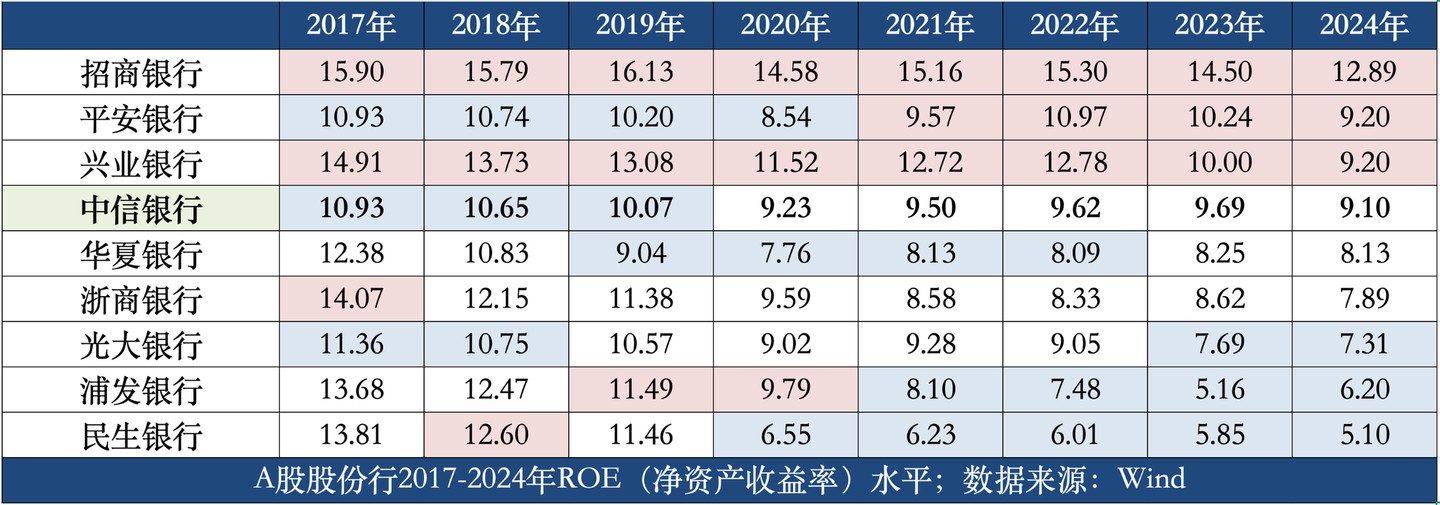
Xinfeng's calculations found that although CITIC BANK's total assets have long been at an upper-middle level among joint-stock banks, its ROE (Return on Equity) from 2012 to 2019 has consistently ranked at the bottom among joint-stock banks (in the last 1-3 positions), presenting a "big and heavy" form.

During this period, CITIC Bank, which saw a significant rise in non-performing loan ratios in the manufacturing and retail sectors, began to realize the importance of retail for stable profits and improved capital returns, initiating a retail transformation that lasted over a decade starting in 2014.

By 2018, retail was regarded as a core equal to corporate business, with its profit contribution rate rising from 2% at the beginning of the reform to 29%;

In 2021, when the profit contribution exceeded 30%, the bank proposed using wealth management as a lever, with "sector integration, public-private linkage, and group collaboration" as the leverage to achieve a "pole vault" in retail financial business;

However, thereafter, the previously rapidly developing retail business of CITIC Bank saw its growth rate come to a halt, with the profit contribution rate of the retail sector falling back to 11% in 2024.

The setbacks of this phase are closely related to the underlying cycles.

With the weakening of residents' income expectations and softening credit demand in recent years, the "golden era" of banks relying on rapid leverage from the household sector has come to an end;

For example, Ping An Bank is still "scraping bones to cure poison," and even the "retail king" China Merchants Bank is struggling to escape performance fluctuations.

However, in the "new three-year plan" proposed in 2024, CITIC Bank still places the importance of retail at the forefront, emphasizing that "if retail is not strong, there can be no talk of being first-class."

Looking at the details, the retail strategy in the bank's new round of strategy has also seen adjustments, with the biggest improvement being the emphasis on the word "system."

In the new strategy, CITIC Bank views the system as the key to advancing retail enhancement, hoping to achieve comprehensive capability improvements such as balanced management of volume and price, and light capital development through systematic construction in customer management, products, risk control, and other areas;

The bank's chairman, Fang Heying, summarizes the current strategy as "system supremacy, long-termism, and self-professionalism," and points out that "retail cannot be driven by points; it must be driven by the whole to build the entire retail business system."

The overall "new three-year plan" also reflects CITIC Bank's greater emphasis on the system:

For example, the "five leading" strategy emphasizes wealth management, comprehensive financing, transaction settlement, foreign exchange services, and digitalization, which are not five isolated business directions but a closely related and mutually promoting organic whole.

Fang Heying explains that "'five leading' is the path of light capital, a refined plan and pragmatic layout built on a solid foundation; they are both points and surfaces, as well as a body, both goals and processes."

From this perspective, the landing of the AIC license is also an important part of the bank's efforts to supplement and improve its system.

The changes in financial report numbers indicate that CITIC Bank's systematic reform has made some progress in the goals of "large and light" and "large and strong" through a winding path:

For example, in the first half of the year, the growth rate of the bank's off-balance sheet and on-balance sheet comprehensive financing scale outpaced that of on-balance sheet assets, deposit growth exceeded liabilities, and wealth management scale growth surpassed deposits, indicating that the bank is abandoning scale obsession and achieving a balance between efficiency and quality.

In the first three quarters, the bank's non-interest income contribution rate was 16.44%, ranking at the upstream level among peers, an increase of 1.43 percentage points year-on-year;

The cost-to-income ratio was 28.58%, ranking at the midstream level among peers, optimizing by 0.21 percentage points year-on-year; The ROE is 6.62%, positioned in the upper-middle of the industry, but has decreased by 0.15 percentage points year-on-year.

Everbright Securities analyst Wang Yifeng expects the bank's overall ROE level to be around 9.81% in 2025;

Wang Yifeng pointed out that the bank significantly reduced its low-yield bill business in the third quarter, stabilizing the overall asset yield level. Subsequently, with the rolling repricing of maturing deposits, the cost control effect is expected to continue to be released.

However, from the performance in the first three quarters, the fundamental performance of China CITIC Bank is not outstanding:

In the first three quarters, the bank's revenue decreased by 3.46% year-on-year to 156.6 billion yuan, and profit increased by 1.6 billion yuan after a "provision replenishment" of 4.83 billion yuan, with a growth rate of 3.02%;

At the same time, the bank's asset quality did not show significant improvement, with a non-performing loan ratio of 1.16% at the end of the quarter, unchanged from the beginning of the year, and the provision coverage ratio decreased from 209.43% to 204.16%, while the loan provision ratio decreased from 2.43% to 2.36%.

This also means that this "big and light" transformation has not yet translated into new growth momentum.

Xinfeng noted that China CITIC Bank has completed personnel changes this year:

With the appointment of President Lu Wei, Vice President Jin Xinian, and Gu Lingyun, the "post-70s" generation has become the backbone of the bank's senior management, completing the "youthful" configuration of the senior team;

Lu Wei returned from the chairman of CITIC Trust, and Dong Wenzan was transferred from the wealth management subsidiary to branch president, among other rotations of senior executives within different positions and subsidiaries of China CITIC Bank, which also helps cultivate versatile talents.

With the new management team in place, whether the bank can achieve a leap in the second growth curve through the systematic layout of more businesses like AIC remains to be seen