Bank of America Hartnett: The market focuses on the surge in U.S. stocks and the possibility of a "new welcome," with the only risk being "the market is too optimistic."

Wallstreetcn
2025.12.21 03:13
portai
I'm PortAI, I can summarize articles.

Bank of America strategist Hartnett pointed out that the market is betting in advance that the economy will accelerate growth in 2026 due to interest rate cuts, tax reductions, and tariff reductions, driving U.S. stock inflows to the second-highest level in history for a single week. Although he is optimistic about the future under dual fiscal and monetary easing, the bank's bullish-bearish sentiment indicator has reached a reverse sell signal of 8.5, warning that market sentiment is overly optimistic and structural risks and short-term adjustments should be monitored

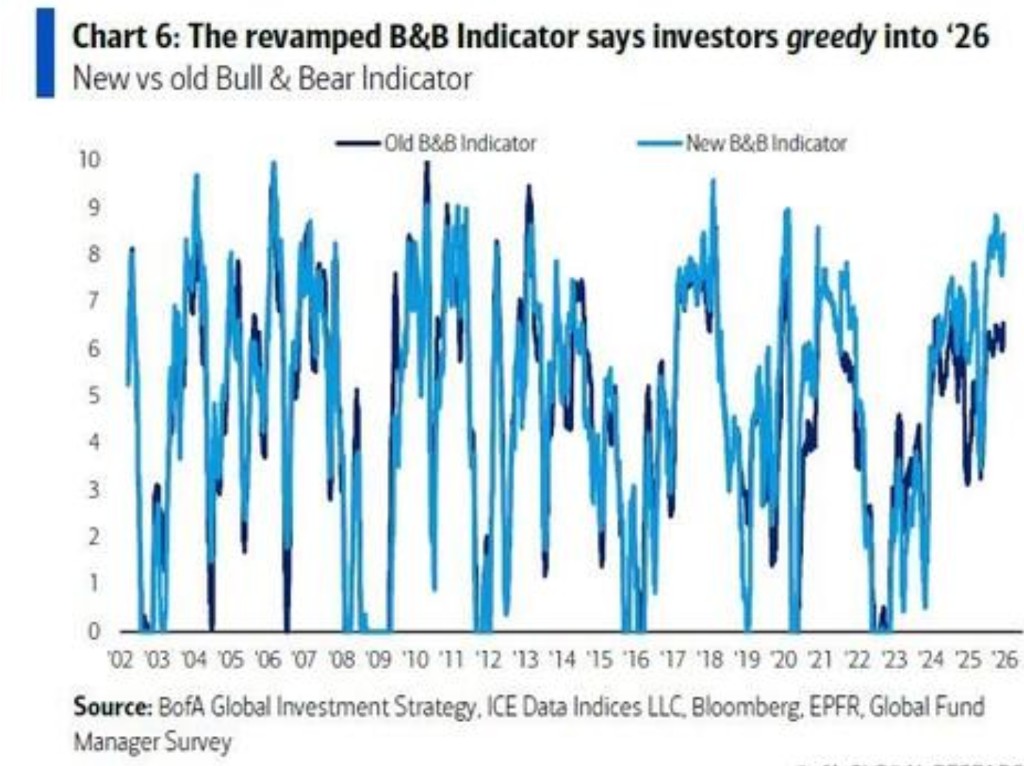
Bank of America strategist Michael Hartnett stated in his latest outlook report that the market has begun to position itself for strong economic growth in 2026. Investors generally expect that measures such as interest rate cuts, tax reductions, and tariff cuts will collectively drive corporate profits to accelerate. However, the bank's bullish-bearish sentiment indicator has now risen to 8.5, reaching a contrarian "sell" signal for risk assets, reflecting that current market sentiment may be overly optimistic, necessitating caution regarding the adjustment risks that may arise.

Capital flows highlight market exuberance. The latest data shows that global stocks saw inflows of $98.2 billion in a single week, with U.S. stocks attracting $77.9 billion, marking the second-largest weekly inflow on record. Meanwhile, funds saw a significant outflow of $43.9 billion from cash-like assets, the largest since April of this year.

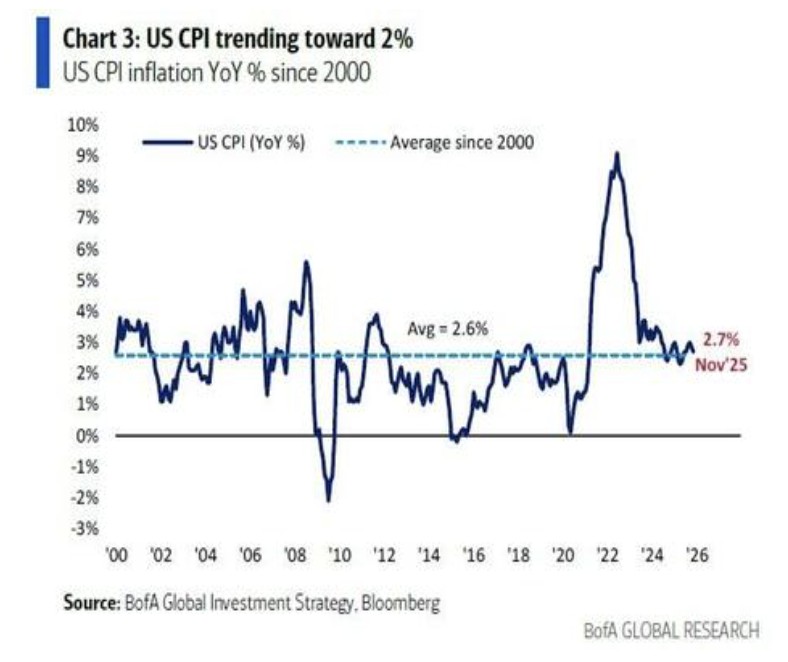
Hartnett believes that under the expectation of dual fiscal and monetary easing, the probability of a market rise next year has significantly increased. The Federal Reserve's continued interest rate cuts, the introduction of a new round of "QE lite" policies, and the ongoing decline in CPI inflation collectively provide support for the market. However, he also warns that current sentiment is in an extremely optimistic range, and caution is needed regarding short-term adjustment risks.

In terms of allocation advice, he prefers to position for the downtrend in inflation by going long on zero-coupon bonds, mid-cap stocks, and emerging market equities, rather than simply chasing the current market's general bullish consensus on risk assets.

U.S. Stock Inflows Reach Record Highs

The current market is undergoing a significant process of capital reallocation. The stock market has become the main focus of capital flows, with a net inflow of $98.2 billion in a single week, of which U.S. stocks absorbed $77.9 billion, setting the second-largest weekly inflow on record, second only to the $82.2 billion in the week of December 18, 2024. In contrast, the bond market performed modestly, recording only $7.9 billion in inflows; gold saw an increase of $3.1 billion. Notably, cryptocurrencies experienced their first outflow in nearly four weeks, amounting to about $500 million, but analysts generally expect this trend to be difficult to sustain and may reverse in the short term.

The main source of this round of capital reallocation is the significant outflow from cash-like assets. Data shows that investors withdrew $43.9 billion from cash in a single week, the largest since April of this year, clearly reflecting a significant warming of market risk appetite.

2026 Trading Strategy: Betting on Downward Inflation

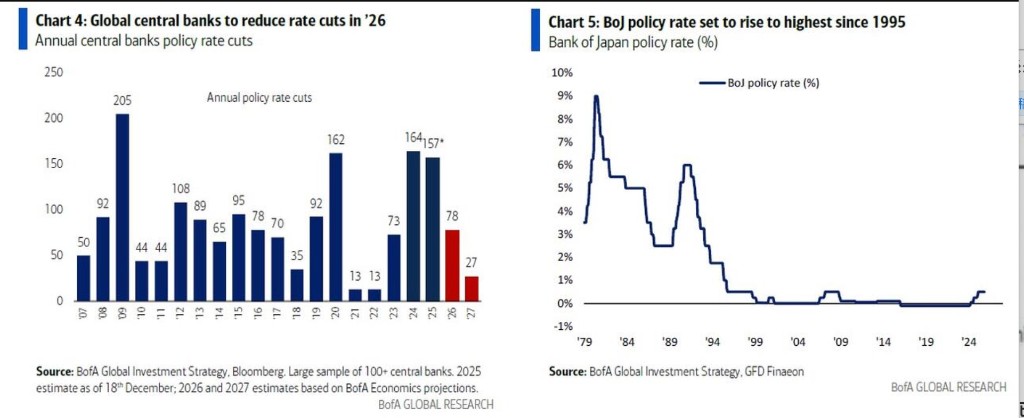
Bank of America strategist Michael Hartnett has constructed a macro trading framework for the first half of 2026. In an optimistic scenario, if CPI falls to 2% and the 10-year U.S. Treasury yield drops to around 3.5%, risk assets are expected to receive significant support. At the same time, the report also points out several potential risks: global liquidity may be nearing a peak, the Federal Reserve's rate cuts may be less than the market's current expectation of 150 basis points, or even less than 80 basis points, and there is a possibility that the Bank of Japan's policy rate could rise to its highest level since 1995. **

However, several structural factors may hedge against the aforementioned risks. These include the possibility of the Federal Reserve unexpectedly restarting quantitative easing, a downward trend in oil prices, economic stimulus measures taken by the Trump administration to alleviate public pressure before the midterm elections, and a labor market that continues to tilt towards employer dominance. These factors all contribute to lowering inflation, yields, and the level of the dollar exchange rate.

Bullish and Bearish Indicators Issue Warning Signals

Despite a positive macro outlook, Bank of America’s bullish and bearish sentiment indicator has risen from 7.9 to 8.5, reaching the threshold for a contrarian sell signal on risk assets. A reading above 8.0 typically indicates that market sentiment has entered an extremely optimistic zone, which historically often foreshadows short-term adjustment pressure.

Since 2002, this signal has appeared 16 times, with the global stock index (ACWI) averaging a decline of 2.4% after the signal is triggered. Relevant statistics show that the maximum drawdowns within 1 month, 2 months, and 3 months after the signal are 4%, 6%, and 9%, respectively, while the potential maximum gains missed during the same period are generally below 2%.

However, the historical accuracy of this indicator is about 63%, and the last two signals have shown significant deviations. After sell signals were issued in December 2020 and July 2024, the stock market did not correct but instead continued to strengthen.

Structural Risks in the Market Begin to Emerge

Although there are no signs of overheating in overall market positions, some structural risks are accumulating. The growth rate of margin debt continues to outpace the market's gains, hedge fund leverage remains high, and momentum trading has persisted for a considerable time.

The current concentration of investor holdings in AI and technology sectors is reminiscent of market structures in 2000 and 2007. Meanwhile, short positions in the market remain crowded, and the cash allocation ratio has fallen to historical lows, coinciding with the upcoming quiet period for corporate stock buybacks and a potential weakening of large buyer support.

More concerning is the general upward trend in global long-term yields, which presents a significant risk. Even if the Federal Reserve continues to push for rate cuts, U.S. long-term rates may still rise due to global factors, thereby increasing bond market volatility and posing a substantial threat to the stock market