


The strongest AI stock in India

India's RRP Company has sparked frenzied speculation due to its name change to "RRP Semiconductor," with its stock price skyrocketing over 55,000% in 20 months, making it the best-performing stock globally. However, the Indian RRP Company has not actually engaged in semiconductor business and has negative revenue. This frenzy driven by the renaming narrative and social media has triggered regulatory investigations, highlighting the blind chase risk of retail investors for AI concepts in a market lacking investment targets
The most astonishing stock performance globally does not come from Silicon Valley, but rather from the Indian market.
The stock price of RRP Semiconductor Ltd. has skyrocketed over 55,000% in the 20 months ending December 17, despite the company's revenue being negative and its actual connection to the semiconductor industry being minimal.
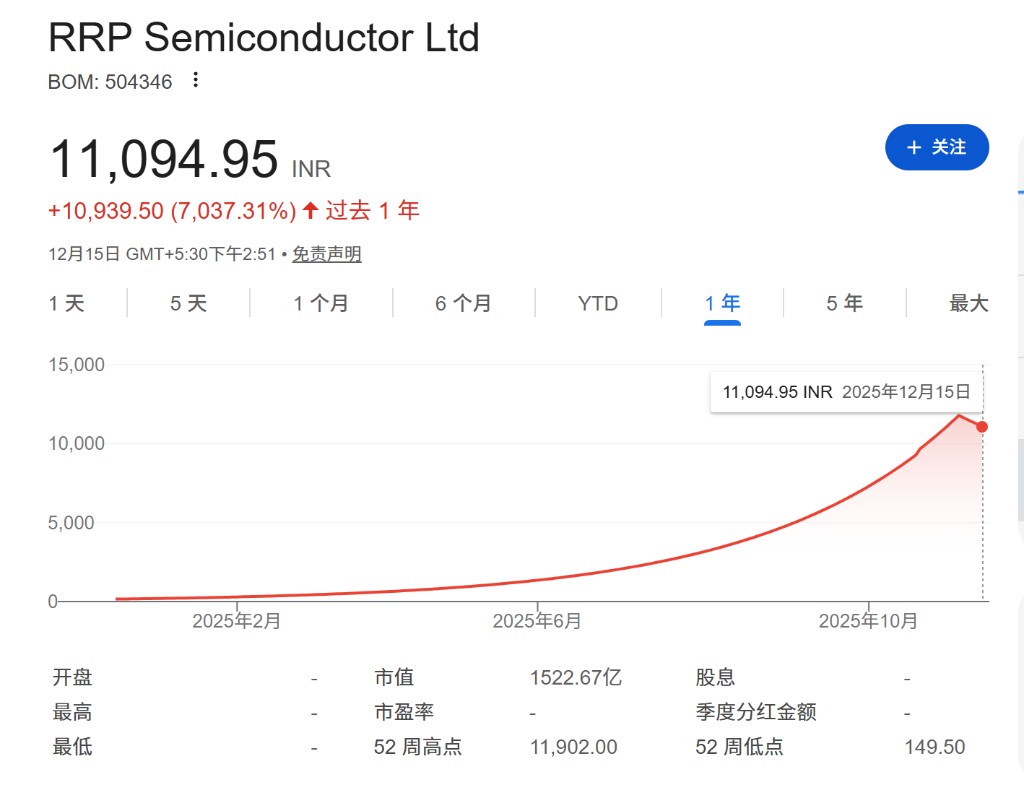
This staggering increase has raised significant alarm among regulators. According to insiders speaking to Bloomberg, the Securities and Exchange Board of India (SEBI) has begun investigating whether there has been any misconduct behind the surge in RRP's stock price. Since peaking on November 7, the stock has fallen 6%, and the exchange has restricted trading of the stock to once a week.
RRP's meteoric rise highlights the immense challenges regulators face in protecting retail investors from the impacts of speculative frenzies. Particularly in the Indian market, where there is a lack of listed chip manufacturing companies, retail investors are extremely eager to find any alternative that can tap into the global AI boom, fueling irrational exuberance in the market.
This best-performing stock globally is evolving into a cautionary tale about chasing the risks of the artificial intelligence bubble. While the company's performance is unlikely to affect the broader rebound of global giants like Nvidia Corp., it reveals how extreme and disconnected earnings have become in certain corners of the market.
Negative Revenue and Two Full-Time Employees
Despite the astonishing stock price increase, RRP's fundamentals are extremely weak. According to the latest financial report, the company's annual report shows it has only two full-time employees. More concerning is that the company reported negative revenue of 68.2 million rupees and a net loss of 71.5 million rupees for the quarter ending in September.
The negative revenue was caused by the company reversing sales that had been recorded in the previous three months. According to Bloomberg, this sales figure stemmed from a 4.4 billion rupee order obtained from Telecrown Infratech Pvt. last November, which was later canceled due to "contractual disputes."
It is this kind of company, driven by online hype, extremely low free float, and India's expanding base of retail investors, that has seen its stock hit the upper limit for 149 consecutive trading days. Until recently, RRP was relatively unknown even in its home market of India, but it has now become a wildly sought-after subject on social media.
The Narrative Bubble of Transforming into Semiconductors
RRP Semiconductor's transformation began in early 2024. At that time, Rajendra Chodankar took over G D Trading and Agencies Ltd., which was engaged in real estate, and renamed it RRP Semiconductor. Chodankar's previous background included providing niche products such as thermal imaging systems Despite the company's name change and being in the spotlight, in a stock exchange document dated November 3, the company admitted that it "has not yet started any form of semiconductor manufacturing activities" and has not applied under government incentive programs.
Investor enthusiasm for the stock largely stems from the confusion between the listed entity and another private company owned by Chodankar, RRP Electronics Pvt. RRP Electronics had announced plans to establish semiconductor assembly and testing facilities in Maharashtra and held high-profile events attended by politicians and cricket legend Sachin Tendulkar.
While the listed company lists RRP Electronics as an affiliate, it does not hold any direct shares in it.
High Concentration of Equity and Regulatory Loopholes
This frenzy masks the stock's extremely low liquidity risk. According to filings with the BSE and the Ministry of Corporate Affairs, approximately 98% of the shares are held by Chodankar and his close circle, who are also involved in other companies under the RRP Group.
Regulatory issues are also gradually coming to light. A source at the BSE indicated that the exchange made an "internal error" when handling the company's stock issuance. SEBI had warned as early as September 2024 that since the company belongs to the founding group of Shree Vindhya Paper Mills, which was delisted in 2017 for violations and faced a 10-year market ban, RRP should be prohibited from entering the securities market. Currently, the BSE may seek guidance from SEBI to extend the share lock-up period until the legal appeal is resolved.
In response to Bloomberg's request for comments regarding the stock price surge and regulatory measures, RRP Electronics declined to comment, citing ongoing legal appeals.
Blind Chasing Due to Lack of Targets
The case of RRP reflects the extreme hunger of the Indian market for chip stocks. Sonam Srivastava, founder of Wryght Research & Capital Pvt., stated, "Semiconductors are very hot, and given the limited stocks available in India, people are willing to buy any related names."
Concerns about AI valuations are spreading globally, with exchanges and chip manufacturers across Asia beginning to warn investors against chasing overheated trades. As the AI frenzy fades and regulatory scrutiny tightens, RRP, a narrative-driven company, is facing severe tests, with the downside risk primarily borne by retail investors who rushed in at high levels.
