


Geopolitical disturbances, U.S. stock futures slightly lower, the dollar rises, gold approaches historical highs, silver hits new highs again

Geopolitical tensions have escalated, leading to increased demand for safe-haven assets, driving precious metals such as gold and silver higher across the board. Although the latest U.S. employment data shows a cooling labor market, there are no signs of a sharp deterioration, prompting traders to reduce bets on a recent interest rate cut by the Federal Reserve. As a result, the U.S. dollar index has risen across the board, and the market's current focus has shifted to the upcoming inflation data for clearer clues on policy direction
On Wednesday (December 17), the Asia-Pacific stock markets generally fell, and U.S. stock futures dipped slightly due to escalating geopolitical tensions, driving funds into commodities such as gold and silver, with silver hitting a new high and gold approaching the historical peak set in October. International oil prices rebounded significantly, with WTI crude oil and Brent crude oil both rising over 1%. The U.S. dollar index continued to rise, gaining over 0.2% during the day.
According to a previous article from Wall Street View, Trump ordered a complete blockade on sanctioned tankers entering and leaving Venezuela, causing U.S. WTI crude oil and Brent crude oil to rise 1.5% during the day. The market is concerned that this action will further tighten supply.
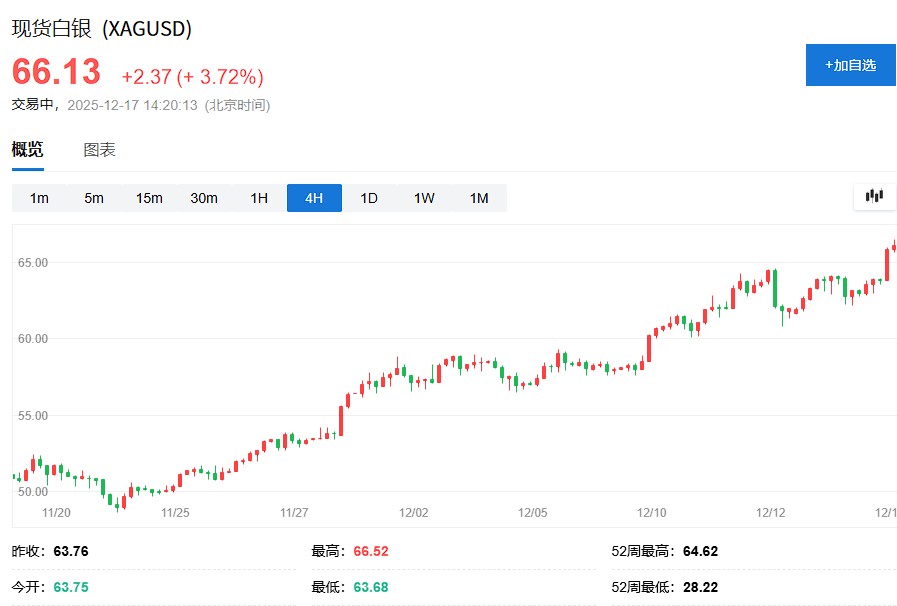
Meanwhile, the escalation of geopolitical tensions has triggered a rise in safe-haven demand, pushing precious metals higher across the board. Spot silver climbed to a historical high above $66 per ounce, while gold prices rose above $4,330, just a step away from the historical peak set in October. Platinum has risen for the fifth consecutive trading day, reaching its highest level since 2011.
Although the latest U.S. employment data shows a cooling labor market, there are no signs of a sharp deterioration, prompting traders to reduce bets on a recent rate cut by the Federal Reserve. As a result, the U.S. dollar rose against all G-10 currencies, and U.S. Treasury yields increased slightly. The market's current focus has shifted to the upcoming inflation data for clearer policy direction clues.
ANZ Group Holdings Ltd. analysts Brian Martin and Daniel Hynes warned that, considering the impact of the previous government shutdown, these weak labor market reports should be interpreted cautiously. The uncertainty regarding the next steps of the Federal Open Market Committee (FOMC) may not be resolved until data flow normalizes next year.
Core Market Trends:
S&P 500 futures rose 0.1%, and Nasdaq 100 futures rose 0.1%;
Japan's Topix index fell 0.2%; Australia's S&P/ASX 200 index fell 0.2%;
The U.S. dollar index rose 0.2%; the euro fell 0.1% against the dollar to $1.1730; the yen fell 0.2% against the dollar to 155.09;
The yield on 10-year U.S. Treasury bonds rose 3 basis points to 4.17%; the yield on 10-year Japanese government bonds rose 2.5 basis points to 1.980%;
The yield on 10-year Australian government bonds rose 2 basis points to 4.75%;
WTI crude oil futures rose 1.45% to $55.93 per barrel; Brent crude oil rose 1.44% to $59.77 per barrel;
Spot gold rose 0.77% to $4,335.77 per ounce; spot silver rose 3.72% to $66.13 per ounce;
Bitcoin fell 1.2% to $86,679.95; Ethereum fell 0.5% to $2,935.74
Demand for Hedging Drives Precious Metals to New Highs
Today, the precious metals market is particularly eye-catching, with gold prices currently rebounding above $4,330 per ounce, ending a brief pullback from the previous trading day, and just a stone's throw away from the historical high of $4,381 set in October.
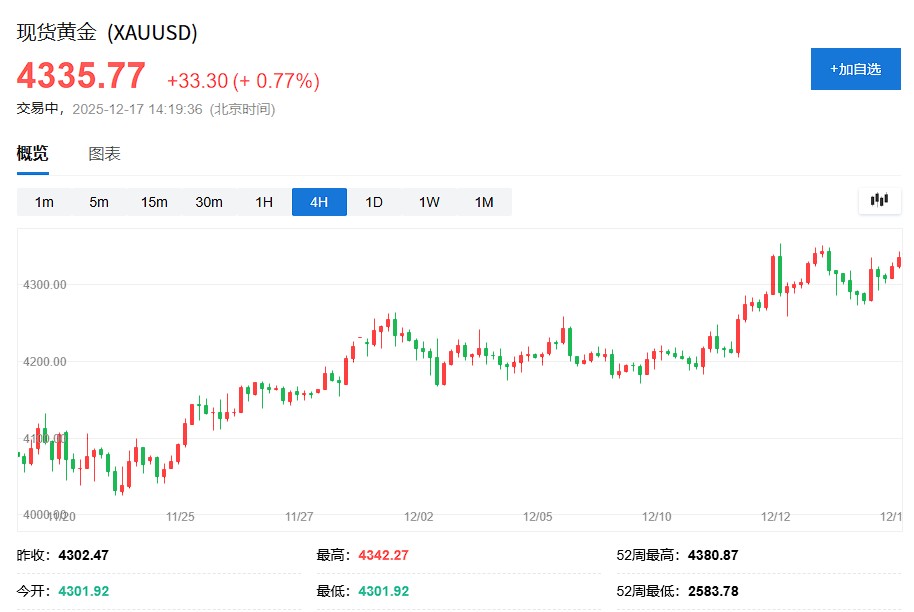
(Current Spot Gold 4H Chart)
Since the beginning of this year, gold prices have surged by about two-thirds, poised to achieve the best annual performance since 1979. This astonishing rally is primarily driven by central banks' large-scale purchases, investors fleeing government bonds and major currencies, and geopolitical tensions.
Silver and platinum have also recorded significant gains. Silver has once again broken through the $66 mark, peaking at $66.52 per ounce, setting a new historical high, while platinum has reached its highest point in over a decade. Analysts point out that this broad rally in precious metals reflects a market trend of accelerating capital inflow into hard assets to hedge against potential risks of escalating geopolitical conflicts.
The rebound in the crude oil market is mainly driven by the latest geopolitical actions of the Trump administration. On Tuesday, Trump ordered a "comprehensive and thorough" blockade of all sanctioned tankers entering and leaving Venezuela and declared the country's rulers as foreign terrorist organizations.
According to an American oil trader's estimate, the U.S. blockade could affect oil transport by 400,000 to 500,000 barrels per day, potentially pushing oil prices up by $1 to $2 per barrel. This escalation has significantly altered short-term market sentiment.
However, analysts remain cautious about long-term trends. LSEG senior oil analyst Emril Jamil noted that unless retaliatory actions affecting the broader oil and gas system in the Americas occur, extreme price increases are unlikely in the short term, with market trading focus still on expectations of global supply surplus.
Latest Non-Farm Employment Data Suppresses Rate Cut Expectations
In contrast to the heated commodities market, the latest U.S. economic data appears more stagnant. According to an article from Wall Street Insight, U.S. non-farm payrolls increased by 64,000 in November, and the unemployment rate rose from 4.4% in September to 4.6%, the highest since 2021. However, considering that October data was impacted by a federal employment contraction of 105,000, the market generally believes that while the data is weak, it is not catastrophic.
Evercore ISI economist Krishna Guha pointed out that the Federal Reserve may view this employment report from a "half-full glass" rather than a "half-empty glass" perspective, as the data is not weak enough to trigger another rate cut in the near term. Current market pricing indicates that the likelihood of a rate cut by the Federal Reserve in January is about 20%Due to employment data suppressing expectations for a Federal Reserve interest rate cut, the US dollar index continues to be strong, with the largest increase against the Japanese yen, and the 10-year Treasury yield rising to 4.17%.
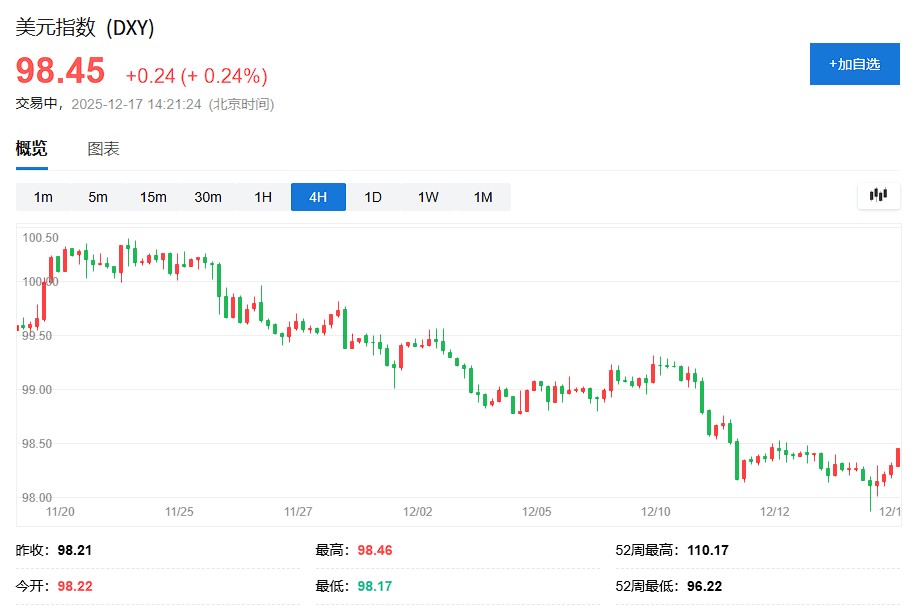
(US dollar index 4H chart)
