


As risk aversion rises, global stock markets decline, gold gives back gains, and investors await guidance from U.S. employment data

Global stock markets fell, and risk aversion increased as investors awaited guidance from U.S. employment data. S&P 500 futures dropped 0.6%, and Nasdaq 100 futures fell 0.9%. Gold retreated 0.4%, and oil prices approached their lowest levels since 2021. The market is focused on the upcoming U.S. employment report and consumer price index to assess economic trends
Global stock markets fell, and the dollar hovered near a two-month low as investors reduced risk exposure ahead of key U.S. economic data releases that will provide important clues for the future path of interest rates.
On Tuesday, the 16th, S&P 500 futures dropped, indicating that U.S. stocks would decline for the third consecutive day. European stock markets were also weak. Oil prices remained near their lowest levels since 2021, while gold retreated after five consecutive days of gains.
The current cautious sentiment in the market is mainly due to the anticipation of the November U.S. employment report set to be released on Tuesday, with the market widely expecting the report to show weakness in the labor market. Given the large amount of key economic data to be released this week, investors chose to temporarily step back and observe to confirm whether the previous narrative about the Federal Reserve's easing policy can be maintained.
- S&P 500 futures fell 0.6%. Nasdaq 100 futures fell 0.9%.
- Euro Stoxx 50 futures fell 0.7%.
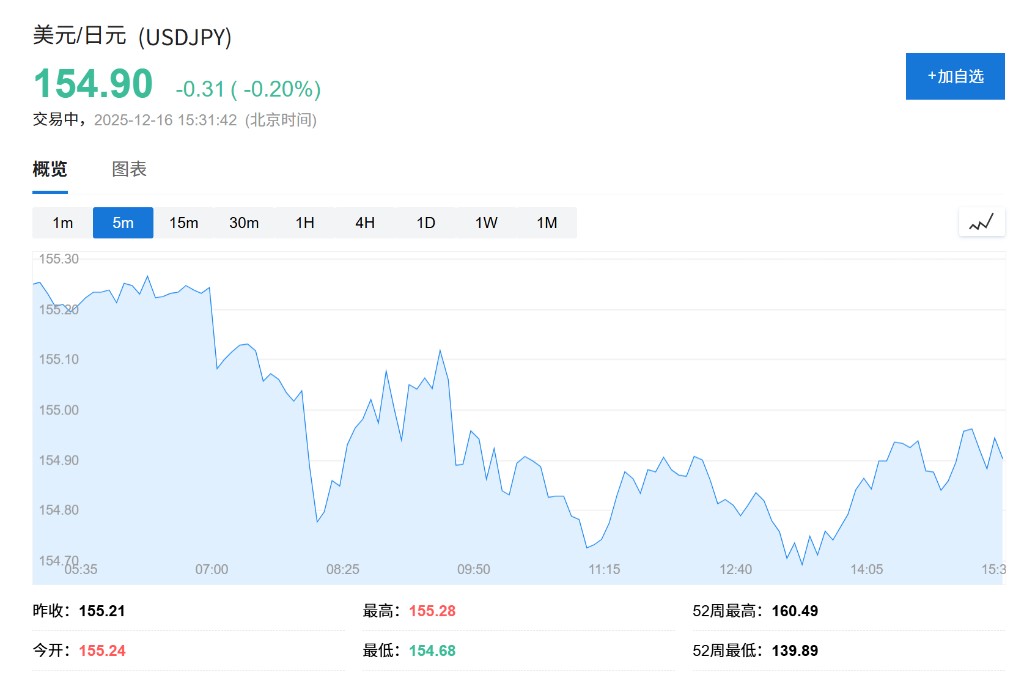
- The U.S. dollar index was little changed, while the yen rose 0.2% to 154.87 per dollar.
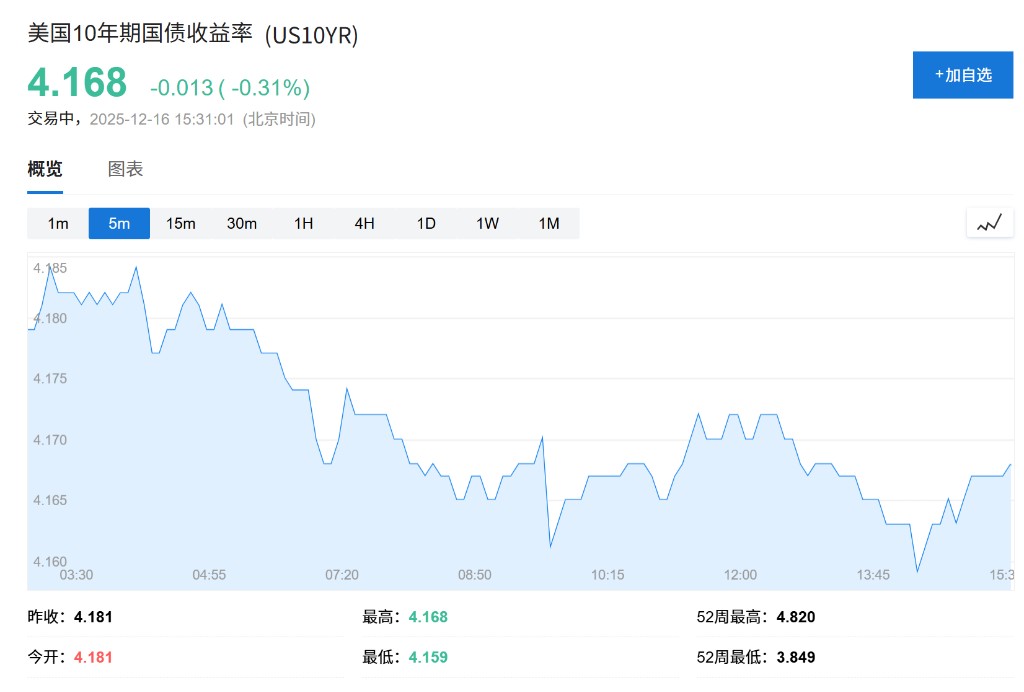
- The yield on the U.S. 10-year Treasury bond was little changed at 4.16%.
- The yield on Japan's 10-year bond was little changed at 1.955%.
- Spot gold fell 0.4% to $4,289.85 per ounce.
- West Texas Intermediate crude oil fell 0.7% to $56.45 per barrel.
- Palm oil fell below 4,000 ringgit per ton, hitting a three-week low due to weak soybean oil and pressure from sluggish Malaysian exports.
Risk Aversion Dominates the Market
As 2025 enters its final weeks, the market's cautious sentiment is increasing. Tareck Horchani, head of the bulk brokerage business at Maybank Securities in Singapore, stated:
"We are seeing a clear risk-averse tone. Valuation concerns are also spreading, and with the release of major macro data such as today's employment report, some funds seem to be reducing their beta exposure or locking in profits."
In addition to the November employment report set to be released on Tuesday—which will also include estimates for the October employment data delayed due to the federal government shutdown—the U.S. Consumer Price Index (CPI) is also scheduled for release on Thursday. This series of dense data releases will be crucial for investors to assess economic trends.
Divergence in Fed Rate Cut Expectations
The yield on the U.S. 10-year Treasury bond stabilized around 4.17%. Despite inflation showing signs of stickiness, the market is still betting that the Federal Reserve will support the labor market through two rate cuts next year.
Chris Larkin from Morgan Stanley E*Trade pointed out that since the Federal Reserve currently seems more focused on the weakness in the labor market rather than inflation, the market may face a "bad news is good news" scenario He stated:
"As long as the data does not suggest a cliff-like drop in the labor market, the market may accept weak data, as this could lead the Federal Reserve to adopt a more dovish stance."
However, there are differing views within the Federal Reserve regarding the policy stance. Federal Reserve Governor Stephen Miran believes that the policy stance is unnecessarily restrictive; while New York Fed President John Williams stated that after last week's rate cut, the policy for next year is in a favorable position. Boston Fed President Susan Collins pointed out that due to concerns about high inflation, the interest rate decision is a "difficult choice."
According to Bloomberg strategist Garfield Reynolds, interest rate traders have decisively shifted this month to bet that 2026 will be a year of more rate hikes than cuts, and rising yields may become a stronger resistance to the stock market's rise.
Technology Stocks Facing Rotation Pressure
Traders are closely monitoring the movements of technology stocks, with AI-related companies still under pressure. The MSCI Asia Technology Index has fallen for the second consecutive day, likely reaching its lowest level since early December. Some investors are rotating funds into sectors that were previously overshadowed by technology stocks.
Ritesh Ganeriwal, Chief Investment Officer at Syfe Pte., stated:
"There is a widespread rotation out of AI and technology stocks, and this trend is spreading to Asia."
Additionally, on the regulatory front, the second-largest exchange in the U.S., Nasdaq, is seeking regulatory approval to extend its trading hours to 23 hours on business days.
Asian Currency Trends and Central Bank Dynamics
In the Asian foreign exchange market, the yen has risen above 155 against the dollar. The market widely expects the Bank of Japan to raise its key interest rate to the highest level in thirty years on Friday. Meanwhile, the Indian rupee has fallen to a historic low.
Risk Warning and Disclaimer
The market has risks, and investment should be cautious. This article does not constitute personal investment advice and does not take into account the specific investment goals, financial situation, or needs of individual users. Users should consider whether any opinions, views, or conclusions in this article are suitable for their specific circumstances. Investment based on this is at their own risk
