


The Federal Reserve's rate cut frequency in 2026, will tomorrow's non-farm payrolls be the deciding factor? Divergence in the bond market intensifies

The U.S. Treasury market is increasingly divided over the interest rate cut path for 2026. Optimists believe that Tuesday's non-farm payroll data could become "the most important data point of next year," determining the pace of rate cuts and validating expectations for early easing; meanwhile, the cautious side argues that the data is distorted, and true pricing should be left to early next year's data and the Federal Reserve meeting on January 28, with high short-term volatility risks in the bond market remaining
The debate over the Federal Reserve's monetary policy path for 2026 is entering a heated stage, and the U.S. Treasury market is holding its breath for the release of a series of key economic data to gauge the central bank's next moves.
With the "data vacuum" caused by the U.S. government shutdown coming to an end, the market is tightly focused on the monthly non-farm payroll data set to be released this Tuesday (December 16). Following the Federal Reserve's recent rate cut of 25 basis points to a range of 3.5%-3.75%, bond traders are currently betting that the central bank will cut rates twice next year to support the labor market and economic growth prospects, even as inflation remains stubbornly high.
This market pricing stands in stark contrast to the Federal Reserve's own guidance, with traders expecting one more rate cut than the Fed has indicated. This expectation gap implies significant market speculation: if the upcoming data confirms that the labor market is cooling, it will validate the market's bet on larger rate cuts, thereby pushing U.S. Treasury prices further up and leading to strong performance in 2026.
However, there remains significant divergence within the market regarding the future endpoint of interest rates. Optimists believe that Tuesday's non-farm data could become "the most important data point of next year," determining the pace of rate cuts and validating expectations for early easing; the cautious side argues that the data may be distorted, and that true pricing should wait for early next year's data and the Federal Reserve meeting on January 28, with high short-term volatility risks in the bond market.
Market's Aggressive Bets, Non-Farm Data Becomes Key "Touchstone"
Currently, there is a clear disconnect between bond traders and the Federal Reserve regarding the policy path for 2026. Traders are betting that the central bank will cut rates twice next year, and if this expectation holds true, U.S. Treasuries could be on track for their best performance since 2020. Against this backdrop, positions in the options market are changing, with some traders beginning to position themselves for a potential shift in market sentiment that could anticipate rate cuts as early as the first quarter. Current market pricing indicates that the next rate cut will not be fully priced in until mid-next year, with the second rate cut expected in October.
At the beginning of this week, the yield on the policy-sensitive 2-year U.S. Treasury was at 3.51%, while the 10-year yield was around 4.16%. The spread between the two reached 66 basis points at Friday's close, the highest level since January 2022. This increasingly steep yield curve reflects the market's complex expectations for future economic growth and policy easing.
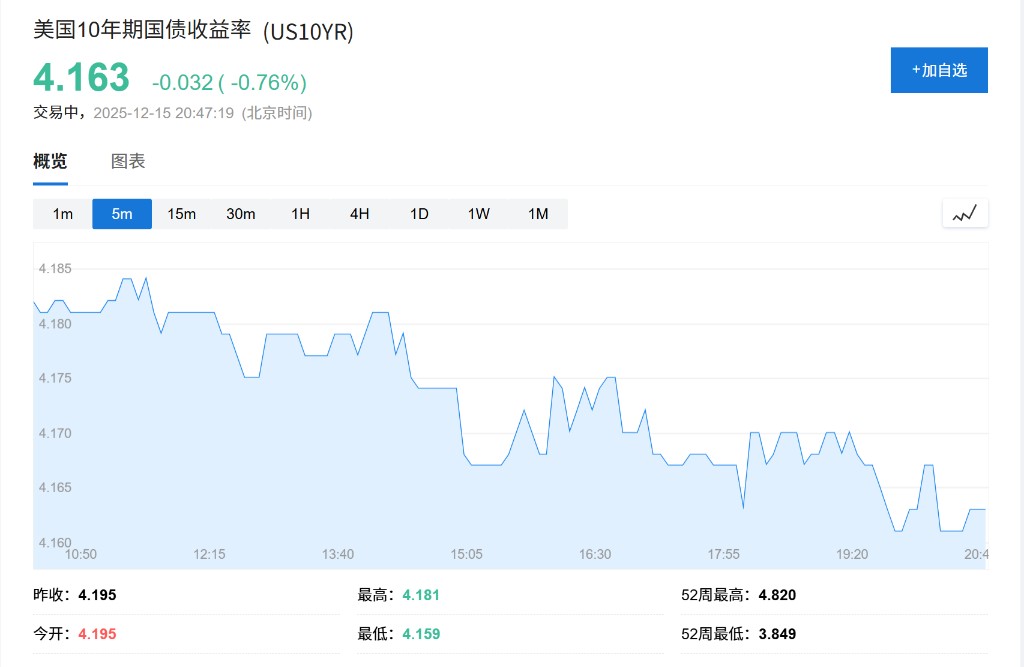
Due to data delays and complications caused by the government shutdown, the non-farm payroll report to be released this Tuesday is seen as a key to filling the information gap. According to the median forecast from a Bloomberg survey, non-farm payrolls in November are expected to increase by 50,000. The previous data from September showed an increase of 119,000 jobs, exceeding expectations, but the unemployment rate rose to 4.4%, the highest since 2021.
Bloomberg strategist Ed Harrison pointed out that for the bond market's upward momentum to continue, the employment report on December 16 will be the next hurdle. If job growth falls to 50,000 or lower as expected, it could drive a rebound in U.S. Treasuries and shift the market's pricing for the first comprehensive rate cut from June to April Conversely, any strong data could trigger a sell-off.
Intense Collision of Bullish and Bearish Views
Institutional investors have diverged on how to interpret the upcoming data. George Catrambone, Head of Fixed Income at DWS Americas, believes that Tuesday's employment data could be "the most important data point of next year." He belongs to the camp that expects the Federal Reserve to have to cut interest rates significantly and bought U.S. Treasuries last week when yields soared to multi-month highs. He pointed out that the direction of the labor market will directly determine the direction of interest rates.
In contrast, Kevin Flanagan, Head of Fixed Income Strategy at WisdomTree, takes a more cautious stance. He believes that due to the government shutdown disrupting data collection, the weight of this week's report may decrease, and the market focus should shift to the data released early next year and the Federal Reserve's policy decision on January 28. Flanagan warned that if the November data is close to September's levels, it could trigger a sell-off in U.S. Treasuries, pushing the 10-year yield up to 4.25%. He tends to believe that the Federal Reserve's rate-cutting cycle is nearing its end and cites research indicating that 3.5% is the neutral interest rate level.
Swap market proxy indicators show that traders currently believe the Federal Reserve will lower rates to around 3.2% in this round of easing.
New Chair Candidates and Political Pressure
In addition to economic data, the leadership changes at the Federal Reserve have also become an important variable affecting investor expectations. With Powell's term ending in May next year and Trump pressuring for lower rates, market attention is rising regarding his successor.
Janet Rilling, Head of the Plus Fixed Income Team at Allspring Global Investments, stated that the arrival of a new chair could mean the Federal Reserve will lean more dovish, even if the economy appears slightly overheated. She pointed out that any signs of weakness in the labor market could serve as "cover" for the new leadership to cut rates.
Meanwhile, the internal divergence on policy paths within the Federal Reserve is also becoming public. Chicago Fed President Austan Goolsbee voted against a rate cut last week, citing his desire to see more inflation data. This internal division, coupled with external political pressure, makes the interest rate outlook for 2026 highly uncertain
