


Carvana, Robinhood, Coinbase – The three stocks that suffered the most in the 2022 bear market of U.S. stocks have all entered the S&P 500 this year

In 2022, Carvana, Robinhood, and Coinbase, which were on the brink of bankruptcy, achieved comprehensive profitability in 2024 through stringent cost-cutting and strategic transformation, and were subsequently included in the S&P 500 index, completing an astonishing turnaround from market outcasts to core assets. This transformation not only signifies the mainstream recognition of their business models but also resulted in heavy losses for investors who had previously engaged in large-scale short selling, highlighting the dramatic rotation of the market within the macroeconomic cycle
In 2022, Carvana, Robinhood, and Coinbase were typical representatives of stock price crashes due to soaring interest rates, high inflation, and an industry winter. Today, these three companies have made an astonishing turnaround, not only repairing their balance sheets but also being fully included in the S&P 500 index, rising from the "bankruptcy reserve" of the past to core assets of the U.S. stock market.
According to Yahoo Finance, the used car retailer Carvana is set to officially join the S&P 500 index later this month, achieving a remarkable increase of up to 11,000% from its low point. Prior to this, the cryptocurrency exchange Coinbase and brokerage Robinhood were respectively included in the benchmark index in May and September of this year.
This series of inclusions marks a significant shift in market sentiment: these three companies, which suffered heavy losses and were on the brink of collapse during the bear market low in 2022, have now become one of the strongest performing groups of stocks in the index.
This dramatic recovery is primarily attributed to the companies' strategic shift from aggressive expansion to profit-oriented approaches. According to the inclusion criteria for the S&P 500 index, companies must achieve profitability in the most recent four quarters and meet a certain market capitalization threshold (for example, Robinhood needed to exceed $22.7 billion at the time of its inclusion).
To overcome this hurdle, the aforementioned companies underwent rigorous cost-cutting and management salary adjustments over the past two years, ultimately achieving profitability in 2024. This not only resulted in heavy losses for short sellers betting on their collapse but also reshaped institutional investors' confidence in the sustainability of their business models.
As Carvana is about to complete its "inclusion," these three companies, which were severely impacted by macroeconomic headwinds, have officially made their return to Wall Street mainstream. Below is a detailed account of how they achieved rebirth through operational adjustments, seizing market tailwinds, and repairing their balance sheets.
Carvana: From Near Bankruptcy to Short Sellers' Nightmare
Few stocks have experienced a turnaround as dramatic as Carvana. In 2022, despite the company's vehicle sales being more than double that of 2019, its annual losses soared to nearly $2.9 billion, ending an eight-year trend of profit growth. The stock price once plummeted 98% to below $4 per share, facing the brink of bankruptcy, and was warned by Morgan Stanley analyst Adam Jonas that the stock price could fall to $0.10.
However, through a series of debt restructurings and operational efficiency improvements, Carvana successfully turned a profit. The company not only achieved its first annual profit in 2024 but also set new records for revenue and gross profit per vehicle earlier this year. With the improvement in fundamentals, its stock price has made an astonishing rebound, which has cost short sellers who heavily bet against it dearly.
Ihor Dusaniwsky, managing director of S3 Partners, told the media that since hitting a historical low in 2022, short sellers of CVNA have incurred a market value loss of $8.44 billion, experiencing a "short squeeze more terrifying than a hurricane." Currently, the market's view on Carvana has fundamentally changed. The company's CEO and Chairman Ernie Garcia stated, "It is very difficult for a team to go through the kind of pressure we experienced over the past two years without falling apart, but we did not fall apart."
Previously bearish Adam Jonas also upgraded his rating to "Buy" in May, predicting that by 2040, Carvana's market share in the used car market will grow from the current 1.5% to 12%, potentially becoming the "Amazon" of the automotive retail industry.
Robinhood: Founders Give Up Bonuses for Full Profitability
As a representative of the 2021 "retail investor rally stocks," the trading platform Robinhood also experienced its darkest moments in 2022, with its stock price plummeting to around $7, amid acquisition rumors and massive layoffs. To save the company, founders Vlad Tenev and Baiju Bhatt agreed to forgo their respective $500 million bonus contracts to help the company save funds and accelerate the path to profitability.
This extreme cost control strategy has achieved significant results. Data shows that although Robinhood's revenue declined by 25% in 2022, its operating expenses dropped significantly by 31%. This financial discipline allowed the company to successfully cross the profitability threshold of the S&P 500 index—achieving profitability over the past four quarters. Robinhood achieved its first full-year profit in 2024, ending three consecutive years of losses.
Since joining the S&P 500 index in September this year, Robinhood's stock price has made a strong comeback, rising about 1450% from its 2022 low, and is expected to become the fourth best-performing stock in the index this year.
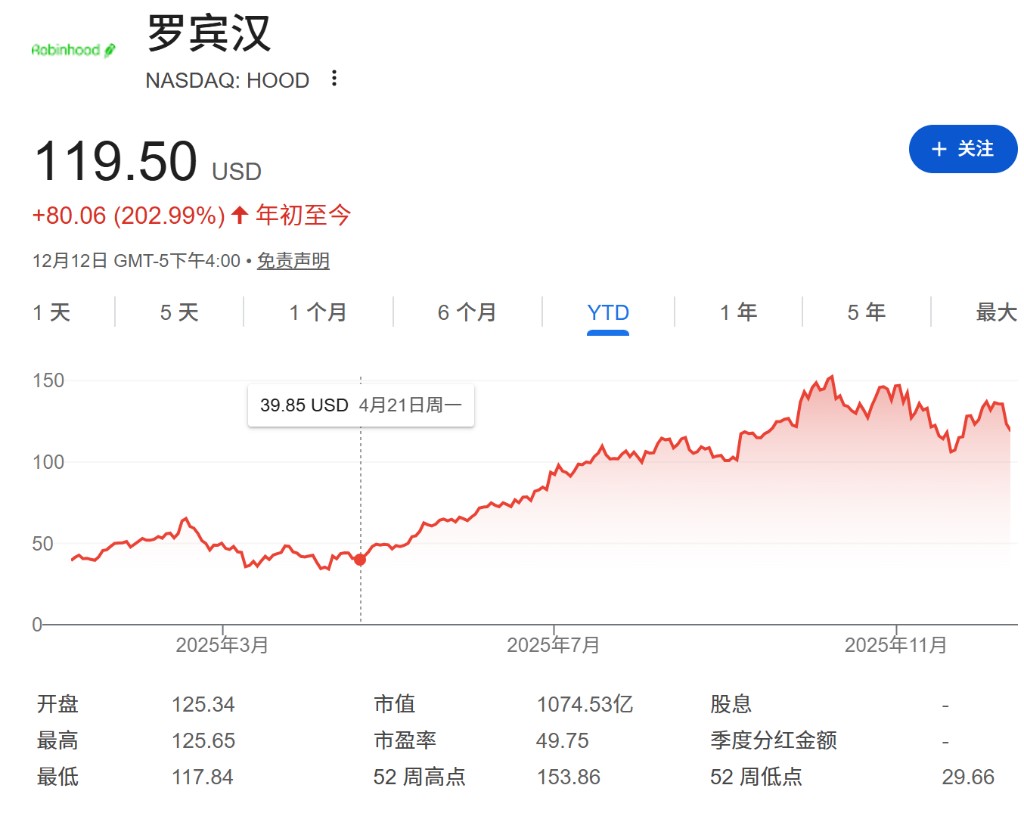
Citizens analyst Devin Ryan pointed out that the company has gradually matured, not only understanding the demands of institutional investors but also achieving a high level of profitability. Additionally, the company is expanding its growth space by launching a "super app" strategy, including new features such as tokenized stocks and prediction markets, and even plans to manage the proposed "Trump account" suggested by the elected U.S. president.
Coinbase: A Turning Point for the Tech Finance Platform and Performance Growth
Coinbase was the first of the three companies to enter the S&P 500 index in May this year, representing a dual turning point in regulatory environment and market position for a company that had previously faced strict scrutiny from the U.S. Securities and Exchange Commission (SEC) over securities law issues.
Strong financial data supports this position. Driven by a rebound in trading volume, Coinbase's revenue surged 54% to $1.87 billion in the third quarter of this year, with net profit jumping from $0.28 per share in the same period last year to $1.50. The consumer trading volume on the platform also increased by 37% quarter-over-quarter, reaching $59 billion Citizens analyst Ryan compared Coinbase to "the AWS of the blockchain space," believing that it not only serves retail investors but also has built a strong barrier by providing infrastructure for institutional clients. In addition, the stablecoin legislation passed this summer and Wall Street's expectations for the future "Market Structure Transparency Act" are seen as the next major catalysts for the industry and Coinbase's stock price
