


JPMorgan Chase 2026 Storage Market Outlook: This year's giant market capitalization approaches $1 trillion, $1.5 trillion in 2027

JPMorgan Chase predicts that the storage chip industry will experience the longest boom cycle in history: the market value of leading manufacturers is expected to approach USD 1 trillion this year and soar to USD 1.5 trillion by 2027, an increase of over 50%. The demand for HBM continues to squeeze traditional DRAM production capacity, and AI inference consumes three times the memory compared to training, leading to a supply-demand gap that will persist until 2027. It is forecasted that DRAM prices will surge by 53% in the fiscal year 2026, with strong enterprise market performance completely offsetting pressure from the consumer side
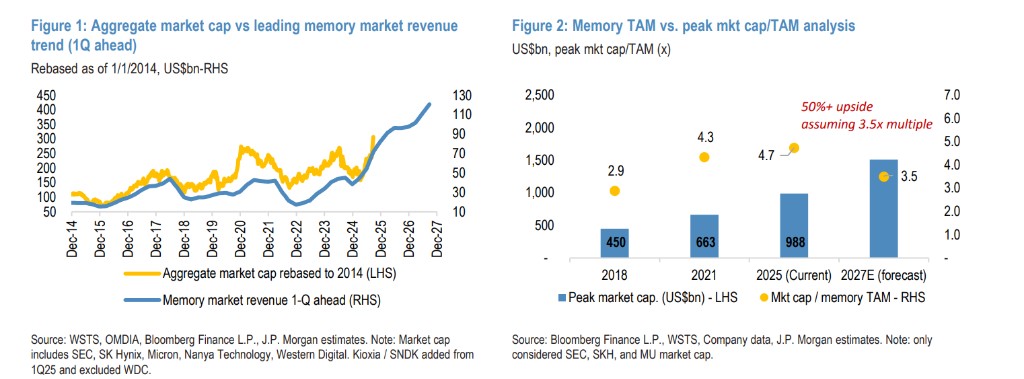
JP Morgan pointed out in its latest research report that the total market capitalization of leading memory chip manufacturers is nearing $1 trillion. Based on historical valuation centers, this figure is expected to soar to $1.5 trillion by 2027, indicating that leading manufacturers still have over 50% upside potential.
According to Chasing Wind Trading Desk, on December 14th, JP Morgan stated in its latest report that the current cycle will be the longest and strongest memory upcycle in history.
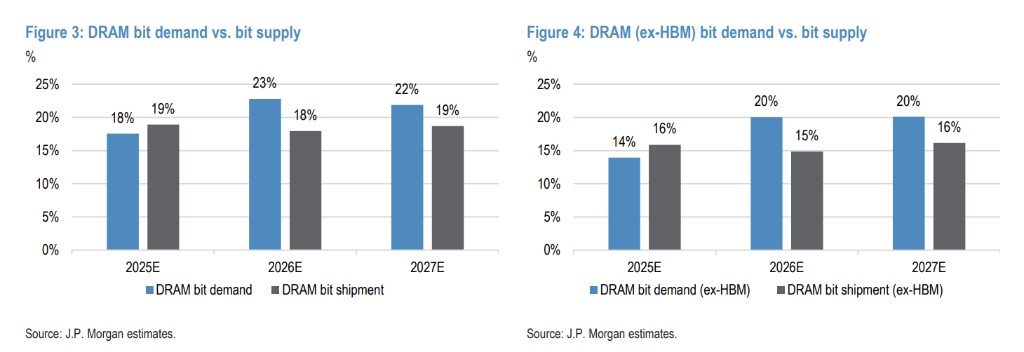
Investors are generally concerned that new capacity in 2027 will lead to an oversupply of DRAM. However, JP Morgan's data model shows that this concern is unnecessary—capacity crowding from HBM and structural demand from AI inference (which consumes three times the memory compared to training) will result in DRAM bit supply growth lagging behind demand growth in the next two years.
The market is experiencing a "dual-track" pricing system. Strong B2B (enterprise/AI) demand supports high prices, while B2C (consumer) faces cyclical pressure. Overall, the upward demand from the server side will completely offset the downward risks from the consumer side.
Valuation Restructuring: Marching Towards $1.5 Trillion
JP Morgan directly addresses investors' pain points in the report: After memory stocks have surged significantly in the past three months and approached the $1 trillion market capitalization threshold, what’s next?
JP Morgan's answer is very clear: Continue to go long.
Based on the "Market Cap/Total Addressable Market (TAM)" valuation framework, JP Morgan predicts that the storage market size will reach approximately $420 billion by 2027. Calculating using the median price-to-sales (P/S) ratio of 3.5 times from the 2018 and 2021 cycles, the combined market capitalization of leading storage and memory manufacturers is expected to approach $1.5 trillion by 2027.
This means that from the current level, leading players still have over 50% market cap upside potential.
The Truth of Supply and Demand: Still Shortage in 2027
The biggest short argument in the market currently is: The new wafer fabs coming online in 2027 and accelerated technology migration will trigger an oversupply of DRAM.
JP Morgan refutes this viewpoint through a bottom-up "capacity-bit" analysis model:
- Ongoing Shortage: Although the supply-demand gap in 2027 may shrink from 5% in 2026 to 3%, it will still be in a state of shortage.
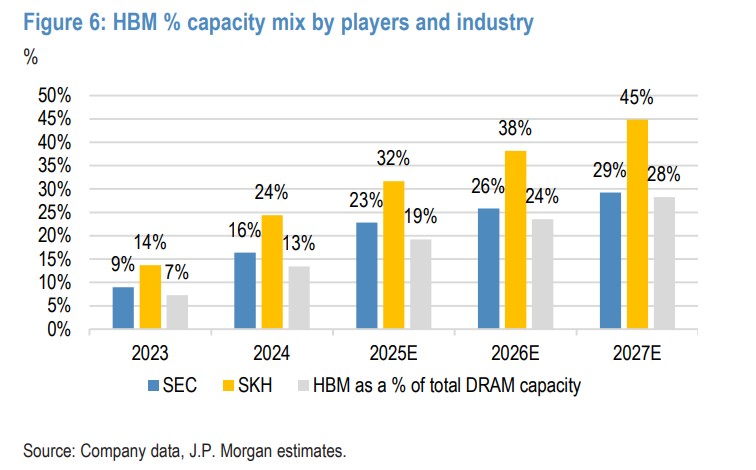
- Capacity Crowding: Strong demand from CSPs (Cloud Service Providers) forces manufacturers to allocate more capacity to HBM. The proportion of HBM in total DRAM capacity is expected to rise significantly from 19% in 2025 to 28% in 2027.
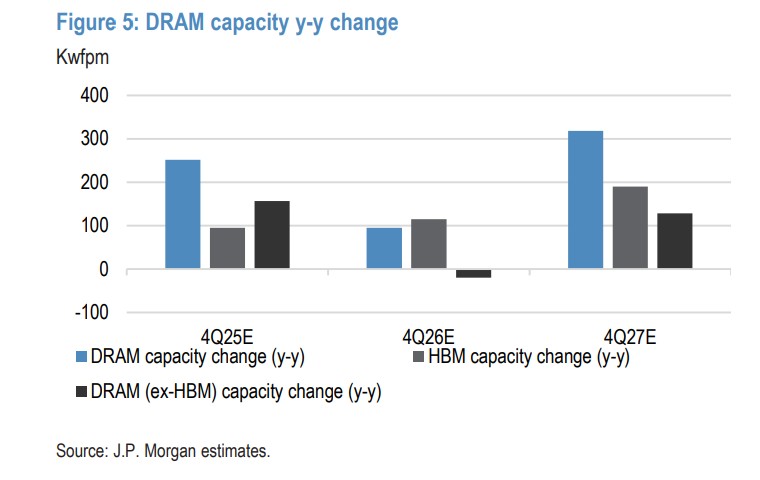
- Limited Supply: Conventional DRAM capacity is actually expected to decline year-on-year in 2026. Even with new capacities from Samsung P4, SK Hynix M15X, etc., coming online in 2027, the growth of DRAM bit shipments will be limited to below 20% due to natural capacity losses from cleanroom space constraints and increased process steps
The Tale of Two Cities of Pricing Power: A B2B Feast and B2C Cycle
This is a "storage hunger game."
CSPs and specific secondary/tertiary consumer electronics brands are aggressively competing for resources, leading to a sharp rise in storage prices recently. JP Morgan predicts that from the second half of 2026 to the first half of 2027, there will be a significant price differentiation in the market:
- B2B Side (AI-driven): Supported by AI inference demand, prices will remain strong.
- B2C Side (Consumer-level): Due to customer resistance to high prices, it will face cyclical price declines.
Key data forecasts:
- Fiscal Year 2026 (FY26E): JP Morgan's model shows that the average selling price (ASP) of DRAM will soar by 53%, while NAND ASP will rise by about 30%.
- Fiscal Year 2027 (FY27E): Even with prolonged high prices, DRAM ASP is expected to increase slightly by 1%, while NAND ASP may see a slight decline of 6%.
AI Driving Force: Structural Opportunities in HBM and eSSD
HBM (High Bandwidth Memory): Riding the Wave of GPU vs. ASIC The positive feedback from Google Gemini 3.0 has sparked a route dispute between GPU and ASIC, which is a double benefit for HBM demand.
- Specification Upgrade: Google's next-generation 2nm TPU may adopt HBM4, coupled with the 4-fold capacity increase brought by Rubin Pro GPU, will continue to squeeze the supply chain.
- Ongoing Shortage: JP Morgan expects the supply-demand shortage of HBM (about 8%-12% gap) to persist through 2027, and may even extend into 2028.
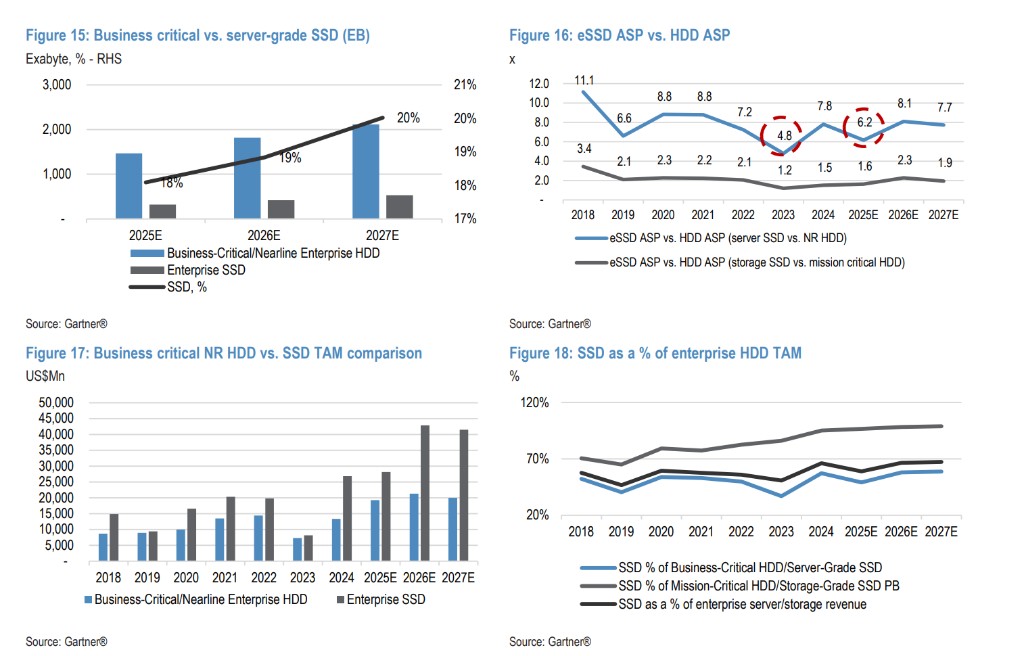
SSD (Solid State Drive): Key for Inference Applications The rise of AI inference is driving the market expansion of enterprise SSDs (eSSD). The SSD deployment in AI servers is three times that of ordinary servers.
Due to the cautious capital expenditure guidance from HDD (Hard Disk Drive) manufacturers in 2026, JP Morgan expects eSSD to enjoy tremendous demand tailwinds in the next six months, driving NAND prices up by 27% in fiscal year 2026.
Capital Expenditure: Growth but Restraint
Despite storage manufacturers announcing a series of capacity expansion plans, JP Morgan believes that the actual growth in bit supply will be offset by challenges from physical migration.
- Equipment Spending Leads: The growth of wafer fab equipment (WFE) for storage is expected to significantly outpace the overall growth in capital expenditure (with DRAM WFE growth of 19%/26% in 2026/2027 respectively).
- Intensity Under Control: Whether for DRAM (below 30%) or NAND (below 20%), the implied capital intensity will be lower than the average level of the past five years. This indicates that the supply side still maintains significant discipline
